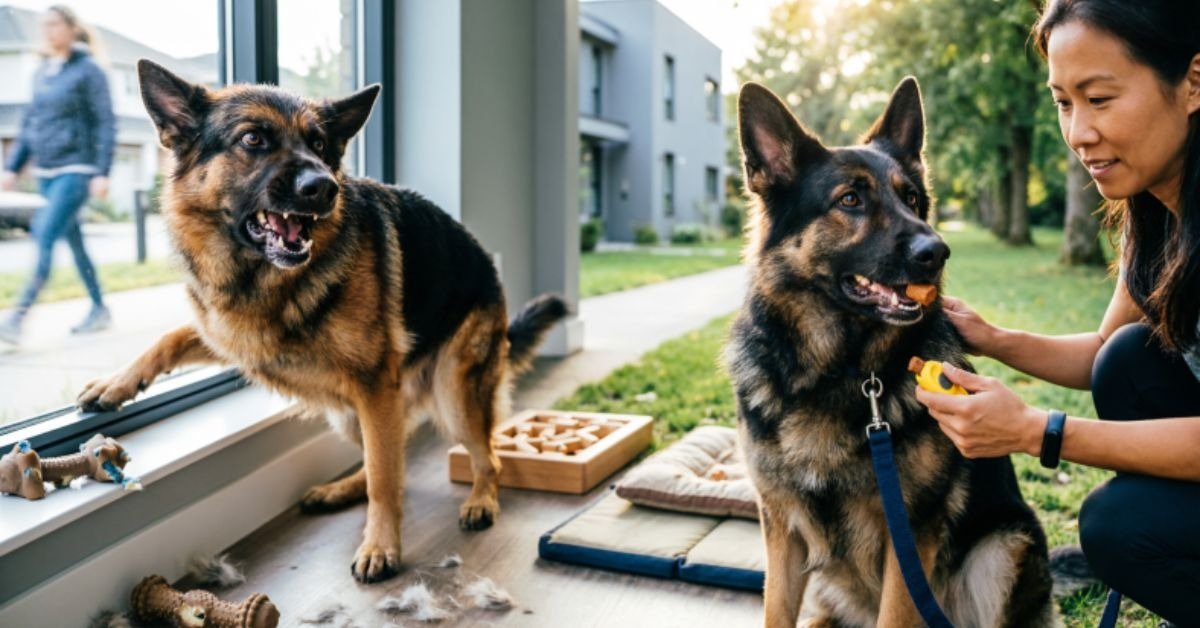
German Shepherds are one of the most brilliant, loyal, and hardworking dog breeds ever developed. Originally bred in Germany as herding and utility dogs, they’ve gone on to serve as police K-9s, search and rescue heroes, guide dogs, and devoted family protectors.
But here’s the paradox: the very traits that make them extraordinary, a sharp mind, intense drive, and strong protective instincts are the same traits that cause serious behavioral problems when those needs aren’t met. A bored, under-stimulated GSD doesn’t just sit quietly. It redirects all that energy into barking, chewing, digging, or aggression.
This is not a “bad dog” problem. It’s almost always a mismatch between what the breed was built to do and the life it’s actually living. And the good news is: every problem covered in this article has a practical, science-based, force free solution.
Understanding the “Why”: Root Causes of GSD Behavior Issues
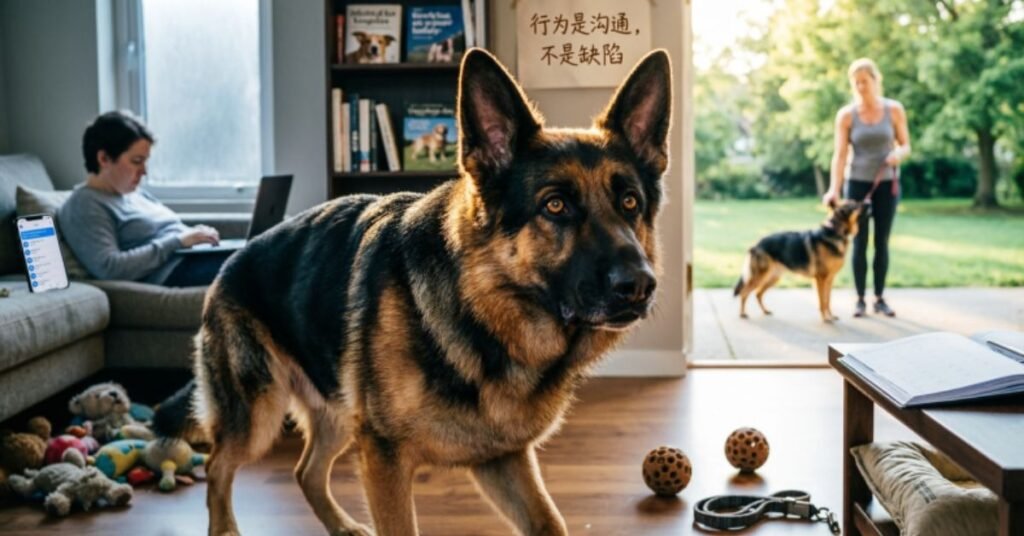
Before fixing a behavior, you need to understand where it comes from. Most German Shepherd behavior problems trace back to three root causes:
1. Unmet Physical and Mental Needs GSDs were bred for hours of sustained, purposeful work every day. A breed standard that demands 2+ hours of vigorous daily activity will fall apart in a low activity household. Boredom in this breed looks like destruction, excessive barking, and anxiety not laziness.
2. Poor Early Socialization The critical socialization window closes around 12–14 weeks of age. Dogs not exposed to a variety of people, environments, and sounds during this window are far more likely to develop fear-based reactivity and aggression as adults.
3. Genetics and Irresponsible Breeding Backyard breeders and puppy mills have produced GSD lines with unstable temperaments, exaggerated anxiety, and poorly calibrated stress responses. No amount of training alone fully compensates for bad genetics.
These three factors often stack on top of each other. A genetically anxious GSD with poor socialization and zero enrichment is in a near-constant state of stress and stressed dogs act out.
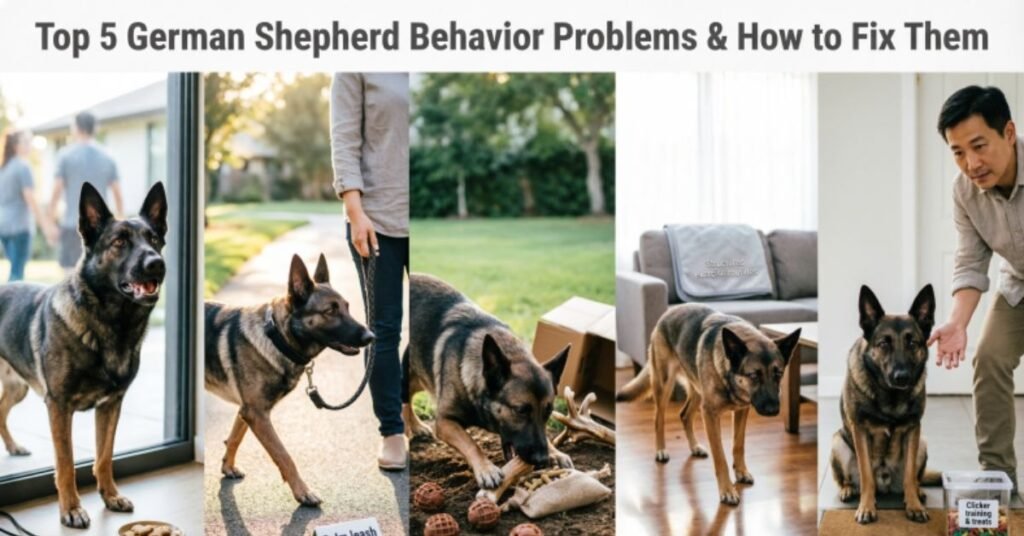
German Shepherd Behavior Problems Explained + Easy Fixes That Work
Problem 1: Aggression and High Reactivity
Why it happens: GSD aggression almost always falls into one of two categories. Fear aggression happens when the dog feels threatened and attacks preemptively to create distance. Territorial aggression happens when the dog perceives a real threat to its home, owner, or family. Common GSD aggression triggers include unfamiliar people approaching the owner, other dogs making direct eye contact, fast-moving strangers, and loud noises near the property.
Red flags: Hard staring and freezing, low growling at strangers, lunging on leash, raised hackles, and air-snapping near visitors.
What to do:
- First, rule out pain or medical issues with your vet. Thyroid problems, for example, can cause irritability.
- Identify your dog’s exact trigger and the distance at which it starts reacting. This is your “threshold.”
- Use counter-conditioning: every time the trigger appears, feed high-value treats. Trigger appears = chicken rains from the sky. Trigger disappears = treats stop. Over weeks, your dog starts associating the scary thing with good things.
- Gradually decrease the distance to the trigger over weeks, never faster than your dog can stay calm enough to take food.
- Teach a redirect behavior like “Watch me” or “Find it” to break the dog’s focus on the trigger.
Punishment-based methods like shock collars or leash corrections make aggression significantly worse. Avoid them entirely.
Problem 2: Severe Separation Anxiety
Why it happens: GSDs are called “Velcro dogs” for a reason. Their working heritage hardwired them to operate in constant partnership with a human. When that bond is broken even briefly some dogs enter a genuine panic state. This is a clinical anxiety response, not misbehavior or spite. German Shepherd separation anxiety solutions must address the root panic, not just the symptoms.
Red flags: Destructive chewing near doors and windows, howling when left alone, pacing and panting before you leave, house-soiling despite being trained, and excessive self grooming.
What to do:
- Set up a camera and film your dog when you leave. You need to know whether it’s true panic or mild whining; they require different approaches.
- Practice micro departures. Step outside for 10 seconds, return calmly, ignore the dog for a couple minutes. Gradually extend the time over days and weeks.
- Build a positive association with the crate by scattering meals inside, hiding frozen Kongs, and letting the dog explore it freely before ever closing the door.
- Desensitize your departure cues. Pick up your keys and then sit back down. Put on your coat and then watch TV. Break the routine that triggers anxiety before you’ve even left.
- Talk to your vet about short-term calming aids like pheromone diffusers (Adaptil) as a bridge while you train.
Problem 3: Excessive Barking, Whining, and Alert Behaviors
Why it happens: GSDs were literally bred to alert their handlers to anything unusual. Barking at strangers, movement, and perceived threats is the breed doing exactly what it was designed to do. The problem is when the volume and frequency become unmanageable. This is often boundary frustration: the dog can see something through the window or fence but can’t investigate, which creates a cycle of escalating arousal. Excessive alerting is also a classic working breed boredom symptom.
Red flags: Sustained barking at windows, running and lunging along the fence line, whining at closed doors, and demanding barking for attention.
What to do:
- Acknowledge the alert first. Say “Thank you” and mean it your dog is doing its job. Then redirect to a “Place” mat with a clear command.
- Teach the “Quiet” command in a controlled way. Trigger one bark, then gently hold the muzzle for two seconds and say “Quiet.” The moment there’s silence, mark it with “Yes!” and deliver a treat. Repeat many times.
- Manage the environment during training. Frosted window film on lower panes removes the visual trigger and gives the training a chance to work.
- Increase overall daily enrichment. A dog with a full mental and physical life simply has less bandwidth for non-stop alerting.
Problem 4: Destructive Chewing and Digging
Why it happens: Chewing and digging are stress relief valves for an under-stimulated GSD. In puppies, nipping and biting are completely normal; pups explore the world with their mouths and use play biting to practice social skills. Without appropriate redirection, though, German Shepherd puppy nipping and biting quickly becomes painful and hard to manage. In adults, destructive chewing is almost always anxiety or boredom never spite.
Red flags: Shredded furniture and shoes, excavated garden beds, hard biting during play, and constant mouthing of hands.
What to do:
- For puppy nipping: the moment teeth touch skin, make a sharp “ouch!” sound and immediately withdraw all attention for 30–60 seconds. You’re mimicking how littermates teach bite inhibition. Every family member must be consistent.
- Always redirect to an acceptable object before withdrawing attention. The lesson is “bite THIS, not that.”
- Give digging dogs a dedicated dig zone, a sandbox or soft-soil corner with buried toys and treats. Reward digging there; redirect calmly from everywhere else.
- Make sure daily enrichment minimums are being met. A dog that has genuinely worked its brain and body rarely has energy left for destructive behavior.
- Use management tools, baby gates, exercise pens, crates to prevent the dog from practicing destructive habits unsupervised while training is ongoing.
Problem 5: Leash Pulling and On-Walk Reactivity
Why it happens: An adult GSD can easily pull 30–40% of its body weight. Pulling is natural; the dog smells something interesting and trots toward it. No dominance happening; the dog is simply faster than you. On-walk reactivity (lunging, barking at other dogs or people) is usually rooted in frustration (“I want to get to that thing!”) or fear (“That thing is coming toward me and I’m trapped!”). The leash actually makes both states worse by preventing normal dog communication and creating a sense of being cornered.
Red flags: Constant forward pressure on leash, choking or gagging while walking, lunging at dogs or people, and an inability to pass triggers calmly.
What to do:
- Switch to a front clip harness immediately. It redirects forward momentum back toward you mechanically, without pain or punishment.
- Use the stop and go method. The moment the leash goes tight, plant your feet and wait. The instant your dog releases tension and glances back at you, mark it and walk forward. Forward movement is the reward.
- Build engagement first. Spend two weeks rewarding your dog for making eye contact with you on every walk. A dog checking in with you can’t simultaneously strain toward something else.
- For reactive dogs, use parallel walking. Walk at a safe distance from the trigger while feeding continuously. Gradually shorten that distance over weeks.
The GSD Mental Stimulation Blueprint

There’s a saying among experienced GSD trainers: a tired German Shepherd is a good German Shepherd. But “tired” doesn’t just mean physically exhausted it means cognitively spent. Research consistently shows that mental exhaustion has a greater calming effect on working breeds than physical exercise alone. Knowing how to mentally stimulate a German Shepherd is the single highest leverage investment you can make in its behavior.
Here are five activities ranked by difficulty:
| Activity | Difficulty | Time Needed | Key Benefit |
| Puzzle toys & snuffle mats | Beginner | 15–20 min | Activates foraging instincts, reduces anxious energy |
| Nosework & scent games | Beginner | 20–30 min | 20 min of scent work = ~1 hour of physical exercise neurologically |
| Agility drills (backyard) | Intermediate | 30–45 min | Physical conditioning + impulse control + handler focus |
| Obedience intervals (3×5 min sprints) | Intermediate | 15 min total | Reinforces your bond; builds impulse control |
| Flirt pole sessions | Advanced | 10–15 min | Safely channels prey drive; teaches “Out” and self-control under arousal |
A German Shepherd that receives nosework games, daily obedience sprints, and a weekly agility session is functionally a different and dramatically calmer dog than one getting only a 45-minute walk each day. Variety is not a luxury for this breed. It is a behavioral necessity.
Conclusion
Training a German Shepherd is not a project with a finish line. It is an ongoing relationship between you and one of the most intelligent dogs on the planet, and it requires patience, consistency, and empathy every single day.
The behavior problems covered in this guide are not character flaws. They are communicating. Your GSD is telling you, in the only way it knows how, that something needs to change. When you respond with structure and positive reinforcement rather than punishment, you’re not just fixing behaviors, you’re building trust. And that trust is what transforms a reactive, anxious, or destructive dog into the loyal, stable companion this breed was always capable of being.
Progress won’t be linear. There will be setbacks. But every consistent repetition rewires a neural pathway. Small daily efforts compound into profound transformation.
Over to you what’s the biggest behavioral challenge your German Shepherd is throwing at you right now? Share it in the comments below and let’s figure it out together.