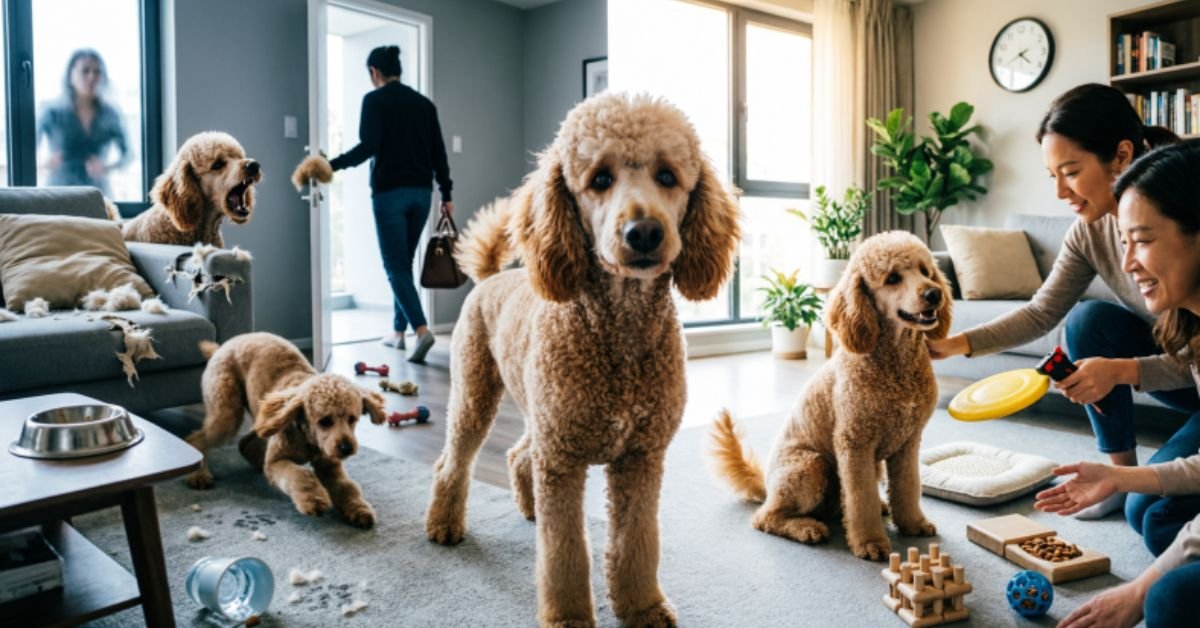
Your poodle is one of the smartest dogs on the planet. That’s not an opinion, it’s science. According to canine intelligence research, Poodles consistently rank among the most intelligent dog breeds in the world. But here’s what many owners discover too late: a brilliant dog living in a boring environment can quickly develop serious poodle dog behavior problems.
If your poodle is barking constantly, chewing furniture, panicking when you leave the house, acting stubborn, or becoming reactive around strangers, you are far from alone. These behaviors are incredibly common in this highly intelligent breed. The good news is that most poodle dog behavior problems are not signs of a “bad dog” they are signs of an under-stimulated mind and unmet emotional needs.
After decades of working with dogs, trainers often see the same pattern with poodles: owners assume something is wrong with the dog, when in reality the dog simply lacks enough mental engagement, structure, exercise, and purpose.
The Root Cause Why Do Poodles Develop Behavior Issues?
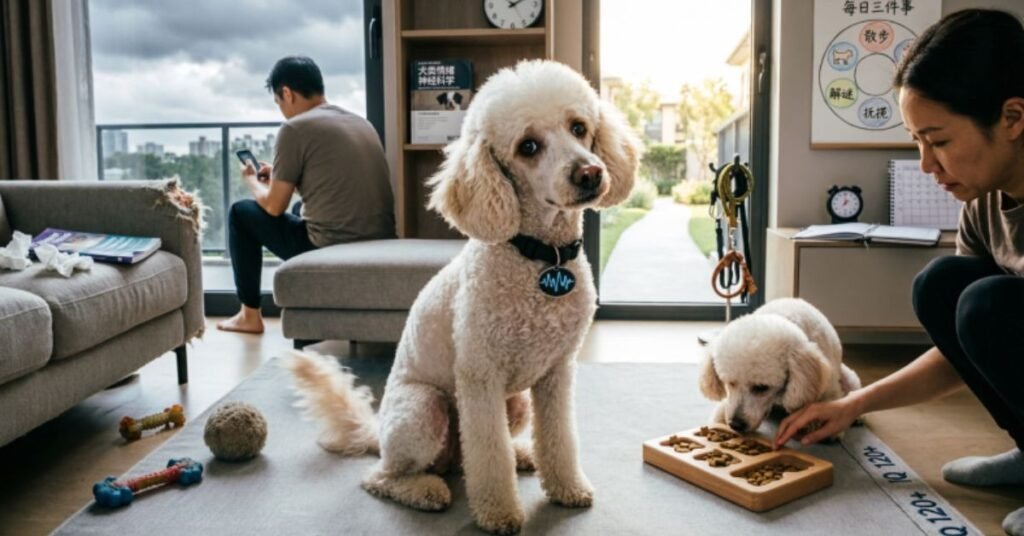
Before we dive into specific problems, you need to understand one key truth: poodle behavior problems almost never come out of nowhere. Poodles were bred to work. They retrieved game from water, performed in circuses, and even served as military dogs. Their brain is wired to think, solve problems, and stay busy.
Three core triggers drive most poodle behavior problems:
- Boredom: A poodle left alone with nothing to do will entertain itself by barking, digging, chewing, or pacing.
- High sensitivity: Poodles are emotionally attuned dogs. They pick up on your stress, your schedule changes, and even your tone of voice. This sensitivity is beautiful but it also makes them prone to anxiety.
- Under socialization: Poodles not exposed to different people, sounds, and places as puppies often grow up fearful or reactive.
Good news: once you identify which trigger is driving the behavior, fixing it becomes much more straightforward.
5 Most Common Poodle Behavior Problems & Expert Solutions
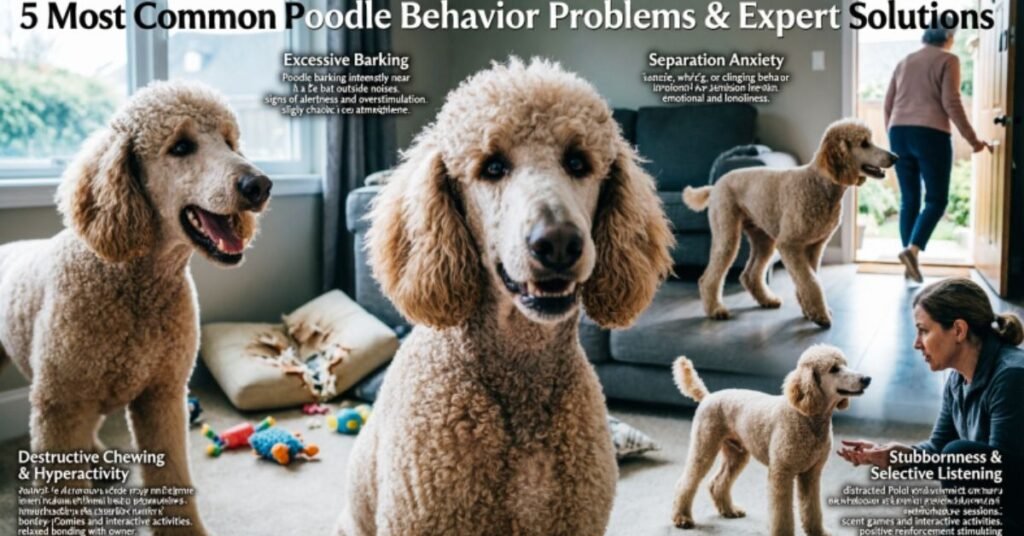
1. Separation Anxiety The “Velcro Dog” Syndrome
Does your poodle follow you from room to room? Do your neighbors complain about howling the second you leave? Does your dog destroy things only when you’re gone?
That’s separation anxiety and it’s extremely common in poodles because of how deeply they bond with their people.
Signs to watch for:
- Whining, barking, or howling when left alone
- Destructive behavior only when you’re away
- Pacing, drooling, or refusing to eat in your absence
- Over the top greeting rituals when you return
Step-by-step fix:
- Practice short departures. Leave for 2 minutes. Return before the anxiety starts. Gradually build up the time over weeks.
- Make departures boring. No big goodbyes. No guilt-driven cuddles right before you leave. Just go.
- Give a high value distraction. A frozen Kong stuffed with peanut butter, only given when you leave, makes your absence the good thing.
- Don’t punish anxious behavior. The dog isn’t being spiteful. They’re terrified. Punishment makes it worse.
- Consider a “safe space.” A crate trained with positive association gives anxious poodles a den-like zone of comfort.
Quick Fix Box: Start leaving your poodle alone for just 1–2 minutes a day, always returning calmly before they panic. Pair departures with a frozen treat. Build duration slowly over 4–6 weeks. Consistency beats any single technique.
2. Excessive Barking and Yapping (Especially in Toy & Miniature Poodles)
Poodles bark. That’s normal. But non-stop barking at strangers, noises, shadows, or literally nothing is a problem you can’t ignore especially in an apartment or a busy household.
Toy and Miniature Poodles tend to bark more than Standards. They’re more alert, more reactive, and often more fearful of their environment.
Why it happens:
- Boredom or pent-up energy
- Fear and over alertness
- You accidentally rewarded it (even yelling “Quiet!” is attention)
- Under-socialization to everyday sounds and people
Step-by-step fix:
- Never reward the bark. Don’t look at, talk to, or touch your dog while they’re barking even to scold them.
- Teach “Quiet” as a command. When they bark, calmly say “Quiet,” wait for a 3-second pause, then reward the silence immediately.
- Reduce the trigger. If window watching causes barking, use frosted window film on the lower panes.
- Drain the tank first. A well-exercised poodle barks significantly less. A 30-minute walk before alone time works wonders.
Quick Fix Box: To stop excessive poodle barking, ignore the bark completely and reward the moment silence returns. Never shout “quiet” , you’re just joining the noise. Redirect to a toy or command like “sit” to break the barking cycle fast.
3. Destructive Chewing and Boredom-Induced Digging
Chewed furniture legs. Shredded pillows. Holes in the backyard. Sound familiar?
This is almost always boring speaking. Poodles that aren’t mentally challenged will find their own entertainment and it’s rarely the kind you’d approve of.
Step-by-step fix:
- Poodle proof your space. Until the behavior is trained out, remove access to things they can destroy. Baby gates and crates are your friends.
- Rotate puzzle toys. Snuffle mats, lick mats, treat dispensers rotate them so novelty stays high. A bored brain that’s busy with a Kong is a brain not chewing your couch.
- Redirect to legal chews. Bully sticks, antlers, or rubber chew toys. When you catch them chewing something wrong, say “Leave it,” remove the object, and hand them their chew toy. Then praise.
- For diggers: Create a designated “digging zone” in the yard. Bury toys there. Reward digging only in that spot.
- Add a training session before alone time. Ten minutes of obedience work mentally tires a poodle more than a 30-minute walk.
Quick Fix Box: Destructive poodle behavior almost always means the dog is under-stimulated. Before leaving home, give a 10-minute training session plus a frozen Kong. Mental exhaustion is your most powerful anti-chewing tool more effective than any deterrent spray.
4. Nipping and Mouthiness in Poodle Puppies
Poodle puppies mouth everything including your hands, ankles, and your children’s fingers. This is normal puppy behavior, but if it’s not corrected early, it turns into adult nipping.
And an adult poodle nipping a child is not cute anymore.
Step-by-step fix:
- Yelp and withdraw. The moment teeth touch skin, say “Ouch!” in a high-pitched voice and immediately stop all play. Freeze completely. Don’t pull your hand away fast that triggers a chase response.
- Time-outs work. If yelping doesn’t stop the biting within a few tries, calmly put the puppy in a quiet room for 60 seconds. No drama. Then resume.
- Redirect to toys. Always have a tug toy or chew available. The moment they try to mouth you, put the toy in their mouth instead.
- Never use your hands as play toys. Wrestling with your hands teaches the puppy that hands are for biting.
Quick Fix Box: Stop poodle puppy nipping by immediately ending play the moment teeth touch skin say “ouch” and turn away. Repeat every single time. Consistency from every family member is what stops the habit. Redirecting to toys speeds up the process significantly.
5. Small Dog Syndrome and Resource Guarding
Toy and Miniature Poodles sometimes develop what trainers call “Small Dog Syndrome” growling at strangers, snapping when touched near food or toys, and acting like the boss of the household.
This usually happens because their small size leads owners to let them get away with things they’d never tolerate in a bigger dog.
Resource guarding signs: growling when you approach their bowl, snapping if you touch them while eating, protecting a specific toy or spot on the couch aggressively.
Step-by-step fix:
- Treat every dog like a dog regardless of size. Rules apply to Toy Poodles the same way they apply to German Shepherds.
- Do “trading” exercises. Approach the bowl while they eat, drop a high-value treat in it, and walk away. You become the person who makes food better, not the one who takes it.
- Do not punish growling. A growl is a warning signal. Take it away and you get bitten with zero warning. Instead, figure out what’s causing the discomfort and work on desensitization.
- Enforce “nothing in life is free.” Your dog sits before meals, walks, and play. You are a calm, consistent leader not a pushover and not a tyrant.
Quick Fix Box: To reduce resource guarding in poodles, approach during meals and drop a high-value treat in the bowl, then leave. Repeat 10 times daily for two weeks. The dog learns that your approach means something better is coming and the guarding motivation fades naturally.
Size Matters: Behavior Differences in Standard, Miniature, and Toy Poodles

All poodles share the same core traits: intelligence, sensitivity, and loyalty. But size does influence which behavior problems tend to show up most.
Standard Poodle Most common issues: Separation anxiety, destructive boredom behaviors, jumping up on people. Key note: Needs 60+ minutes of vigorous exercise daily. High trainability means boredom sets in fast without mental challenges.
Miniature Poodle Most common issues: Excessive barking, fearfulness, Small Dog Syndrome if coddled too much. Key note: Very adaptable to apartment life but needs consistent rules. Don’t let the small size fool you into skipping structure.
Toy Poodle Most common issues: Yapping, resource guarding, anxiety, nipping when startled or handled roughly. Key note: Most emotionally sensitive of the three. Gentler socialization required. Protect from rough handling fear based behavior is the #1 issue.
The bottom line: Standards tend to act out from boredom; Minis and Toys tend to act out from anxiety or inconsistent rules. Adjust your approach accordingly.
How to Discipline a Poodle Without Ruining Their Trust
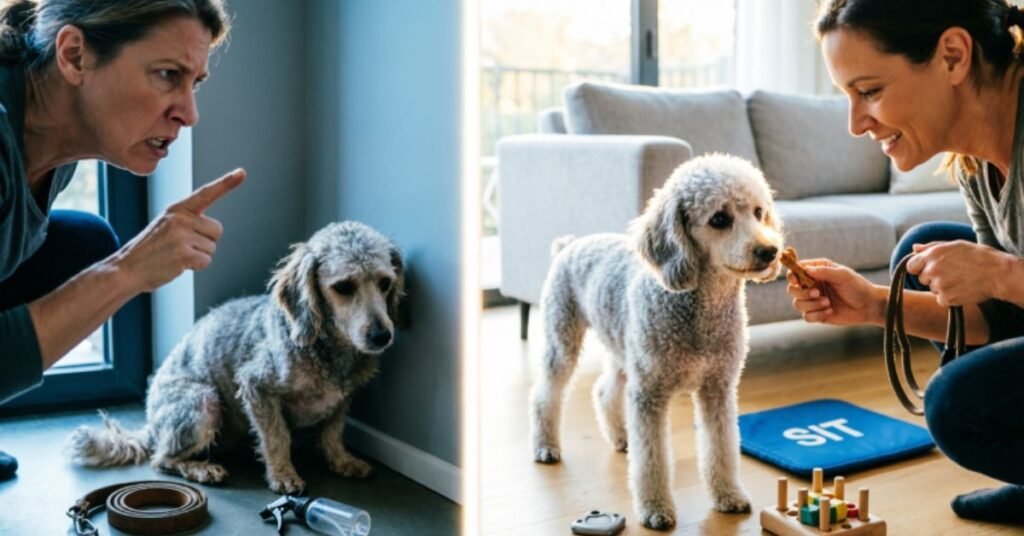
Poodles do not respond well to harsh corrections. At all.
Yelling, leash jerking, or physical punishment with a poodle breaks trust, creates anxiety, and makes behavior problems worse not better. Their sensitivity is the same quality that makes them so trainable. Work with it, not against it.
Positive reinforcement is not just the “nice” approach. For poodles, it is the most effective approach, full stop.
DO this:
- Reward the behavior you want immediately and consistently
- Use a calm, firm “No” and redirect to the correct behavior
- Train in short 5–10 minute sessions poodles learn fast and bore fast
- Be consistent same rules, every day, every family member
- Use time outs (remove attention) for unwanted behavior
- End every session on a win even a small one
DON’T do this:
- Yell, scream, or physically punish your poodle
- Repeat a command 10 times if ignored say it once, then enforce it
- Let bad behavior slide “just this once” inconsistency destroys training
- Use punishment-based methods out of frustration
- Train when you’re angry poodles sense your mood and shut down
- Reward whining or barking with attention even negative attention counts
The magic formula for poodles is simple: clear rules + calm enforcement + generous rewards for getting it right. That’s it. That’s the whole system.
The Bottom Line
Poodle dog behavior problems are almost never random. They’re signals. Your dog is telling you something that they’re bored, anxious, under stimulated, or confused about the rules.
The good news? Poodles are the most trainable dogs in the world. Once you understand what’s driving the behavior and apply consistent, positive strategies, you’ll see results faster than with almost any other breed. Start with the one problem causing you the most stress right now. Pick the fix from this guide. Apply it consistently for two weeks. You’ll be amazed at what changes.
Frequently Asked Questions
Are poodles naturally aggressive?
No, poodles are not naturally aggressive dogs. Most biting, snapping, or growling in poodles comes from fear, anxiety, or poor socialization rather than true aggression. With proper training and early exposure to different people and environments, poodles are gentle, sociable dogs.
Why is my poodle suddenly acting out?
A sudden change in behavior almost always signals something new: a change in your routine, a move, a new pet or baby, a health issue, or even a shift in diet. Rule out medical causes first with a vet visit, then look at what changed in the environment or schedule around the same time the behavior started.
How much daily exercise does a poodle need to stay calm?
Standard Poodles need at least 60 minutes of vigorous exercise per day. Miniature Poodles need around 30–45 minutes, and Toy Poodles need 20–30 minutes of daily activity. Mental exercise training sessions, puzzle toys, nose work counts just as much as physical walks and is essential for a calm, well behaved poodle.
Can poodle behavior problems be fully fixed?
Yes the vast majority of poodle behavior problems are completely fixable with consistent training, proper exercise, and addressing the root cause. Some deeply ingrained issues like severe separation anxiety may benefit from working with a certified professional trainer or a veterinary behaviorist, but there is almost always a path forward.