
There’s a reason Boxer owners half jokingly call their dogs “the Peter Pan of the dog world.” Boxers refuse to grow up. That clown like, bouncing, face-licking energy that made you fall in love with them at 10 weeks old? It’s still fully intact at age four. And while that exuberant spirit is part of what makes the breed so deeply loveable, it’s also the root of some genuinely exhausting daily challenges.
If you’ve found yourself Googling at midnight because your Boxer just demolished your sofa cushions or body slammed your elderly mother-in-law, you are not alone and you are not failing as a dog owner.
Boxer dog behavior problems are among the most searched topics in the pet niche, and for good reason. This guide is built to give you both no fluff, no generic advice that applies to any dog, just deep, practical, Boxer-specific guidance you can start applying today.
Understanding the Boxer Dog Temperament: The Root of the Behavior

Before you can solve a behavioral problem, you have to understand why it exists. With Boxers, that means getting honest about three core traits that are hardwired into the breed’s DNA: extraordinary energy, heightened emotional sensitivity, and one of the slowest neurological maturity rates of any purebred dog.
The sensitivity piece catches many owners off-guard. Boxers are unusually attuned to human emotion. They pick up on stress, tension, inconsistency, and frustration with remarkable accuracy, and they respond to those cues often by escalating the very behavior you’re frustrated about. This creates a negative feedback loop that is genuinely difficult to break without understanding what’s driving it.
Finally, the slow maturity rate is simply a biological fact. Most Boxers don’t reach full neurological and emotional maturity until somewhere between 3 and 4 years of age. Expecting a 2-year-old Boxer to behave with the settled composure of a 5-year-old Labrador is an unfair and unwinnable comparison. That slow developmental arc means consistent, patient training isn’t just recommended for Boxers; it is the only approach that works.
Top 5 Common Boxer Dog Behavior Problems & 2026 Proven Solutions

Use the rapid reference table below to diagnose the issue at a glance, then jump to the full breakdown underneath for the step-by-step fix.
| # | Behavior Problem | The Hidden Trigger | 2026 Direct Action Protocol |
| 1 | Extreme Hyperactivity | Energy/mental stimulation deficit; breed-level drive with no constructive outlet | Sniff walks + “Earn Everything” model + daily 10-min training sessions |
| 2 | Separation Anxiety | Intense pack bonding; cortisol-driven panic response, not boredom | Graduated departure training (30 sec → 15 min); camera monitoring; vet consult for severe cases |
| 3 | Protective Aggression | Under-socialization or fear + suppressed stress from past aversive handling | Counter-conditioning below threshold + BAT 2.0 + CPDT-KA certified trainer |
| 4 | Jumping on Guests | Accidentally reinforced greeting behavior; every reaction = reward | “Four on the floor” household rule + sit-to-greet + “go to place” on doorbell cue |
| 5 | Counter-Surfing & Chewing | Self-reinforcing scavenging; oral stimulation need unmet | Environment management + rich legal chew rotation + “leave it” trained via positive reinforcement |
1. Extreme Hyperactivity and Over-Exuberance
Why It Happens
Hyperactivity in Boxers is almost never a disorder; it’s a mismatch between energy output needs and what the daily environment provides. A working breed dog on two 15-minute walks is a pressure cooker. Boxers also crave interaction, not just movement. A solo run in the yard does far less than 20 minutes of engaged fetch, because the mental component is what truly tires them out.
How to Fix It
- Implement the “Earn Everything” model. Before meals, outside time, or affection your Boxer performs a brief sit or down-stay. Ten seconds per interaction, done consistently, builds impulse control around the clock.
- Swap one walk for a structured sniff walk, 3–4× per week. Let your Boxer lead on a 5-meter long-line. Sniffing activates the parasympathetic nervous system and is 3–5× more mentally exhausting than walking at pace.
- Add passive enrichment. Puzzle feeders, frozen Kongs, and “find it” scatter feeds burn cognitive energy while you get on with your day.
- Two focused 10-minute training sessions daily. Teaching new behaviors spin, back up, weave creates neural demand. A Boxer who just finished a focused session is measurably calmer for hours afterward.
2. Severe Separation Anxiety (Destructive Panic)
Why It Happens
Boxers bond intensely. Genuine isolation doesn’t make them bored it triggers a physiological stress response closer to panic than sulking. When a Boxer destroys a door frame, it’s cortisol and adrenaline, not spite. This is especially common after sudden routine changes: a new job schedule, a child starting school, or a household member moving out.
How to Fix It
- Never leave cold turkey. Start with 30-second absences. Return before your Boxer escalates, give a calm greeting, and leave again. Build incrementally to 1, 3, 7, then 15 minutes over days or weeks. Rushing the protocol resets progress.
- End the emotional farewell. Long goodbyes signal that something significant is happening. Give a stuffed Kong 2–3 minutes before you leave so your Boxer is already self-settled at departure.
- Use a camera don’t guess. Many owners discover their dog settles within 15 minutes (manageable). Others find the dog panics within 2 minutes and needs veterinary support. The camera gives you actual data, not assumptions.
- Consult a vet behaviorist for severe cases. Fluoxetine or trazodone, prescribed alongside behavior modification, consistently outperforms training alone in clinical outcomes for separation anxiety.
3. Protective Aggression and Dominance Triggers
Why It Happens
Boxers are a guardian breed. Protective instincts are not a bug in their behavioral programming, they are a feature. However, a Boxer that hasn’t been properly socialized or whose instincts have been amplified through fear, inconsistent handling, or previous aversive training can display reactivity and aggression that goes beyond appropriate guarding. It’s also worth understanding that “dominance aggression” as a concept has been substantially revised in modern behavioral science. What owners often interpret as dominance is typically anxiety, resource guarding, or a dog who has learned that aggressive behavior gets the pressure to stop.
How to Fix It
- Socialization is non-negotiable, and it never really ends. Puppies need positive exposure to a wide variety of people, dogs, sounds, and environments before 16 weeks. Adult Boxers with reactivity need counter-conditioning systematic exposure to their triggers at a distance where they remain below their reactivity threshold, paired with high-value food rewards, to rewire the emotional association.
- Work with a Certified Professional Dog Trainer (CPDT-KA) or a board-certified veterinary behaviorist, not YouTube alone. Aggression cases require skilled assessment. The specific type of aggression, fear based, resource-guarding, and territory determines the protocol. A misidentification can make the problem worse.
- Stop any use of physical correction or flooding techniques immediately. Leash corrections, alpha rolls, dominance-based “corrections” do not address the underlying emotional state driving the aggression. They suppress visible signals while the underlying stress escalates a pattern that frequently precedes bite incidents.
- Use Behavior Adjustment Training (BAT 2.0) for leash reactivity. This method, developed by trainer Grisha Stewart, teaches dogs to make good choices in the presence of triggers by giving them functional reinforcement (moving away from the trigger) rather than food alone. It’s particularly effective for Boxers because it respects their intelligence and gives them agency.
4. Excitable Jumping on Guests
Why It Happens
Jumping up is one of the most universally complained-about boxer dog behavior problems and also one of the most easily mismanaged. Boxers jump because they have been rewarded, even accidentally. Every time a guest laughed, pushed the dog away (physical contact = attention), spoke to the jumping dog, or made eye contact, the behavior was reinforced. Boxers are athletic and powerful; a 65-pound Boxer launching itself at an unsuspecting guest can cause real injury, regardless of friendly intent.
How to Fix It
- Establish a “four on the floor” rule across the entire household. No exceptions. If jumping gets any attention from any person any time, the behavior will persist. All family members and regular visitors need to be briefed.
- Train an incompatible behavior, not just a punishment for jumping. Teach a solid “sit” as the greeting behavior. When your Boxer sits calmly, the guest bends down to greet them. The dog learns that sitting, not jumping is the key that unlocks attention. This is not just more humane than corrections; it’s faster.
- Manage the environment during the learning phase. Keep your Boxer on a leash or behind a baby gate when guests arrive until the sit-to-greet behavior is reliable. Flooding a dog in training with unmanaged greetings during practice undermines the process.
- Teach “go to place.” Directing your Boxer to a designated mat or bed when the doorbell rings gives them a job and an outlet for arousal that doesn’t involve launching themselves at your guests. With repetition, this becomes a conditioned response: doorbell rings, Boxer goes to place.
5. Counter Surfing and Destructive Chewing
Why It Happens
Counter-surfing is both a scavenging behavior and an enrichment-seeking behavior. Boxers are tall, curious, and food motivated, a counter with something interesting on it is practically an invitation. The behavior is self-reinforcing: the first time your Boxer snags a chicken breast off the counter, the reward is enormous and the lesson is deeply embedded. Destructive chewing, separately, is nearly always a symptom of either under-stimulation, teething (in puppies), or anxiety. It’s not spite dogs don’t have the cognitive architecture for revenge it’s an oral self-soothing or stimulation-seeking behavior.
How to Fix It
- Manage the environment relentlessly during the training phase. Keep counters clear. This isn’t giving up; it’s preventing practice. Every time your Boxer successfully counter-surfs, the behavior gets stronger. Environmental management is the fastest way to stop the bleeding while you train the alternative.
- Create a rich legal chewing menu. Provide bully sticks, raw meaty bones (appropriate size), deer antlers, structured chew toys, and frozen Kongs on a rotating basis. When your Boxer has genuinely satisfying legal outlets for chewing, the drive to chew inappropriate items drops substantially.
- Teach “leave it” and “off” with positive reinforcement. Place a low-value item on a low surface, cue “leave it,” and reward heavily when your dog looks away. Gradually increase difficulty. This gives you a verbal tool that works in real situations.
- Never free-feed. Mealtimes should be structured and predictable. A Boxer who is slightly food-motivated at mealtimes is far more responsive to training than one who has constant access to food and therefore less incentive to work for rewards.
Is It Behavioral or Medical? When to See a Vet

This is a section that most behavioral guides skip, and it’s a genuine disservice to owners. Sudden or escalating behavioral changes in a Boxer, particularly a dog who was previously calm and well-adjusted can sometimes be rooted in medical conditions rather than behavioral ones.
Hypothyroidism is worth flagging specifically because it’s relatively common in Boxers and can manifest as anxiety, aggression, fearfulness, or cognitive slowing. A simple blood panel checking T4 and TSH levels can rule this out, and the condition is highly manageable with daily medication once diagnosed.
Chronic pain, including hip dysplasia, degenerative joint disease, and aortic stenosis (a heart condition Boxers are predisposed to), can cause a previously tolerant dog to become short-tempered, reactive, or avoidant of physical contact. If your Boxer is snapping when touched in certain areas or has become reluctant to engage in physical play, a veterinary examination should precede any behavioral intervention.
Neurological conditions such as brain tumors (Boxers have elevated rates of certain cancers) can also alter behavior, sometimes appearing as sudden aggression, confusion, or obsessive behaviors with no apparent trigger.
The rule is straightforward: any sudden, unexplained change in behavior in an adult Boxer warrants a veterinary consultation before you assume it’s a training problem. Ruling out medical causes is not just responsible ownership, it’s the foundation of any effective behavioral plan.
The 2026 Golden Rule for Training Boxers: Positive Reinforcement Only
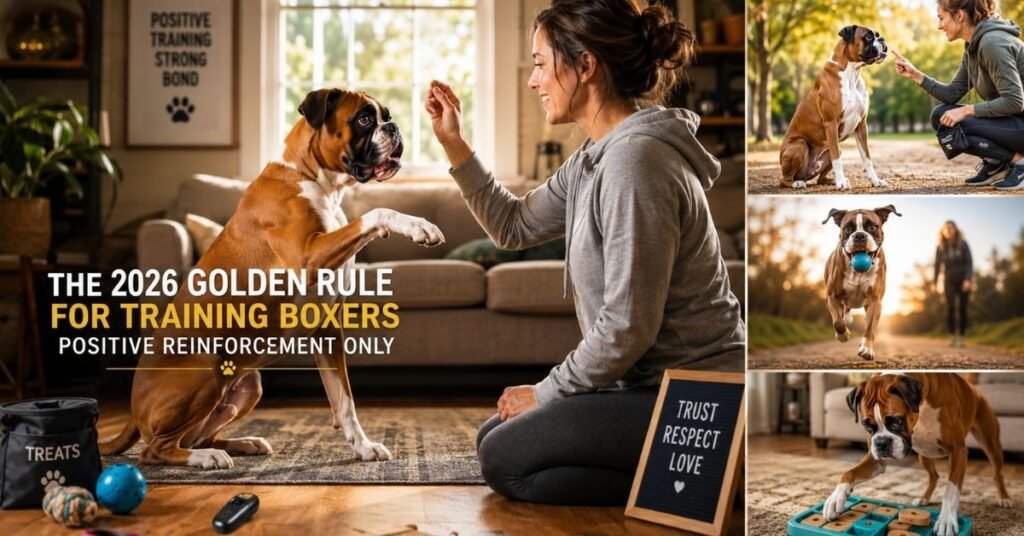
If you take one thing from this guide, make it this: the Boxer’s emotional sensitivity is not a liability. It’s your single greatest training asset if you use the right tools.
Boxers trained with aversive methods shock collars, prong collars, physical corrections don’t become better behaved. They become suppressed. The behavior goes underground while the emotional state deteriorates, often resurfacing as anxiety or redirected aggression. The modern, science-based alternative works with the Boxer’s psychology instead of against it:
- Boxers are highly food-motivated. The drive that makes them raid counters makes them attentive, enthusiastic learners when food is in play.
- They thrive on social engagement. Verbal praise, play, and touch are powerful secondary reinforcers that sustain behavior long after food rewards are phased out.
- Positive reinforcement builds trust and trust is the foundation of any reliable relationship with a powerful dog.
The CCPDT, IAABC, and AVSAB all endorse force-free, reward-based training as the evidence-supported standard. When evaluating any trainer for your Boxer, look for those credentials first and walk away from anyone still talking about “being the alpha.”
Your Boxer Can and Will Get There
Boxer dog behavior problems are real, they are demanding, and there are days they will test every ounce of your patience. But they are also, without exception, workable. The same intensity that makes a Boxer destructive when under-stimulated makes them absolutely electric training partners when their needs are met. The same sensitivity that makes them shut down under harsh handling makes them deeply tuned-in, responsive, and almost theatrical in their enthusiasm when they understand what you’re asking.
Consistency, structure, and patience applied with empathy and backed by science will shape your Boxer into exactly the companion you imagined when you brought them home. Not a perfectly obedient robot, but a confident, settled, joyful dog who knows the rules, trusts the relationship, and channels all that magnificent Peter Pan energy into a life you both love.