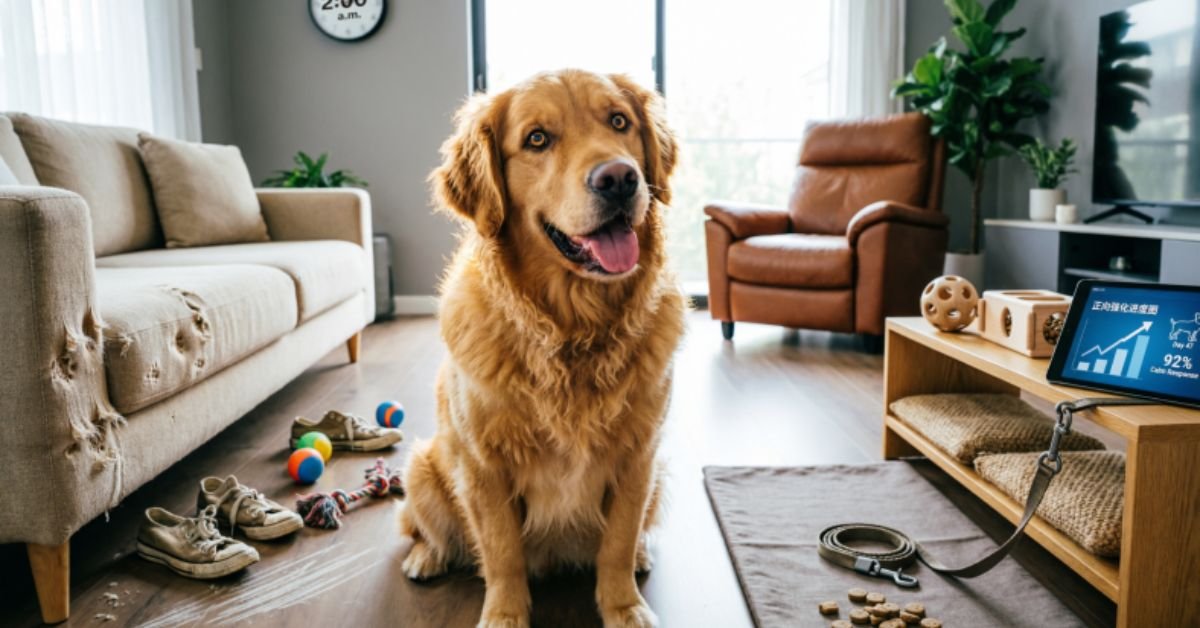
If you share your home with a Labrador Retriever, you already know the paradox: the dog the world calls “the perfect family pet” can also be the dog that ate your couch, knocked over your grandmother, and barked at 2 a.m. for no apparent reason. These common Labrador Retriever behavior problems can leave even experienced owners feeling frustrated and confused.
But the truth is, you are not failing as a dog owner, and your Lab is not “bad.” What’s happening is a fundamental mismatch between the dog evolution designed and the modern world we’re asking them to live in. Labrador Retrievers were bred for endless physical activity, intense social connection, and mentally demanding work, not hours of boredom inside homes and apartments.
1. Understanding the Lab Mind: Genetics vs. Environment

Built for a job they no longer have
Labrador Retrievers were purpose bred for one of the most demanding tasks in working dog history: retrieving waterfowl in freezing conditions, swimming through surf, carrying heavy game softly in their mouths, and doing it all day long with enthusiasm.
Every behavior problem you see in your Lab is a working dog’s trait expressed in the wrong context.
Destructive chewing? That’s a retrieval drive with nothing to retrieve. Jumping on guests? That’s social exuberance bred into a dog meant to work in close contact with humans. Hyperactivity? That’s stamina designed for 8-hour field days, compressed into an apartment.
The mental stimulation deficit
A 2025 study published in Applied Animal Behaviour Science confirmed what many trainers have long suspected: Labs require an average of 2 hours of combined physical and mental stimulation daily to maintain behavioral equilibrium. Most pet Labs receive less than 45 minutes.
The result is a dog running on cognitive empty and a brain that invents its own stimulation, usually through behaviors their owners find maddening.
Pro Tip: A 15-minute sniff walk or puzzle session tires a Lab more than a 30-minute run. The nose contains 300 million olfactory receptors engaging it burns enormous cognitive energy. Before you increase exercise, try increasing sniff time and food puzzle sessions first.
2. The 3-3-3 Rule for Rescue Labradors

If you’ve recently adopted a Lab from a shelter or rescue, this section is essential reading. The 3-3-3 Rule is now the gold standard framework for understanding a rescue dog’s behavioral adjustment timeline, and it prevents thousands of unnecessary shelter returns every year.
3 Days Survival Mode Your Lab is overwhelmed and shut down. They may not eat, drink, or show any personality. This is not their true character, this is a brain flooded with cortisol, the stress hormone.
3 Weeks Learning the Routine Personality begins to emerge. The dog starts understanding your schedule and environment. Some behaviors actually worsen at this stage as they become more comfortable. This is completely normal and expected.
3 Months Full Decompression Your dog now feels safe enough to show you who they really are. Real training and relationship building can now begin in earnest.
The critical mistake most new adopters make is attempting intensive training or socialization in the first three days. The brain of a newly adopted dog is literally incapable of forming new neural pathways during acute stress. Your only job in those first 72 hours is to create safety: quiet environment, predictable schedule, calm voices, zero pressure.
Pro Tip The Decompression Walk: During the 3-3-3 transition, replace structured leash walks with “decompression walks” on a long line (15–30 feet) in low-traffic areas. Let your Lab lead, sniff freely, and move at their own pace. This activates the parasympathetic nervous system, lowers cortisol, and accelerates bonding faster than any training exercise.
3. Post Pandemic Separation Anxiety 2.0

Between 2020 and 2022, millions of people adopted dogs while working from home. Then offices reopened. The result was a global crisis in canine separation anxiety and Labrador Retrievers, as one of the most human-bonded breeds on earth, were disproportionately affected.
By 2026, behavioral veterinarians are dealing with what clinicians now call Separation Anxiety 2.0: a second wave driven by hybrid work schedules, irregular departure patterns, and years of under-socialization. Unlike classic separation anxiety, this form is characterized by unpredictability; the dog never knows which days will involve 8-hour absences and which won’t, making habituation nearly impossible.
Signs your Lab has separation anxiety:
- Destruction exclusively near exits (doors, windows, baseboards)
- Eliminating indoors despite being fully house-trained
- Excessive drooling, panting, or pacing before you leave
- Barking or howling immediately upon your exit
- Refusal to eat when alone, even with high-value food
- Excessive self-licking or paw chewing
Modern solutions for 2026:
1. Departure desensitization: Practice “fake departures” pick up your keys, put on your shoes, open the door, then sit back down. Repeat 20–30 times daily until your dog stops reacting. The goal is to break the pre-departure ritual’s emotional meaning.
2. Independence training: Practice “place” (staying on a mat) while you move to other rooms. Gradually increase distance and duration before any actual alone-time training begins.
3. Predictability scheduling: If you have a hybrid work schedule, maintain consistent departure times even on at-home days. Predictability dramatically reduces anticipatory anxiety.
4. AI-assisted monitoring: 2026’s pet camera systems now offer real-time. Intervening early before a full anxiety spiral is far more effective than returning to a destroyed room.
5. Veterinary behavioral support: For severe cases, board-certified veterinary behaviorists may recommend short term pharmacological support (SSRIs or situational anxiolytics) as a bridge while behavioral modification takes hold. This is not a failure, it is physiology.
Important: Crating an anxious dog does not treat separation anxiety it often amplifies it. A crate is a management tool for a comfortable dog, not a containment solution for a panicked one.
Pro Tip: If your Lab is showing distress in a crate, consult a veterinary behaviorist before continuing. Never force crate time on an already anxious dog.
4. The Gut Brain Connection: Diet and Hyperactivity
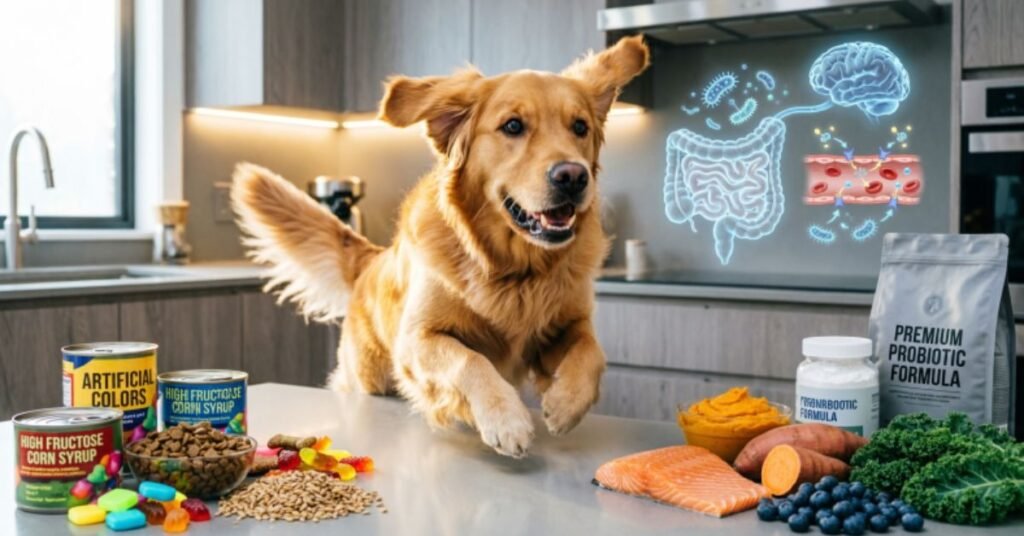
One of the most significant behavioral discoveries of the past three years is the confirmed link between the gut microbiome and canine behavior. Research from the 2025 International Veterinary Behavior Congress demonstrated that Labs fed ultra processed kibble high in simple carbohydrates showed significantly elevated hyperactivity scores and lower frustration tolerance compared to Labs on whole-food or microbiome-supportive diets.
The mechanism involves the gut brain axis: specific bacterial strains in the canine gut produce neurotransmitters including serotonin and GABA. When these populations are disrupted by inflammatory diets, the behavioral consequences are measurable.
Signs that diet may be driving behavior problems:
- Hyperactivity that does not resolve with exercise
- Impulsivity and poor frustration tolerance
- Food guarding that seems to escalate over time
- Anxiety that worsens despite consistent behavioral intervention
Dietary adjustments worth discussing with your vet:
- Reduction of ultra-processed ingredients and simple carbohydrate fillers
- Addition of canine-specific probiotics (Lactobacillus rhamnosus strains show particular promise in 2025–2026 research)
- Omega-3 fatty acids (DHA/EPA) for neurological support and reduced inflammation
- Consistent feeding schedule irregular mealtimes disrupt microbiome rhythm
Pro Tip The 30-Day Diet Trial: Before concluding that your Lab’s hyperactivity requires intensive behavior modification, try a 30-day dietary shift to a higher quality, lower-glycemic food under veterinary guidance. Multiple trainers now report remarkable behavioral improvement without any additional training intervention. Diet is the most underutilized behavior tool in the average dog owner’s kit.
5. Genomic Temperament Testing in 2026

Among the most exciting developments in veterinary behavioral science is Genomic Temperament Testing the ability to analyze a dog’s DNA to predict behavioral tendencies with increasing accuracy.
As of 2026, commercial tests can screen for genetic markers associated with fear reactivity, aggression thresholds, noise sensitivity, sociability, and trainability. For Labrador Retrievers specifically, researchers have identified variants in genes related to dopamine regulation (affecting impulsivity), serotonin pathways (affecting anxiety), and the POMC gene, a Lab-specific variant that affects both obesity and obsessive food-seeking behavior.
Approximately 25% of Labrador Retrievers carry the POMC variant. It doesn’t just cause weight gain it creates a neurological state of perpetual hunger that drives obsessive food-seeking and can intensify resource guarding. If your Lab has this variant (identifiable via DNA test), food-based training must be managed more carefully than in typical dogs. This is physiology, not greed.
What genomic testing can and cannot tell you:
- Can predict: Predisposition to anxiety, resource guarding intensity, trainability index, noise sensitivity
- Cannot predict: Actual behavior genes create tendencies, environment shapes expression
- Most valuable for: Tailoring training approaches before problems develop, informing medication decisions, helping adopters choose compatible dogs
Pro Tip: Genomic testing is not a crystal ball. A dog with high genetic anxiety risk, raised in a calm and enriched environment, will almost always outperform a genetically “easy” dog raised in chaos. Use the data to inform your approach, not to label your dog.
6. Modern Training Tools and Techniques for 2026
Positive reinforcement: the science is settled
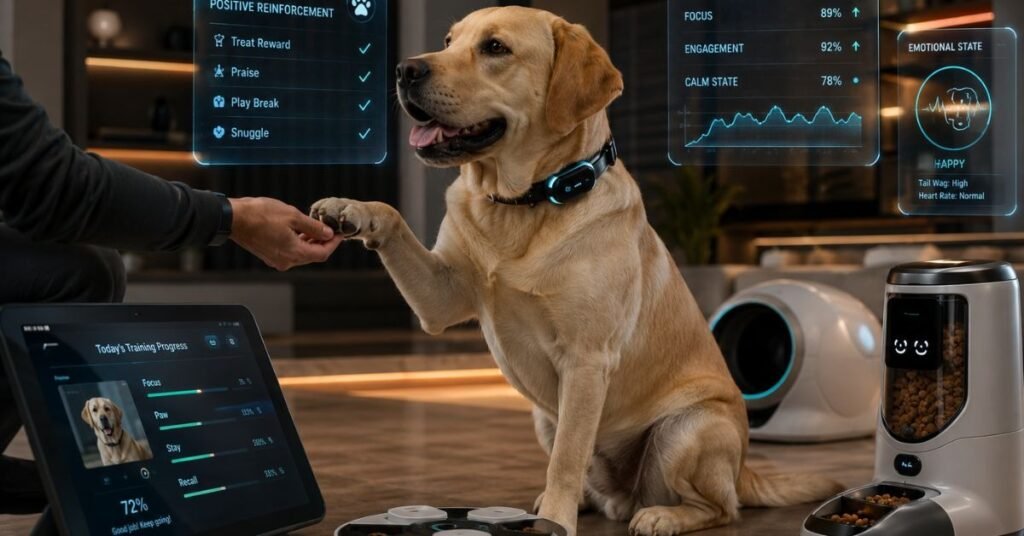
As of 2026, the evidence is unambiguous. Positive reinforcement-based training produces faster learning, better retention, lower anxiety, and stronger human dog bonds than punishment based methods. Multiple meta analyses of canine behavioral research confirm that aversive tools prong collars, e-collars, alpha rolls increase cortisol, reduce trust, and are associated with increased aggression over time.
This is not a philosophical preference. It is the current scientific consensus.
AI-driven interactive puzzle toys
The 2024–2026 generation of pet tech has delivered genuinely impressive tools for cognitive stimulation. AI-driven puzzle feeders now adapt difficulty in real time based on your dog’s success rate, preventing both boredom (too easy) and frustration (too hard). Some systems connect to apps that track cognitive performance over time. Early data suggests consistent puzzle engagement produces measurable improvements in impulse control within 30 days.
Scent work: the underrated revolution
Nose work teaching dogs to identify and indicate on specific target odors has emerged as the single most effective behavioral intervention for anxious, hyperactive, and reactive dogs. It requires total focus, builds confidence, is suitable for dogs of all physical conditions, and taps directly into the Lab’s olfactory superpower. Classes are available in most cities and beginner kits make home practice easy to start.
Pro Tip The 5-Minute Training Rule: Labs learn best in short, high-value sessions. Five focused minutes of training with a high rate of reinforcement beats 30 minutes of drilling every time. Train before meals for peak motivation, keep sessions upbeat and fast-paced, and always end before your dog loses focus. Always finish on a success.
7. Common Misconceptions vs. 2026 Scientific Reality

| Misconception | 2026 Scientific Reality |
| “Labs just need more exercise.” | Physical exercise without mental stimulation often creates a “fit and still crazy” dog. Cognitive engagement is equally critical. |
| “Your Lab is trying to be alpha.” | Dominance theory has been thoroughly debunked. Labs push boundaries due to lack of training clarity, not power struggles. |
| “Punishment teaches what NOT to do.” | Punishment suppresses behavior without teaching alternatives and elevates cortisol long-term. Positive reinforcement outperforms aversive methods in every measurable metric. |
| “The guilty look means they know they did wrong.” | The “guilty look” is an appeasement response to your angry body language not evidence of moral understanding. Dogs lack the cognitive architecture for guilt. |
| “Labs are too old to train after 2 years.” | Neuroplasticity in dogs is lifelong. Adult Labs often train more efficiently than puppies due to improved impulse control. |
| “Food guarding is natural — ignore it.” | Resource guarding is highly modifiable with early intervention. Ignoring it allows escalation to dangerous levels. |
| “Behavior problems are always a training failure.” | Genetics, gut health, chronic pain, thyroid dysfunction, and neurological factors all drive behavior. A full veterinary workup before intervention is best practice. |
| “Getting a second dog will cure separation anxiety.” | True separation anxiety is about the absence of the primary human figure. A second dog provides companionship, not the human bond the anxious dog is missing. You may end up with two anxious dogs. |
Final Word: Your Lab Is Not the Problem
Every behavior challenge your Labrador Retriever behavior problems presents is information about their needs, their history, their biology, and the gap between what evolution built them for and what modern life offers them.
The good news: Labs are among the most trainable, adaptable, and forgiving dogs on earth. With the right approach structured positive reinforcement, adequate cognitive stimulation, appropriate veterinary support, and a genuine commitment to understanding their needs the vast majority of behavioral problems resolve completely.
This is not a sprint. It is one of the most rewarding relationships you will ever build. Your Lab already loves you unconditionally. Now you have the tools to help them thrive.