You love your Collie. But lately, it feels like you’re living with a furry tornado, one that herds your kids, barks at every passing car, and has redecorated the backyard with holes you didn’t ask for.
Here’s the truth most generic pet sites won’t tell you: your Collie isn’t being difficult. They’re being exactly what centuries of selective breeding designed them to be. Collie dog behavior problems aren’t character flaws. They’re working drives running wild in a world that no longer has sheep to herd.
Understanding that difference is the first step to actually fixing things.
At a Glance: 5 Collie Dog Behavior Problems, Their Triggers & Fix Type

| Behavior Problem | Primary Trigger | Fix Category | Urgency Level |
| Herding & Heel Nipping | Moving objects / running children | Redirect + Outlet Sport | High — escalates without structure |
| Separation Anxiety | Bond rupture / departure cues | Desensitization + Routine | High — self-injury risk |
| Excessive Alert Barking | Visual/auditory environment | Management + Cue Training | Medium |
| Destructive Chewing & Digging | Boredom / under-stimulation | Enrichment Audit + Redirect | Medium |
| Fear-Based Noise Reactivity | Loud unpredictable sounds | Counter-conditioning + Vet Support | High in sensitive lines |
Use this table as a fast diagnostic. If your Collie is showing multiple behaviors simultaneously, start with whichever carries the highest urgency, usually anxiety or nipping before layering in enrichment changes.
Decoding the Collie Mind: Why Core Instincts Look Like “Bad Behavior”
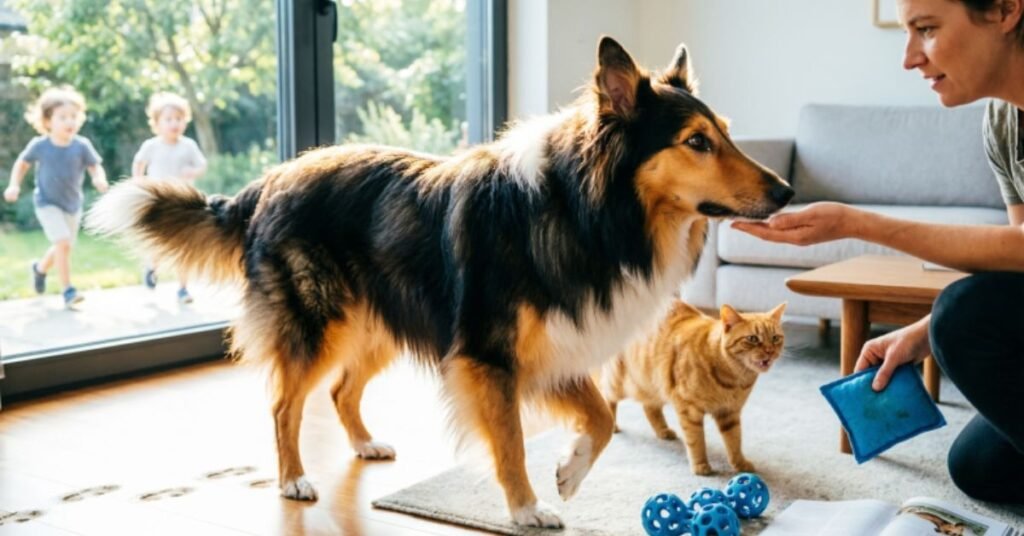
Collies whether you have a sleek Border Collie or a majestic Rough Collie were bred to work 8 to 12 hours a day alongside a shepherd. Their brains are wired for constant decision-making, problem-solving, and physical movement.
The single biggest mistake Collie owners make is confusing physical tiredness with mental exhaustion. A 45-minute walk will tire a Labrador. For a Collie, it barely takes the edge off. What they crave and desperately need is cognitive work.
Think of it this way: a Collie’s brain is a high-performance engine. A daily walk is idling in a parking lot. Without real cognitive load, that engine doesn’t shut off it starts running hot and burns up your furniture instead.
A Collie with a stimulated mind is calm, biddable, and genuinely easy to live with. A Collie running on boredom is a different animal entirely: reactive, obsessive, anxious, and destructive. Most of what gets labeled “bad behavior” falls into the second category.
5 Common Collie Dog Behavior Problems & How to Fix Them
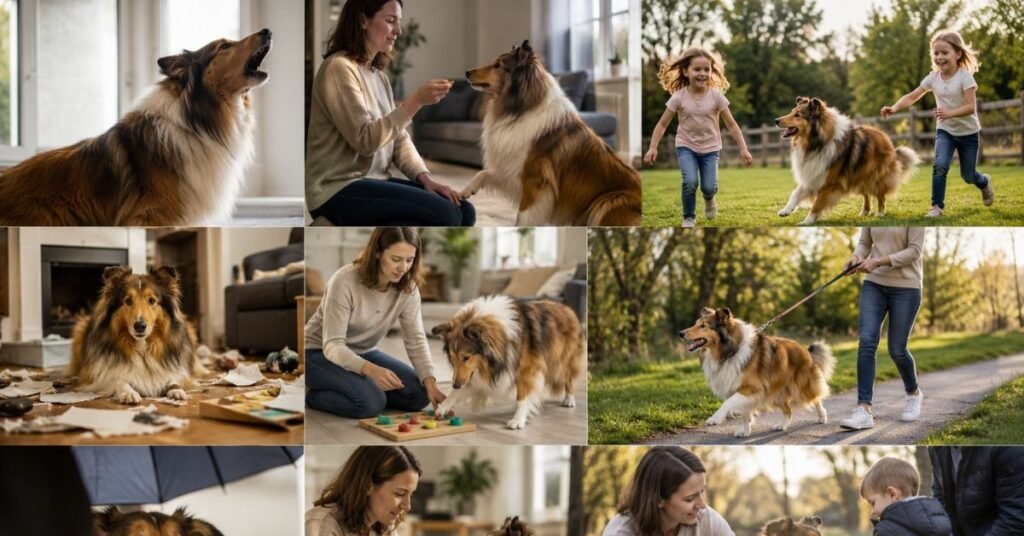
The Herding Instinct: Nipping at Heels & Chasing
Heel nipping and chasing in Collies is an instinct-driven behavior, not aggression it is the border collie herding instinct activating in response to fast movement, and it requires a structured outlet and consistent interruption to resolve.
Why it happens: When your Collie nips at your child’s heels or chases the cat, they’re not threatening anyone they’re doing their job. Moving objects trigger an almost involuntary eye stalk chase nip sequence that’s hardwired across generations of herding selection. The behavior intensifies when the dog is under-exercised, over-aroused, or has never been taught a competing response.
How to fix it step by step:
- Interrupt and redirect the moment contact or chase begins. Use a calm, neutral marker word (“nope” or “wrong”), not a shout, and immediately pivot to an incompatible behavior “sit,” “down,” or “touch” (nose to hand). Reward the alternative behavior heavily with a high-value treat.
- Stopping collie nipping requires household-wide consistency. Every person in the home must respond identically. One family member laughing at heel nipping resets weeks of careful work; the behavior gets rehearsed and reinforced even if everyone else is correcting it.
- Give the instinct a legal outlet every single day. Treibball is the gold standard a sport where dogs use their nose and body to herd large inflatable balls into a goal. Even 15 minutes of structured Treibball or controlled fetch-with-rules per day reduces household nipping substantially within two to three weeks.
- Restructure the environment during the learning phase. Ask children to move slowly and calmly around the dog until reliable impulse control is established. Don’t simply correct the dog while leaving the trigger conditions unchanged that’s an unfair setup.
- Build a “freeze” cue. Teach your Collie to stop mid-motion on a single verbal cue (“freeze” or “enough”). Start by rewarding any momentary stillness during play, then generalize. This cue becomes your emergency brake before a nip makes contact.
Severe Separation Anxiety & Distress
Separation anxiety in Collies is a genuine panic disorder not spite or boredom characterized by distress signals that begin at pre-departure cues and persist until the owner returns.
Why it happens: Rough Collies in particular bond with extraordinary depth to their person or family unit. This is a breed level trait, not a training failure. When that bond is suddenly severed even for a few hours the resulting rough collie separation anxiety can look like a full panic response: sustained howling, destructive behavior, self injury, pacing, and house soiling despite perfect indoor manners at all other times. Critically, it often begins before you’ve even left triggered by you picking up your keys or putting on your shoes.
How to fix it step by step:
- Begin with micro-departures measured in seconds, not minutes. Step outside the door. Count to 20. Return calmly without ceremony. Build to 60 seconds, then 3 minutes, then 10 stretching the intervals over days or weeks, not a single afternoon. The dog must remain below their anxiety threshold at every stage.
- Break the pre-departure trigger chain. Pick up your keys and sit down. Put on your shoes and make a cup of tea. Practice these cues repeatedly throughout the day with zero departure attached, until your Collie stops reacting to them. This alone can produce visible improvement within a week.
- Install a positive pre-departure anchor. A frozen Kong stuffed with layered food, peanut butter base, frozen broth middle, kibble top given exclusively when you leave creates a reliable emotional counter-association. “Owner leaving” stops predicting panic and starts predicting the best food of the day.
- Use a camera to observe, not assume. Many owners believe their dog settles after 10 minutes. A camera often shows the truth: the dog is still pacing at 45 minutes. Accurate data tells you where you actually are in the desensitization process.
- Pursue a veterinary behavioral assessment for severe cases. True separation anxiety as distinct from boredom-based destruction frequently responds best to a combination of systematic desensitization and short-term medication. There is no shame in that approach. It is the most evidence-backed route for significant cases.
Excessive and Alert Barking
Excessive barking in collies is a guardian instinct misfiring in a domestic environment. The dog is genuinely doing their job, but their threat threshold is set far too low for modern household life.
Why it happens: Collies were used on farms not just to herd, but to alert. That surveillance and announcement drive is deeply ingrained. In a suburban home, the result is a dog who bark-reports every passing car, bird, window reflection, and gust of wind. The problem isn’t the barking itself, it’s that the dog can’t self-interrupt once started, and every repetition strengthens the neural pathway.
How to fix it step by step:
- Teach “Quiet” as an active, rewarded cue not a suppression command. Wait for any natural pause of two or more seconds in a barking episode. The instant silence arrives, mark it with a click or “yes” and reward. Repeat until the pause lengthens on its own, then attach the verbal cue “quiet” to it.
- Acknowledge before you redirect. Say “good alert” once this signals to your Collie that their communication was received. Then immediately ask for incompatible behavior: “go to your mat,” “find it,” or “touch.” Dogs that feel heard consistently de-escalate faster than dogs whose barking is simply suppressed.
- Actively manage the practice environment. A Collie stationed at the front window for three hours of arousal-level barking is rehearsing and strengthening that behavior daily. Frosted window film on lower panes, strategic baby gates, or rotating the dog to a quieter room during peak foot-traffic hours interrupts the rehearsal loop.
- Never raise your voice in response. To a Collie’s nervous system, shouting is indistinguishable from barking; you appear to be joining the alarm chorus, which validates and escalates it.
Destructive Chewing and Digging
Destructive chewing and digging in Collies is almost always a symptom of insufficient mental stimulation; the behavior functions as self-directed stress relief when cognitive needs go unmet.
Why it happens: Chewing and digging are normal, healthy canine behaviors in controlled doses. In a Collie, they tend to surge specifically when mental stimulation for Collies falls below the breed’s threshold. A bored Border Collie doesn’t just mouth a shoe they systematically dismantle it, move to the baseboard, then excavate a trench system in the garden. The behavior isn’t random; it’s patterned and purposeful.
How to fix it step by step:
- Conduct an honest enrichment audit. Track how many minutes of genuine cognitive engagement your Collie received today not walking, but thinking. Training sessions, puzzle feeders, scent work, trick shaping. If the honest answer is under 30 minutes, you’ve identified both the problem and the solution.
- Apply the “30-minute rule” before creating or leaving the dog alone. A Collie who has completed a 30-minute structured mental work session immediately prior to isolation is measurably calmer and far less likely to redirect onto furniture or soil.
- Rotate enrichment to preserve novelty. A puzzle feeder that was challenging on Monday is effortless by Thursday. Maintain a rotating bank of 6 to 8 different enrichment tools and cycle them on a weekly schedule.
- Create a designated legal dig pit. A sandbox or a defined garden area filled with loose soil, buried toys, and intermittently hidden treats gives the behavior a legal home. Redirect every unsanctioned digging episode calmly and consistently to that location. Within three to four weeks, most dogs default to their pit.
- Treat chew outlets as a behavioral prescription, not a luxury. Appropriate chew items, bully sticks, vet-approved raw meaty bones, durable rubber toys satisfy jaw activity that the breed genuinely needs. Remove the outlets and the chewing behavior transfers to your possessions.
Fear-Based Reactivity & Noise Sensitivity
Noise sensitivity in Collies is a physiological fear response not stubbornness triggered by the breed’s heightened sensory processing, and it requires gradual counter conditioning rather than exposure or dismissal.
Why it happens: Noise sensitivity is one of the most underdiagnosed collie dog behavior problems, and one of the most distressing for both dog and owner. Collies carry a nervous system tuned for precision and sensitivity; the same trait that makes them extraordinary at reading subtle shepherd signals also makes them acutely vulnerable to sudden loud stimuli. Thunderstorms, fireworks, construction noise, smoke alarms, and even certain TV frequencies can trigger trembling, panting, hiding, hypersalivation, and in some dogs, frantic escape attempts that result in self-injury.
How to fix it step by step:
- Never use forced exposure. “Flooding” a noise-sensitive Collie by locking them in a room with the triggering sound and waiting for them to “get over it” consistently worsens the fear response and damages trust. Desensitization must be gradual, voluntary, and always below the dog’s distress threshold.
- Run a structured sound desensitization program. Use a YouTube or Spotify storm/firework track played at barely-audible volume during a highly positive activity, a meal, a play session, or a training game. Increase volume in 5% increments only when your dog is fully relaxed at the current level. Rushing this process resets progress.
- Build a genuine safe haven, not just a crate. A safe haven is a location your dog self-selects, never used for confinement or punishment, located in the quietest room in the home. Line it with worn clothing that carries your scent. The dog should choose to go there during normal days, not only be forced there during storms.
- Plan ahead for predictable high-stress events. New Year’s fireworks and storms with advance weather warnings give you time to act. Consult your vet about event-specific anxiety support short-term medication, pheromone diffusers (Adaptil), or clinical supplements including L-theanine. These are legitimate, compassionate tools, not last resorts.
- Track patterns, not episodes. Note which specific sounds trigger reactions and at what volume or distance. This data makes veterinary consultations significantly more productive and allows you to target desensitization precisely.
The Ultimate Mental Stimulation Routine for Collies

Generic “puzzle feeder” advice doesn’t cut it for a breed that was solving real-time herding problems across mountainsides. Here are three genuinely high-yield brain work approaches you can start this week:
1. Structured Scent Work Sessions (K9 Nose Work) Nose work teaches your dog to locate a specific odor target birch oil is the standard starting scent used in K9 Nose Work programs. Hide the scent on one of several identical cardboard boxes and let your Collie search independently to find it. When they alert (nose touch or stare at the correct box), mark and reward. Progress from boxes to furniture hides to full-room searches. A single 20-minute scent work session consistently produces more behavioral calm than an hour of physical exercise, because it engages the dog’s decision-making and olfactory processing simultaneously.
2. The “Which Hand” Expanding Sequence Start with a treat hidden in one of two closed fists. Once your Collie reliably nose-targets the correct hand, expand the game: three opaque cups, then five identical containers spread around a room, then containers across two rooms. Add layers of rules, must sit before searching, must wait for a release cue, must search in a prescribed order. The constant micro-decision-making taps directly into the border collie herding instinct for reading environmental signals and anticipating outcomes. This game scales endlessly as the dog’s skill increases.
3. Custom Multi Layer Frozen Lick Mats A flat lick mat is solved in 90 seconds by a motivated Collie. Upgrade it: freeze a thin yogurt base first, add a second frozen layer of mashed sweet potato, then a top layer of xylitol-free peanut butter with kibble or blueberries pressed in. Place it on a textured rubber mat for additional sensory input. The multi-layer challenge extends the session to 15 or 20 minutes, and the rhythmic licking itself activates the parasympathetic nervous system producing measurable physiological calm. This makes it particularly effective as a post-outing decompression tool or during mild environmental stress.
You and Your Collie Are Going to Be Fine
There’s no shortcut with this breed, and anyone who promises one is selling something. But there’s also no mystery here. Collies act out when they’re under-stimulated, under-understood, or overwhelmed and every single one of those states has a direct, actionable solution.
The dog nipping at heels has a herding brain that needs a legal job and a consistent interrupt. The dog trembling during a storm has a sensitive nervous system that needs a patient, structured plan not dismissal. The dog dismantling the furniture has a working drive that needs redirecting, not punishing.
Pick one behavior from the comparison table at the top of this article. Build one routine around it. Give it three focused weeks before evaluating results. Progress with Collies is rarely perfectly linear, but it is cumulative and real and the bond you build while working through these challenges is extraordinary in a way that’s hard to describe until you experience it.