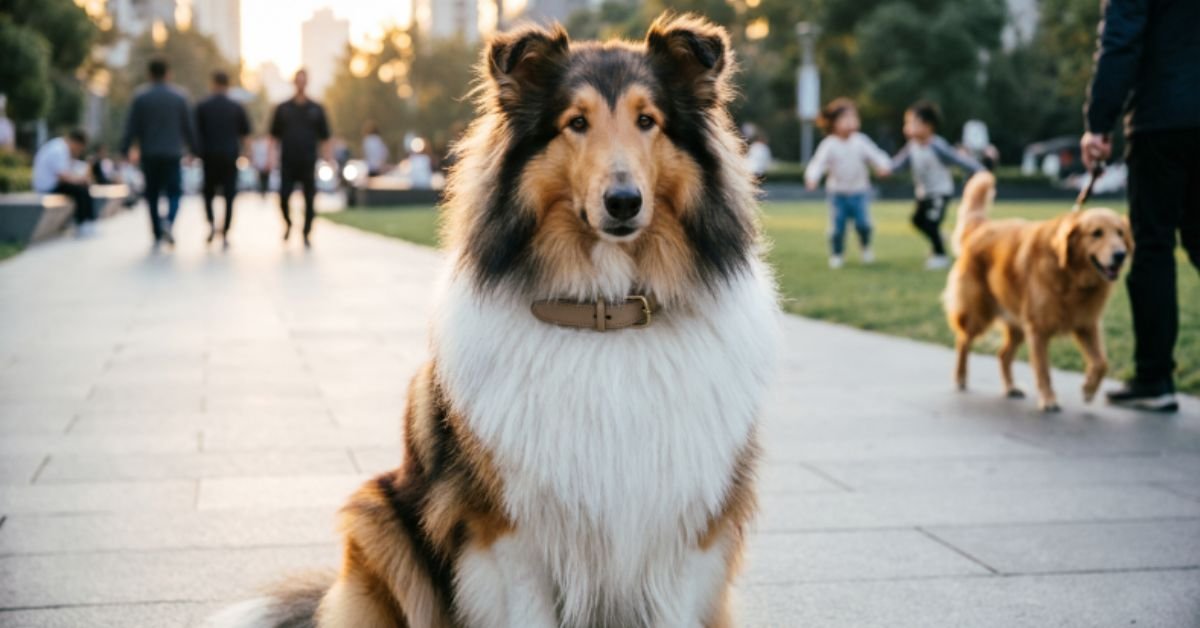
If you have ever watched a Collie freeze at the park, bark relentlessly at a passing bicycle, or press themselves against your legs when a stranger approaches, you already know this is not a “bad dog.” This is a brilliant, emotionally intelligent herding breed that has been let down by socialization advice designed for Labrador Retrievers.
In our experience Socialization of Collie Dog working with Rough Collies, Smooth Collies, and Border Collies, the single biggest mistake owners make is treating socialization as a performance forcing interactions, flooding their dogs with stimulation, and measuring success by how many strangers their dog “accepted” in a session. This approach backfires spectacularly with Collies.
The Collie Temperament Why One Size Fits All Socialization Doesn’t Work

To understand why Collies need a bespoke socialization plan, you first need to understand what centuries of selective breeding have built into their nervous system. Collies whether Rough, Smooth, or Border were engineered to be acutely sensitive to their environment. They needed to notice a sheep drifting from the flock, anticipate a predator before the shepherd saw it, and respond to whistle commands at 400 metres.
The Herding Instinct and Its Social Consequences

Fast movement running children, cyclists, joggers triggers the predatory motor sequence in a Collie: stalk, eye, chase. During socialization, this instinct creates three specific challenges:
- Eye stalk fixation: Your Collie freezes and locks onto a moving target, appearing completely switched off to your commands.
- Nipping and circling: Attempts to “gather” children or joggers by nipping at heels and circling around them.
- Barking as distance creating: Collies use vocalization to move things away, especially when they feel their personal space is being invaded.
Noise Sensitivity: The Hidden Socialization Saboteur

Collies consistently rank among the most noise sensitive dog breeds. Thunderstorms, fireworks, traffic, and even the squeal of playground equipment can create lasting negative associations during the critical developmental window. In our experience, a single badly timed exposure to a frightening sound during weeks 8 to 12 can set back socialization progress by months. This is precisely why the neutrality approach of gradual, low arousal, and always at the dog’s pace is so transformative for this breed.
The 2026 Socialization Standard: The Power of Neutrality

The old Socialization of Collie Dog advice said: get your puppy to meet as many people and dogs as possible before 16 weeks. The problem? Meeting is not the same as coping. Forcing a nervous Collie puppy to greet every stranger at the farmer’s market does not build confidence, it builds a dog who learns that their stress signals are ignored.
The 2026 neutrality based approach reframes the goal entirely: your Collie does not need to love every stimulus they need to be able to exist calmly in its presence.
What Is Neutrality Training?
Neutrality training, sometimes called environmental habituation or threshold work, teaches the dog to notice a trigger and choose to disengage. The four key principles are:
- Sub threshold exposure: Always work at a distance where the dog notices the trigger but remains below their reactivity threshold, tail relaxed, ears soft, able to take treats.
- Mark the look, not the greeting: Use a clicker or marker word the moment your Collie glances at the trigger and stays calm. Reward heavily. The dog learns: I can see that thing and choose not to spiral.
- No forced interactions: Never push your Collie toward something that makes them uncomfortable. If a stranger wants to pet your dog and your dog is stiff, say “Not today, thank you.” Advocate fiercely for your dog.
- Retreat is a valid choice: Build value in “let’s go” turning away from a trigger. A dog who can disengage is a genuinely confident dog.
Essential Socialization Milestones for Collie Puppies (Weeks 8–16)

The socialization of collie dog window closes at approximately 16 weeks. During this time, positive and neutral exposures literally shape the neural pathways your Collie will use to process the world for the rest of their life. Here is our recommended Collie specific checklist, organized by sensory category.
Textures (Weeks 8–10)
- Grass, gravel, concrete, wet grass, rubber matting, and sand
- Metal surfaces such as vet tables introduced at home with treats placed on a baking tray
- Stairs of varying heights Rough Coat Collies can feel unstable on open-backed stairs
Sounds (Weeks 8–14 Introduce Gradually)
- Traffic sounds start with low volume recordings played during mealtimes
- Children playing this is crucial; Collies who miss this exposure often become chronic chasers
- Household appliances such as vacuum cleaners, washing machines, and hairdryers run them in an adjacent room first
- Veterinary clinic sounds book a happy visit with no treatment, just positive associations
People and Animals (Weeks 10–16 Neutrality Focus)
- People wearing hats, hi-vis vests, uniforms, or carrying umbrellas and walking sticks
- Calm adult dogs parallel walking is far safer than nose to nose greetings
- Cats, chickens, and horses if your Collie will live rurally always on lead, always sub-threshold
- Babies and toddlers observe from a distance and never force proximity
Handling the Herding Instinct in Public Places

One of the most common questions we receive at DailyPetInfo is: my Collie tries to herd children at the park. What should I do? Managing herding behavior during socialization requires both management and training running at the same time.
Immediate Management Strategies
- Use a 2-metre fixed lead in environments with fast-moving triggers not a flexi or retractable lead, which gives the dog momentum to build chase arousal.
- Position yourself between your Collie and the movement trigger to interrupt the predatory motor sequence before it escalates to a full stalk.
- Carry high-value reinforcers real meat or cheese. Dry kibble will not compete with a running child for a Collie’s attention.
The “Find It” Interrupt
Train the “find it” cue at home first scatter treats on the ground and say “find it” as you scatter them. Once the behavior is reliable, this becomes your go-to interrupt the moment you see your Collie beginning to fixate. Scattering food on the ground engages their nose, and sniffing is neurologically calming.
Socializing the Adult or Rescue Collie: Is It Too Late?

We are asked this question constantly, and our answer is always the same: no, it is never too late but the process changes significantly for adult and rescue Collies. The critical socialization window has closed, but the adult brain retains neuroplasticity. The tools are counter conditioning and systematic desensitization.
Counter Conditioning
If your rescue Socialization of Collie Dog is frightened of men in hats, the goal is to make men in hats predict wonderful things. Every time a man in a hat appears at a safe distance, the highest value food you own appears. Man disappears and food stops. Repeat this hundreds of times. The brain’s fear center slowly begins to re-associate “man in hat” with anticipation rather than dread. This process takes weeks to months, not days, and patience is absolutely non-negotiable.
Systematic Desensitization
For a Collie who is reactive to traffic, the step by step process looks like this:
- Week 1: Sit in a parked car watching traffic from 100 metres away while feeding treats continuously.
- Weeks 2 to 3: Walk on a quiet residential street during low traffic times of day.
- Weeks 4 to 5: Walk alongside moderate traffic with a 10-metre verge of distance between you and the road.
- Week 6 onwards: Reduce the distance only when the dog is consistently relaxed at the current level.
Common Socialization Mistakes That Lead to Reactive Collies
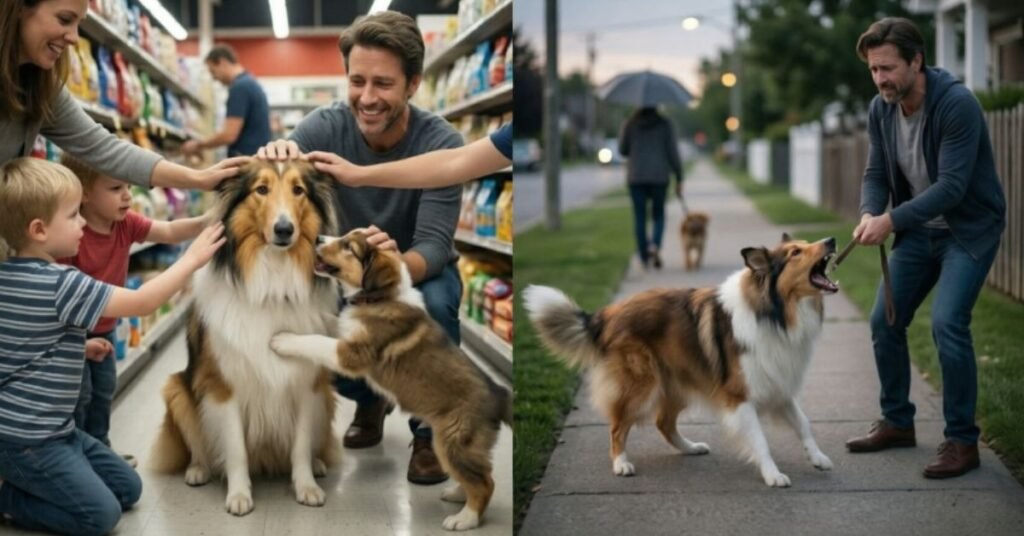
In our work with Collie owners, we see the same mistakes appearing again and again. These are the patterns most likely to create the reactive, anxious Collie that everyone wants to avoid.
- Flooding: Taking your Collie puppy to a busy market or dog show before they have any coping skills. Signs that your dog is being flooded include freezing, excessive panting, yawning, lip licking, and a shut down dog who stops moving entirely.
- Forced greetings: Allowing strangers to approach and forcibly pet your dog when your dog is clearly uncomfortable. The hand reaching over the top of the head is the most universally threatening gesture for a nervous dog. Teach your Collie that a presented hand means they can sniff it on their own terms or simply ignore it.
- Over stimulation accumulation: Dogs have an arousal “bucket” that fills throughout the day. A Collie who was fine at the park, fine at the cafe, and fine at the pet shop may completely fall apart on the way home because the bucket overflowed. Schedule socialization as single environment sessions with proper recovery time in between.
- Punishing stress signals: Scolding a growl removes the warning system, not the fear. A Collie who has been punished for growling skips the growl entirely and goes straight to snapping. Always treat a growl as communication and remove your dog from the situation calmly.
- Using puppy classes designed for bully breeds: Many group classes involve chaotic off lead play that is completely overwhelming for Collie puppies. Look for classes that include structured calm work and individual approach exercises.
Confidence Is Built, Not Born
Every Collie who shrinks from the world began life with the full potential to move through it with ease. The dogs who become reactive, noise-phobic, or shut down are not genetically destined for those outcomes; they are the product of socialization methods that ask too much, too fast, without building the internal resources to cope.
The 2026 shift toward neutrality training is the most important development in Collie welfare we have seen in a generation. It asks us, as owners, to slow down. To sit at the edge of the car park rather than walking through the crowd. To mark the calm glance rather than demanding the greeting. To be our dog’s advocate before we are their trainer.
Frequently Asked Questions
Are Collies good with cats?
Collies can absolutely live happily alongside cats, but the herding instinct means introductions must be carefully managed.
How do I stop my Collie from barking at strangers?
Barking at strangers is a distance-increasing behavior your Collie is asking the stranger to go away. Punishing the bark does not remove the anxiety; it removes the warning signal.
At what age should I start socializing with my Collie puppy?
Socialization should begin the moment your puppy arrives home, typically at 8 weeks. Even before vaccinations are complete, you can socialize safely by carrying your puppy in your arms to expose them to sounds, sights, and smells without ground contact risk.
Is a Border Collie socialized the same way as a Rough Collie?
The principles are identical, but the intensity differs. Border Collies typically display stronger eye stalk chase sequences and higher overall arousal levels than Rough or Smooth Collies.