Boxers are not a generic large breed in a muscular body. Their deep-chested anatomy, genetic predisposition to arrhythmogenic cardiomyopathy, brachycephalic airway, and notoriously sensitive digestion make Boxer dog food and nutrition a clinical subject not a marketing one. Most articles tell you to buy high-protein kibble and call it a day.
This guide goes further: into the specific cardiac amino acids this breed requires, the skeletal risks of calcium oversupplementation in puppies, and the real dietary reasons behind the infamous Boxer gas problem. Whether you feed raw, home-cooked, or premium kibble, what follows is the nutrition intelligence built for this breed specifically.
The ‘Deep-Chest’ Dilemma: Boxer Dog Food and Nutrition Around Bloat Risk

Gastric Dilatation-Volvulus (GDV) risk in Boxers is directly increased by large meal volumes, rapid eating, and excessive air swallowing all of which are manageable through targeted feeding mechanics. Their narrow, deep thorax gives the stomach unusual room to shift and rotate, especially when gas accumulates post-meal. The structural fix is not optional.
Kibble size and hydration are your first lever. Large, airy kibble pieces cause aerophagia air-gulping which accelerates GDV risk. Choose small-to-medium, dense kibble and add warm water or low-sodium bone broth before serving. This pre-softens the food, slows intake, and reduces fermentation-driven gas downstream. Raw and home-cooked feeders have an inherent advantage here: chunk-format food requires chewing, which naturally reduces aerophagia.
Meal frequency is structural, not optional. Two to three smaller meals per day keeps gastric volume manageable. One large daily meal is a documented GDV risk factor in deep-chested breeds. Split portions evenly a small morning meal and larger dinner still leaves the stomach disproportionately full during the highest-risk post-dinner window.
Avoid elevated food bowls unless prescribed for mobility reasons. Counter to older advice, raised bowls have been associated in multiple studies with increased GDV incidence in large breeds. A slow-feeder bowl or snuffle mat reduces meal speed by 40–60% without changing the diet at all. Enforce a 60-to-90-minute post-meal rest before any vigorous activity.
The Hidden Heart Connection: Why Boxer Dog Food and Nutrition Must Include Taurine and L-Carnitine

Taurine and L-Carnitine deficiency in Boxers directly increases the risk of cardiac dysfunction, particularly given the breed’s genetic predisposition to Arrhythmogenic Right Ventricular Cardiomyopathy (ARVC). The heart is one of the body’s highest-energy organs, relying on fatty acid metabolism that requires L-Carnitine as a transport molecule. Without it, myocardial energy production becomes inefficient. Taurine protects cardiac cell membranes and supports normal electrical conduction; its depletion has been directly linked to dilated cardiomyopathy (DCM) in multiple dog studies.
The FDA’s 2018 investigation into grain-free, legume-heavy diets and DCM is directly relevant here. Peas, lentils, and chickpeas used as cheap protein substitutes in most grain-free kibbles appear to reduce taurine bioavailability either by interfering with endogenous synthesis or by lacking the amino acid precursors (methionine, cysteine) needed for taurine production. For a breed already at cardiac risk, this is a compounding threat, not a minor footnote.
Kibble vs. Raw vs. Home-Cooked: Heart Health Comparison
| Factor | Premium Kibble | Raw (PMR) | Home-Cooked |
| Taurine Content | Variable; look for added taurine on label | High (muscle meat, heart) | High if heart/organ meat included |
| L-Carnitine Source | Synthetic addition in some formulas | Beef heart (richest natural source) | Beef heart, lamb |
| Legume Risk | High in grain-free formulas | None | None |
| Supplementation Needed | Taurine 500 mg 2x/day if grain-free | May still benefit from taurine supplement | Consult vet for complete amino acid panel |
| Control Over Ingredients | Low | High | Highest |
| Vet Oversight Required | Label reading sufficient | Ratio guidance recommended | Mandatory for balance |
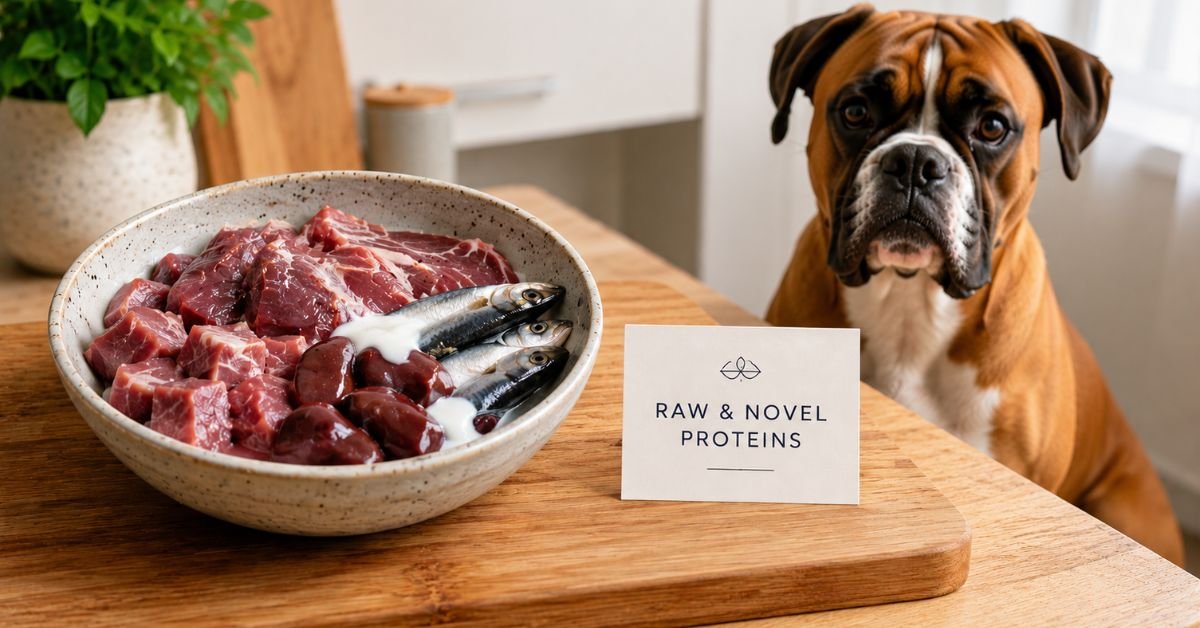
Kibble feeders: choose formulas listing beef, lamb, or salmon as the first ingredient — not peas or lentil protein concentrate. If you use grain-free, supplemental taurine at 500 mg twice daily has been used in clinical cardiac studies. Raw feeders using prey model (80% muscle meat, 10% organ, 10% bone) get the best natural taurine and L-Carnitine intake, but breed-specific supplementation is still worth discussing with your vet.
Allergy Archeology: Moving Beyond Grain-Free in Boxer Dog Food and Nutrition

The most common food allergens in Boxers in order of clinical frequency are chicken, beef, dairy, wheat, and egg, with chicken being the single most misidentified culprit. Many owners cycle through multiple grain-free kibble brands without improvement because every formula still uses chicken as the primary protein. The grain was never the problem.
Boxers who present with chronic loose stools, recurrent ear infections, inter-digital paw licking, or persistent gas after multiple food changes are showing classic signs of protein hypersensitivity. The solution is a strict 8-to-12-week novel protein elimination trial: one protein source the dog has never eaten before, nothing else. Venison, rabbit, duck, and kangaroo are the most commonly used elimination proteins. No treats, no flavoured supplements, no table scraps a single exposure resets the immune window.
White Boxers warrant specific mention. Community observations in r/Boxer and among experienced breeders consistently report higher rates of skin sensitivity and food pickiness in white Boxers carrying two copies of the extreme white piebald gene. The research base is anecdotal, but the pattern is consistent enough to justify starting any white Boxer on a novel protein diet and prioritising omega-3 supplementation from the outset.
Hydrolysed protein diets where proteins are enzymatically broken into fragments too small for immune recognition are the next step when elimination trials fail. These are prescription formulas and require a veterinary dermatologist referral for appropriate selection.
The Boxer Life-Stage Blueprint: Precise Shifts in Boxer Dog Food and Nutrition
Puppy Phase (8 Weeks to 18 Months)

Knuckling in Boxer puppies where the front paws turn under at the knuckle joint is directly linked to calcium-phosphorus imbalance during rapid skeletal development, not just genetics. Over-supplementing calcium in puppies fed a complete large-breed formula is a documented cause of dysregulated bone growth, osteochondrosis, and knuckling. If your puppy is on a complete and balanced large-breed formula, adding calcium supplements is harmful, not helpful.
Target a large-breed puppy formula with a calcium-to-phosphorus ratio of 1.2:1 to 1.5:1 and calcium content no higher than 1.5% on a dry matter basis. Protein should sit at 28 to 32% from named animal sources not plant protein concentrates to support the muscle development that stabilises joints during skeletal growth spurts.
Adult Phase (18 Months to 7 Years)
Adult Boxers need 25–28% dry matter protein from quality animal sources, 14 to 18% fat, and controlled carbohydrates. Their metabolism shifts significantly after spaying or neutering weight gain can appear within weeks without a corresponding caloric reduction. Marine-source omega-3s (EPA and DHA) should be supplemented beyond what kibble provides: approximately 1,000 mg of fish oil per 20 lbs of body weight daily is the standard veterinary starting point.
Senior Phase (7+ Years)
Senior Boxers need more bioavailable protein, not less sarcopenia (muscle wasting) is the primary threat, not excess protein intake. Reduce total calories by cutting carbohydrate and fat density while maintaining or increasing protein from highly digestible animal sources. Reduce phosphorus if early renal changes are detected. Glucosamine, chondroitin, taurine, and omega-3s should all be active by this stage. Digestive enzyme supplementation becomes essential as pancreatic output declines naturally with age.
Reddit-Inspired Troubleshooting: Real Boxer Dog Food and Nutrition Problems, Actually Solved
Why Is My Boxer Skipping Meals?
A Boxer refusing food is primarily caused by palatability, boredom, mild gastric upset, or learned holding-out behaviour not illness, in most cases. One missed meal in a healthy adult is not a concern. Two missed meals warrants monitoring. Three consecutive missed meals, or any skipped meal combined with lethargy, distended abdomen, or repeated retching, requires immediate veterinary evaluation to rule out GDV.
The practical fix: rotational feeding across two or three protein sources breaks the monotony cycle and reduces the risk of developing chronic intolerances from single-protein feeding. Warm the food to just above body temperature to increase aroma. Add a small amount of low-sodium bone broth or freeze-dried meat topper to reset palatability interest. Avoid repeatedly escalating to “more exciting” foods when your Boxer hesitates this trains the behaviour to hold out for upgrades.
Managing Boxer Gas Through Enzyme-Rich Diets
Boxer gas is primarily caused by aerophagia (air-swallowing from brachycephalic anatomy), fermentable fibre ingredients, and inadequate digestive enzyme output all of which are dietary and addressable. This is not simply a breed quirk.
The dietary audit is straightforward: check your kibble for legumes, chicory root (inulin), and beet pulp in the first ten ingredients. These are highly fermentable fibres that feed gas-producing bacteria in the large intestine. Removing them is often the single most effective intervention.
Supplementing with a broad-spectrum digestive enzyme blend (protease, amylase, lipase) taken with every meal ensures that food is broken down in the small intestine before it reaches fermentation-prone zones. Probiotic strains Lactobacillus acidophilus and Bifidobacterium animalis support a microbiome that produces less methane and hydrogen gas. Plain kefir or unsweetened goat’s milk provides live cultures naturally and is well-tolerated by most Boxers in small amounts. Always transition between foods over 10 to 14 days minimum to prevent microbiome disruption.
Preventative Nutrition: The Core Philosophy of Boxer Dog Food and Nutrition

Preventative Boxer nutrition means making the cardiac, skeletal, digestive, and dermatological decisions today that reduce veterinary emergencies tomorrow. Taurine supplementation does not eliminate ARVC but it may delay expression. Divided meals and slow-feeders do not guarantee a bloat-free life but they stack the probability in your dog’s favour. “Complete and balanced” on a label means minimum legal requirements met, not optimal health delivered.
Read the ingredient panel. Rotate proteins. Supplement taurine, fish oil, and digestive enzymes with intent. Feed twice a day. Your Boxer will still run headfirst into the coffee table and demand to sit on your lap at full adult weight but they’ll do it for longer.
Final Verdict:
There is no single “best” food for every Boxer but there is a clear framework every owner should follow regardless of feeding method. Feed twice daily in measured portions. Prioritise named animal protein over plant substitutes. Supplement taurine and marine omega-3s proactively, not reactively. Rotate proteins every few months to prevent intolerances from developing. Keep legume-heavy ingredients low, especially in grain-free formulas. And treat the deep chest as what it is a structural risk factor that demands feeding discipline for life.
The Boxer community on r/Boxer and Quora is full of owners who spent years troubleshooting gas, allergies, and cardiac diagnoses after the fact. Most of those issues have a nutritional thread that runs through them. You now have the map. Use it early, and your Boxer gets more years of doing exactly what they do best being the most chaotic, loveable dog in any room they enter.
Frequently Asked Questions:
Q1. What is the best protein source for Boxer dogs?
Beef, lamb, and salmon are the top choices of beef for L-Carnitine, salmon for omega-3s, lamb as a novel protein for allergy-prone dogs. Avoid chicken as a default; it’s the most common Boxer allergen.
Q2. Should I feed my Boxer a grain-free diet?
Only with caution. Legume-heavy grain-free formulas have been linked to DCM, and Boxers already carry cardiac risk (ARVC). If you go grain-free, supplement taurine at 500 mg twice daily and keep peas and lentils low on the ingredient list.
Q3. How many times a day should I feed my Boxer?
Two to three times daily in divided portions. One large meal per day is a documented GDV risk factor in deep-chested breeds never skip the split.
Q4. Why does my Boxer have so much gas?
Primarily aerophagia (flat-face air-swallowing) plus fermentable fibres like peas, inulin, and beet pulp in kibble. Add a broad-spectrum digestive enzyme supplement and remove legume-heavy ingredients most owners see improvement within two weeks.
Q5. What causes knuckling in Boxer puppies?
Calcium-phosphorus imbalance during rapid bone growth often triggered by over-supplementing calcium on top of an already complete large-breed formula. Never add extra calcium unless your vet specifically instructs it.
Q6. Do Boxer dogs need taurine supplements?
Yes, especially on grain-free diets. Taurine supports cardiac cell function, and Boxers with ARVC have an elevated baseline risk. A standard starting dose is 500 mg twice daily — confirm with your vet.
Q7. Why is my Boxer a picky eater?
Boxers are naturally selective they eat with their nose first. Warm the food slightly, add a bone broth topper, and rotate proteins every few months to prevent boredom-driven refusals.
Q8. Is raw feeding safe for Boxers?
Yes, when properly balanced. A prey model raw diet (80% muscle meat, 10% organ, 10% bone) delivers natural taurine and L-Carnitine with no legume fillers. Work with a vet nutritionist to ensure complete balance.