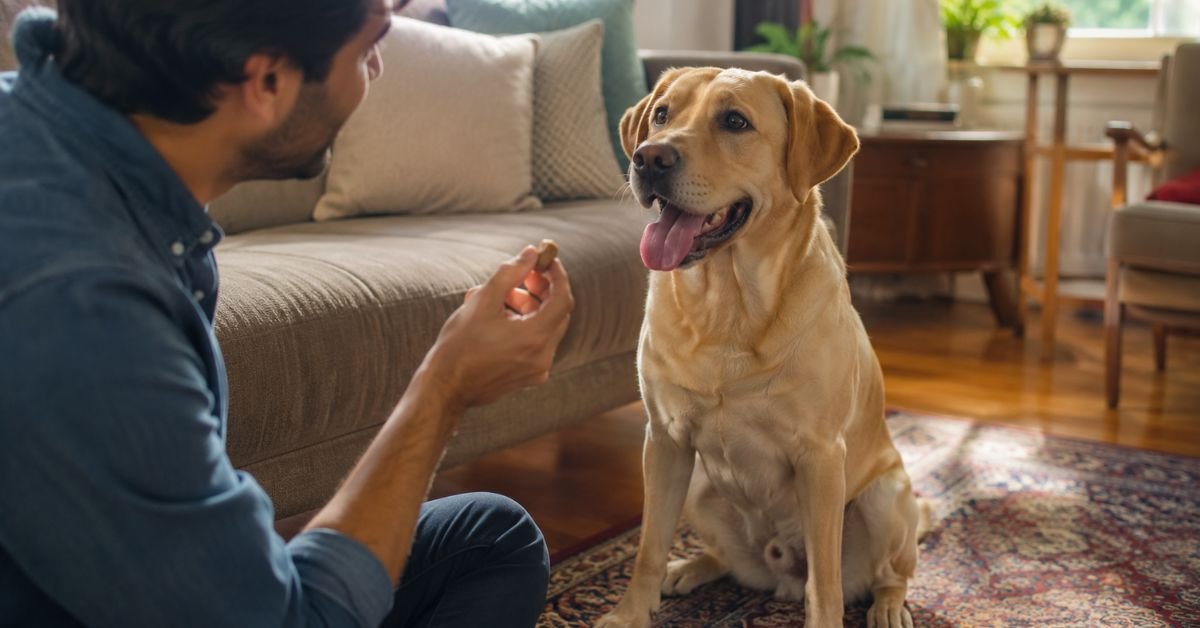
When my Lab, Bruno, was about five months old, he ate the corner off my couch cushion, dragged a fully loaded diaper bag across the yard, and then looked at me like he’d had a rough day. That’s the training tips for Labrador retriever experience in a nutshell chaos wrapped in a wagging tail., and understanding what’s actually driving the behavior in front of you, not just suppressing it.
Quick summary: Labs respond best to reward-based, cooperative training rather than dominance-based correction. Start socialization early but keep it calm and controlled, redirect chewing instead of punishing it, build recall through layered distraction exposure, and use short daily sessions rather than one long weekly class.
Labs are not “easy” dogs. They’re smart, sensitive, food-obsessed, and built with an engine that doesn’t have an off switch until year three. The good news? Once you understand how their brain actually works, training stops feeling like a battle and starts feeling like teamwork.
Why Old-School Methods Are Failing Modern Labs
Quick answer: Correction-based training (leash pops, dominance theory, forced compliance) tends to backfire with Labs because they’re naturally eager to please and highly food/social motivated. Force-free, cooperative methods produce faster learning, lower anxiety, and better long-term reliability.
A decade ago, “training” meant leash corrections and dominance theory. Walk into any 2026 training facility now and you’ll hear a different language entirely cooperative care, consent-based handling, and force-free reinforcement.
Here’s why that shift matters for Labs specifically:
- They’re people-pleasers by nature, so punishment tends to create anxiety, not obedience.
- Their retriever instincts respond far better to redirecting behavior than suppressing it.
- Modern research shows fear-based training increases reactivity in high-drive breeds like Labs.
I switched from correction-based training to reward-based methods with my second Lab, Daisy, and the difference was night and day. She learned faster, trusted me more, and stopped shutting down during sessions.
The Cooperative Care Shift
Cooperative care means your dog has a say. Instead of forcing a nail trim, you teach a “chin rest” cue so your dog opts in.
This isn’t fluffy nonsense it builds a dog who trusts your hands, your vet, and your groomer instead of tolerating them through gritted teeth.
Smart Tech Is Actually Useful Now (Not Just a Gimmick)

Quick answer: AI-driven puzzle feeders, reinforcement-tracking apps, and smart activity collars help fill the gap between formal training sessions by keeping a Lab’s brain engaged throughout the day, not just during scheduled practice.
I was skeptical of tech-assisted training for years. Then I tried an AI-powered puzzle feeder with Bruno during a particularly destructive chewing phase, and it genuinely changed our routine.
Tools worth considering in 2026:
- AI-driven puzzle feeders that adjust difficulty based on how fast your dog solves them, keeping high-energy Labs mentally tired instead of just physically exhausted.
- Positive reinforcement tracking apps that log training sessions, so you can spot patterns (like your Lab losing focus after 8 minutes, every single time).
- Smart collars that monitor activity levels, helping you tell the difference between “needs a walk” and “needs a nap.”
None of this replaces hands-on training. But it fills the gaps between sessions, which for a Lab’s brain, matters more than people realize.
Puppyhood Socialization: Beyond the Basics

Quick answer: Effective Lab socialization means short, calm, controlled exposures to new people, animals, and environments not overwhelming crowds. Quality of exposure matters far more than quantity.
.
Quality Over Quantity
Dragging your puppy to a crowded dog park isn’t socialization it’s sensory overload. I learned this the hard way with Daisy, who came home from her first “puppy meetup” shaking and refusing to eat dinner.
Instead, aim for:
- Short, calm exposures to new environments (5-10 minutes, not an hour)
- Controlled introductions to one or two calm dogs at a time
- Letting your puppy observe from a distance before engaging
The Underrated Skill: Novelty Tolerance
Labs who grow into confident adults aren’t just exposed to things they’re taught that new, weird, unexpected stuff is safe.
Try this: rotate random objects in your yard weekly (a folding chair, an umbrella, a bike). Let your puppy investigate on their own terms. This builds resilience that basic “meet strangers” socialization skips entirely.
Handling the Infamous Labrador Energy

Quick answer: Structured mental and physical activity not endless running is what actually settles a high-energy Lab. Pair short training bursts with scent games and impulse-control drills for lasting calm.
If you’ve ever wondered why your six-month-old Lab still acts like a puppy, you’re not alone Labs don’t fully mentally mature until 2 to 3 years old.
Structured Energy Beats Random Exercise
A tired Lab isn’t necessarily a well-behaved Lab. I used to run Bruno for an hour thinking it would calm him down. It just built his stamina.
What actually worked:
- Swapping pure exercise for structured games fetch with a “drop it” cue mid-play, not just mindless ball-throwing
- Adding scent work (hiding treats around a room) to tire the brain, not just the legs
- Using short, frequent training bursts (5 minutes, several times a day) instead of one long session
The 3-Second Rule
Before letting your Lab do anything they want greet a guest, jump in the car, chase a squirrel ask for 3 seconds of calm first. Sit, eye contact, whatever works. This tiny habit rewires impulsivity over time far better than one big “obedience class” ever will.
Mouthiness and Chewing: The Truth Nobody Tells You
Quick answer: Chewing is a genetic instinct in Labs, not defiance. Redirect it with rotating chew textures and “trade up” exchanges instead of punishing it punishment doesn’t address the underlying drive.
When my Lab first tried to chew through my favorite running shoes, I panicked and assumed something was wrong with him. Turns out, it’s just… being a Lab.
Labs were bred to carry things in their mouths. Chewing isn’t misbehavior it’s a genetic itch that needs scratching, literally.
What Actually Reduces Chewing
- Texture rotation: Labs get bored of the same chew toy fast. Rotate 3-4 textures weekly (rubber, rope, nylon, frozen treats).
- “Trade up,” not “take away”: Instead of yanking something from their mouth, offer a higher-value item in exchange. This prevents resource guarding down the line.
- Frozen enrichment: A frozen washcloth with broth is a game-changer during teething months.
Punishing chewing rarely works because it doesn’t address the actual need. Redirect it, don’t suppress it.
Advanced Mental Stimulation (Once Basics Are Down)

Quick answer: Once foundational cues are solid, give your Lab an actual “job” scent work, object retrieval by name, or simple household tasks using a structured weekly progression rather than random enrichment.
Once your Lab has the fundamentals, generic training tips stop being enough. This is where most owners plateau and where most Labs start getting “difficult” out of sheer boredom.
Try Job-Based Training: A Step-by-Step Progression

Labs were bred as working dogs. Give them an actual job and behavior problems often shrink on their own. Here’s a realistic four-week progression rather than a vague suggestion:
- Week 1: Teach “find it” with a single hidden treat in one room. Aim for 5 repetitions per session, twice a day, until your Lab locates it in under 10 seconds consistently.
- Week 2: Introduce a second scent target (a specific toy) and hide both in the same room. Reward only the correct item by name to build discrimination.
- Week 3: Assign one household “task,” such as carrying a small item (like the mail) from the door to a designated spot. Break it into three sub-steps: pick up, carry, drop at target.
- Week 4: Rotate between 2-3 established “jobs” across the week one scent game, one object-name task, one carry task spending no more than 10 minutes per session to avoid mental fatigue.
Track progress with a simple log (success rate out of 5 attempts) so you can see genuine improvement rather than guessing.
Name Recognition for Objects
Labs are shockingly good at learning object names some research-documented dogs know 100+ words. Start with two toys with very different textures and names, run 10 repetitions per session, and only add a third object once your Lab correctly selects between the first two at an 80% success rate or higher across three consecutive sessions.
Reading Your Lab’s Body Language (Most Owners Miss This)
Quick answer: Most training setbacks are communication failures, not stubbornness. Watch for whale eye, lip licking, and head-turning away from treats these signal stress, not disinterest.
Here’s something that took me embarrassingly long to learn: most “behavior problems” are actually communication problems. Your Lab is telling you things constantly you just have to know what to look for.
Signs Your Lab Is Overwhelmed, Not Being Stubborn
- A sudden “whale eye” (whites of the eyes showing) during handling or nail trims
- Lip licking or yawning when nothing is tired or hungry about the moment
- Turning their head away from a treat they’d normally snatch instantly
When Daisy started refusing treats during grooming sessions, I assumed she was just being picky. It took a trainer pointing out her tucked tail and stiff shoulders for me to realize she was stressed, not disinterested. Once we slowed down and added breaks, the “pickiness” disappeared.
Why This Matters for Training
If you push through stress signals with more repetition or higher-value treats, you’re not training faster you’re just teaching your Lab to mask discomfort. That’s how “randomly reactive” dogs get made. Reading the early signals and backing off is often the fastest way to actually make progress.
A simple habit that helps: film short clips of your training sessions occasionally. Watching them back in slow motion reveals tension and hesitation that’s easy to miss in real time.
Building a Reliable Recall (The Skill That Actually Saves Lives)
Quick answer: Reliable recall requires layered distraction training across multiple environments, a reward hierarchy better than the environment’s distractions, and a dedicated “emergency” cue reserved only for the highest-value reward.
Sit and stay get all the attention, but recall is the command that matters most, especially for a breed as prone to chasing birds, squirrels, and mysterious smells as Labs are.
Why Standard Recall Training Fails
Most people practice recall in low-distraction environments, get a few successes, and assume it’s “done.” Then their Lab bolts after a rabbit at the park and ignores every call. The gap between backyard recall and real-world recall is where most training falls apart.
Build it in four measurable stages:
- Stage 1 (Indoors, no distractions): Practice 10 reps per session until you get a 9/10 success rate across three sessions.
- Stage 2 (Backyard, mild distractions): Repeat the same 9/10 benchmark before progressing. Use a long line for safety.
- Stage 3 (Quiet public space, moderate distractions): Drop your success threshold expectation to 7/10 initially, and keep a long line attached until consistency returns to 9/10.
- Stage 4 (Busy park or trail, high distractions): Only attempt off-leash recall here once Stage 3 is consistently reliable across at least five separate outings.
The Emergency Cue Trick
Train a separate, rarely-used “emergency recall” word that’s only ever followed by the best reward imaginable think small pieces of grilled chicken or cheese, never regular kibble. Practice it just 2-3 times a month in low-stakes situations so the word stays powerful and never gets diluted by everyday use.
Consistency: The Unsexy Secret That Actually Works
Quick answer: The biggest predictor of a well-trained Lab isn’t the method used it’s whether every household member applies the same rules and cues every time.
Nobody wants to hear this part, but it’s the truth: the biggest difference between a well-trained Lab and a chaotic one usually isn’t the method. It’s consistency.
- Every family member needs to use the same cues and same rules
- “Sometimes okay on the couch” reads to your Lab as “always worth trying”
- Training doesn’t stop after puppy class it’s a lifestyle, not a course
I’ve seen more Labs struggle from mixed signals at home than from any actual training gap.
Final Thoughts on Raising Your Perfect Lab
Labrador Retrievers aren’t hard to train because they’re stubborn they’re hard to train because they’re intelligent, sensitive, and full of energy that needs direction, not suppression. The dogs I’ve raised taught me that patience beats punishment every time, and connection beats control.
If you take nothing else from this, take this: meet your Lab where they are, use tools (tech or otherwise) that support cooperation, track your progress instead of guessing at it, and stay boringly, wonderfully consistent. That’s really the whole secret.
Frequently Asked Questions
At what age should I start training my Labrador puppy?
You can start the moment they come home, usually around 8 weeks. Keep sessions playful and under 5 minutes at that age focus on name recognition and basic focus before formal commands.
Why does my Labrador ignore commands he clearly knows?
Usually it’s not defiance it’s distraction or insufficient reinforcement history in that specific environment. Practice known commands in new, distracting locations to build reliability, not just at home.
Are AI puzzle feeders actually worth buying for Labs?
For high-energy or food-motivated Labs, yes. They provide mental stimulation that slows down fast eaters and reduces boredom-driven destructive behavior, especially during teething or adolescence.
How do I stop my Lab from jumping on guests?
Teach an incompatible behavior, like a hand-target or sit-stay at the door, and practice it with low-distraction guests first. Punishing jumping without teaching an alternative rarely sticks long-term.
Is it too late to fix bad habits in an adult Labrador?
Never. Labs remain highly trainable well into adulthood. It may take more repetition than with a puppy, but with consistency and positive reinforcement, most habits can be reshaped.
L