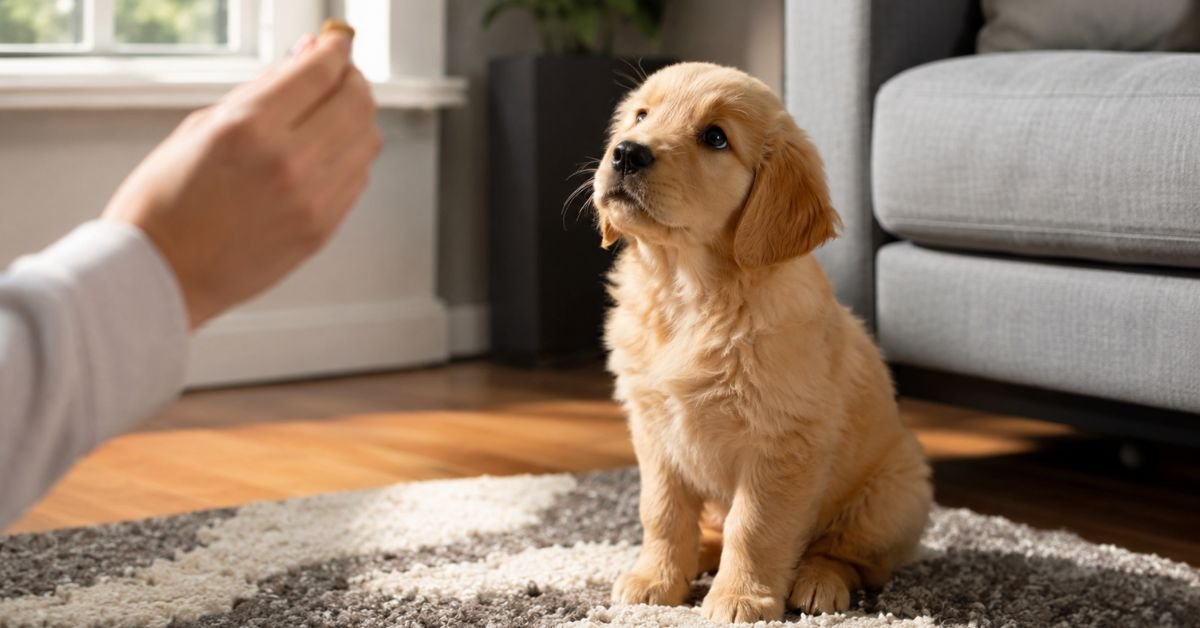
Training tips for golden retriever puppies work best when they combine force-free positive reinforcement, structured socialization, and modern mental enrichment. Below is a complete, step-by-step 2026 roadmap covering every stage of training, from the first week home through advanced enrichment.
If you’ve just brought home a Golden Retriever puppy, welcome to the beautiful chaos one minute they’re napping like a velvet loaf, the next they’re stealing a sock at full sprint. In my experience, owners who struggle most simply don’t have a plan yet. This guide gives you one.
What Is Force-Free Training and Why Does It Matter in 2026?
Force-free training tips is a method that uses only positive reinforcement rewarding desired behaviors while avoiding pain, fear, or intimidation to correct unwanted ones.
Key shifts defining 2026 training standards:
- Positive reinforcement is the default, not an alternative approach, backed by decades of behavioral science showing it produces faster, more durable results than correction-based methods.
- Smart pet tech supports consistency, including app-connected clickers, automated treat dispensers, and AI habit-tracking tools.
- Enrichment is treated as essential, not optional mental stimulation is now considered as important as physical exercise.
When I trained my own Golden, Bodhi, I assumed “sit” and “stay” were the whole job. They’re the opening scene, not the finale.
Puppyhood Essentials: Building the Foundation (8 to 16 Weeks)

The 8 to 16 week window is a critical socialization and learning period during which a puppy’s brain forms lasting behavioral associations.
Step-by-step foundation plan:
- Load a marker signal. Pair a clicker or the word “yes” with a treat 20–30 times a day with zero behavioral expectation, until your puppy’s ears perk at the sound alone.
- Teach name recognition. Say your puppy’s name; the instant they look at you, mark and reward. Repeat across different rooms and distraction levels.
- Teach a hand touch. Present your palm a few inches away; when your puppy’s nose bumps it, mark and reward. This single cue later supports recall, redirection, and loose-leash walking.
- Teach sit. Hold a treat above your puppy’s nose and move it slightly back over their head; as their rear lowers, mark and reward.
- Keep sessions to 5 minutes, 2–3 times daily. Puppy attention spans are short, and brief, high-success sessions build confidence faster than long ones.
Personal Pro-Tip: I loaded Bodhi’s clicker for two full days before asking him to do anything. It felt slow, but once he understood “click means treat,” teaching sit took about four minutes.
Socialization in the Modern World: A Complete Checklist

Socialization is the structured, positive exposure of a puppy to new sounds, surfaces, people, animals, and environments during their critical developmental window (roughly 3–14 weeks).
The 2026 Socialization Checklist:
- Surfaces: grass, gravel, tile, metal grates, sand, wood decking
- Sounds: vacuum cleaners, traffic, thunder recordings, doorbells, fireworks (recorded, low volume)
- People: children, people with hats/umbrellas/beards, people using mobility aids
- Animals: calm, vaccinated, well-matched dogs; cats; other household pets
- Environments: vet clinic lobby, pet store, car rides, elevators, busy sidewalks
How to run a socialization session, step by step:
- Choose one new stimulus per outing to avoid overwhelming your puppy.
- Keep initial exposure at a distance where your puppy notices the stimulus but stays relaxed (loose body, soft ears, willing to take treats).
- Mark and reward calm curiosity the moment your puppy notices the new stimulus.
- Gradually decrease distance over multiple sessions, always staying below your puppy’s stress threshold.
- End each session on a successful, low-stress note never push past visible fear or shutting down.
2026 tool tip: Habit-tracking apps now let you log socialization exposures like a checklist, which quickly reveals gaps. We discovered Bodhi hadn’t met a man with a beard until week 14 an easy fix once we saw the gap.
Leash Training: The Complete Step-by-Step Method

Loose-leash walking is a trained behavior in which a dog walks beside or near their handler without pulling against leash tension.
The “Be a Tree” Method full walkthrough:
- Start indoors or in a low-distraction yard. Attach the leash and let your puppy explore while you stand still.
- Take one step forward. If the leash stays slack, mark and reward immediately.
- Stop the instant you feel tension. Do not pull back or move forward simply become a statue.
- Wait for slack. The moment your puppy turns toward you or takes a step back even briefly mark and reward.
- Resume walking only when the leash is loose again. Repeat steps 2 to 4 continuously.
- Add distractions gradually a new smell, another person, a passing dog once your puppy is reliable in low-stimulation settings.
- Increase duration slowly, moving from 5-minute yard sessions to full neighborhood walks over 2 to 4 weeks.
Equipment guidance:
| Equipment | Recommended? | Why |
| Front-clip harness | Yes | Reduces pulling leverage without pain |
| Flat collar | Situational | Fine once loose-leash walking is established |
| Choke/prong/shock collar | No | Linked to increased anxiety and leash reactivity |
| Retractable leash | No, during training | Prevents consistent leash-tension feedback |
Personal Pro-Tip: Our walks used to take 45 minutes because we stopped every ten feet. Frustrating in the moment but within three weeks, Bodhi was walking beautifully beside me.
Advanced Mental Stimulation: The 2026 Enrichment Shift

Enrichment training refers to structured mental and sensory activities — separate from obedience that satisfy a dog’s instinctual needs and reduce boredom-driven behavior problems.
Core enrichment activities, ranked by ease of setup:
- Snuffle mats / puzzle feeders turn mealtime into a 10–15 minute mental workout instead of a 90-second inhale.
- Scent work (“find it”) hide 5 to 10 treats around a room; release your dog to search. Start easy, increase difficulty over sessions.
- Decompression walks 30–45 minutes on a long line (15–30 ft) in a low-traffic natural area, with no commands, allowing free sniffing.
- Frozen food puzzles stuff a food toy and freeze it for a longer-lasting, self-soothing activity.
- Smart treat dispensers app-connected devices that let you remotely reward calm behavior or run short training games while away.
Personal Pro-Tip: On rainy days, a 15-minute “find it” game leaves Bodhi just as pleasantly tired as an hour-long hike.
Handling Jumping, Nipping, and Zoomies
These three behaviors are the most common Golden Retriever training challenges, and each has a specific, force-free correction protocol.
Jumping 3-step fix:
- Turn away and withhold all attention the instant paws leave the ground.
- Reward four-on-the-floor generously, every time.
- Teach sit-for-greeting as an incompatible replacement behavior.
Nipping 3-step fix:
- Redirect the mouth onto an appropriate chew toy immediately.
- Use a short, calm “ouch,” then briefly pause play — mimicking littermate feedback.
- Never apply physical correction; it tends to escalate mouthing rather than reduce it.
Zoomies how to handle them: Zoomies are a release of pent-up energy, not misbehavior. Provide a safe space to run it out, and treat frequent zoomies as a signal to schedule more physical or mental exercise earlier in the day.
Common Training Mistakes That Slow Progress
Even well-intentioned owners can accidentally sabotage training. Recognizing these patterns early saves months of frustration.
- Training sessions that are too long. Puppies under 6 months typically lose focus after 5 to 10 minutes; pushing past that builds frustration rather than learning.
- Inconsistent cues. Using “down,” “off,” and “no jumping” interchangeably confuses dogs pick one word per behavior and have every household member use it.
- Rewarding too late. A reward given more than 1–2 seconds after the behavior often reinforces whatever the dog is doing then, not the original behavior this is why a marker (clicker or “yes”) matters so much.
- Skipping generalization. A puppy who sits reliably in the kitchen may not sit at the park; behaviors need to be re-taught across new locations, distances, and distraction levels.
- Punishing fear-based behavior. Growling, barking, or retreating from a scary stimulus is communication, not defiance punishing it tends to suppress the warning signal without resolving the underlying fear.
Personal Pro-Tip: Early on, I corrected Bodhi for growling at the vacuum instead of pairing the vacuum with treats. He got quieter about his fear, but not less afraid a mistake I didn’t repeat.
Building a Weekly Training Schedule
A structured weekly rhythm helps ensure training, socialization, and enrichment all get consistent attention rather than happening randomly.
Sample weekly structure for a 3–6 month old puppy:
- Daily (every day): 3 short obedience sessions (5 minutes each), 1 enrichment activity (puzzle feeder or scent game), leash practice during at least one walk
- 3x per week: A dedicated socialization outing to a new environment or with a new controlled stimulus
- 1–2x per week: A longer decompression walk on a long line in a low-traffic natural setting
- Ongoing: Logging sessions in a habit-tracking app to spot patterns in energy, focus, and problem behaviors
This rhythm keeps training sustainable for you and appropriately paced for your puppy’s developing attention span.
Conclusion: Trust the Process
Training a Golden Retriever isn’t about robotic obedience it’s about building trust and communication over time. Some days will feel like breakthroughs; others will feel like your puppy forgot everything you taught them. Both are normal.
Lean on force-free methods, use 2026’s smart tools to stay consistent, and don’t underestimate a well-timed puzzle toy or decompression walk. With patience, you’ll end up with a companion who’s not just well-trained, but genuinely happy and so will you.
Frequently Asked Questions
1. At what age should I start training my Golden Retriever puppy?
Start the moment you bring them home, typically around 8 weeks, focusing on marker training, name recognition, and gentle socialization rather than formal obedience.
2. How long does it take to fully train a Golden Retriever?
Basic manners are usually solid within a few months of consistent daily practice, but full behavioral maturity often isn’t reached until 2–3 years of age.
3. Are Golden Retrievers easy to train?
Yes, generally their food motivation and eagerness to please make them highly responsive to positive reinforcement, though consistency and mental stimulation are essential given their energy levels.
4. What’s the best training method for Golden Retrievers in 2026?
Science-based, force-free positive reinforcement is current best practice, often supported by smart tools like automated treat dispensers and AI habit-tracking apps.
5. How much daily training and exercise does a Golden Retriever puppy need?
Several short training sessions (5–10 minutes each) throughout the day, combined with age-appropriate exercise and enrichment like puzzle feeders or scent games.
6. Do I need a professional trainer, or can I train my Golden Retriever myself?
Most basic and intermediate training can be done at home using force-free methods; a certified professional is recommended for specific issues like leash reactivity, resource guarding, or severe anxiety.