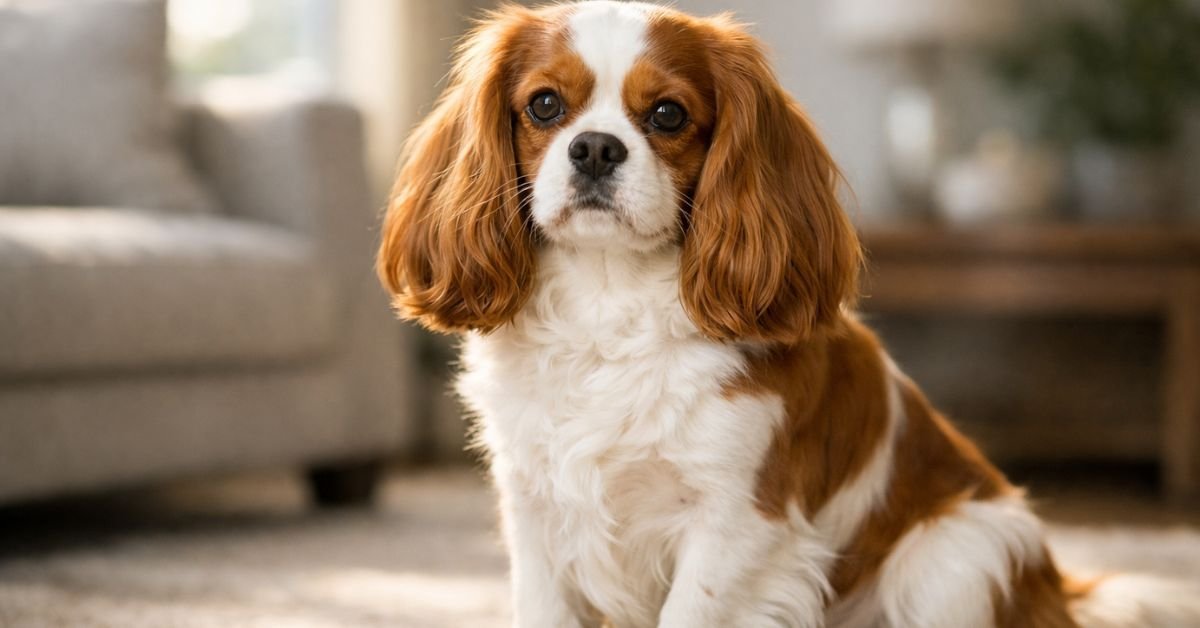
The Cavalier King Charles Spaniel is a small, silky-coated companion breed originally developed for British royalty and now consistently ranked among the most popular family dogs worldwide. Weighing 12 to 18 lbs with a gentle, people-first temperament, the Cavalier adapts equally well to apartments and large homes.
What most first-time owners underestimate: this breed requires early socialization, consistent positive-reinforcement training, and a structured grooming routine to stay confident and healthy. Skip any one of these three pillars and even the sweetest Cavalier can develop anxiety, matted fur, or behavioural problems.
This guide covers all three with a week-by-week socialization table, breed-specific grooming tool breakdown, and a training method proven to work with emotionally sensitive dogs.
Quick Breed Reference:
| Feature | Detail |
| Weight | 12–18 lbs (5.4–8.2 kg) |
| Height | 12–13 inches at shoulder |
| Lifespan | 9–15 years |
| Energy Level | Moderate |
| Trainability | High |
| Grooming Needs | Moderate to High |
| Good with Kids & Pets | Excellent |
What Is a Cavalier King Charles Spaniel’s Temperament?
A Cavalier King socialization guide temperament is defined by three core traits: unconditional affection toward humans, low aggression toward other animals, and high sensitivity to tone and environment. Unlike many toy breeds, the Cavalier is not independent or stubborn it is wired to follow human cues, which makes it both highly trainable and prone to separation anxiety when left alone for extended periods.
This emotional sensitivity is the lens through which all training and socialization decisions should be made. Loud corrections, rough handling, or chaotic environments do not produce a well-adjusted Cavalier they produce a fearful one.
Temperament comparison by breed type:
| Trait | Cavalier | Chihuahua | Pomeranian |
| Bonds with one person | No — bonds with everyone | Often yes | Sometimes |
| Tolerates alone time | Poorly | Moderate | Moderate |
| Responds to correction | Shuts down | Pushes back | Pushes back |
| Child-safe | Excellent | Moderate | Moderate |
| Trainability | High | Moderate | Moderate |
Cavalier King Charles Spaniel Socialization Schedule (Weeks 8–20)

A Cavalier King Charles Spaniel socialization schedule is a week-by-week plan of controlled exposure to people, animals, surfaces, and environments during the critical developmental window between 8 and 16 weeks of age the period when the puppy brain processes new experiences without a fear default.
Missing or mishandling this window is the single most common reason adult Cavaliers develop anxiety. Every new experience during this period should be paired with a high-value treat and end before the puppy shows stress signals (yawning, lip-licking, tucked tail).
Week-by-Week Cavalier Socialization Table
| Age (Weeks) | Priority Exposures | Environment | Success Marker |
| 8–9 | Family members, handling (ears, paws, mouth), household sounds | Home only | Puppy stays relaxed during full-body touch |
| 10–11 | New adult visitors, children, car rides, crate and collar introduction | Home + yard | Enters crate voluntarily for treats |
| 12–13 | Vaccinated dogs, puppy classes, varied outdoor surfaces (grass, gravel, tile) | Controlled public spaces | Plays or sniffs calmly with one unknown dog |
| 14–15 | Bicycles, strollers, joggers, café patios, umbrellas | Low-traffic outdoor areas | Neutral body language near moving objects |
| 16–17 | Vet clinic (non-exam visit), grooming salon introduction, stairs, elevators | Vet + groomers | Accepts groomer handling without trembling |
| 18–20 | Crowds, off-leash safe areas, thunderstorm desensitization audio | Dog-friendly public events | Recovers quickly after mild startle |
Rule of 100: Before 16 weeks, aim for 100 positive exposures across people, places, animals, sounds, and surfaces. Keep a written checklist.
Positive Reinforcement Training for Cavalier King Charles Spaniels
Positive reinforcement training for Cavaliers involves rewarding desired behaviors with high-value treats and praise immediately, as this sensitive breed shuts down under physical or verbal correction. Unlike terriers or working breeds that can tolerate leash pressure or raised voices, the Cavalier reads negative feedback as a threat and stops offering behavior altogether.
Training session rules for this breed:
- Sessions: 5–7 minutes, twice daily
- Reward timing: Within 1–2 seconds of the correct behavior
- Treat value: Rotate between chicken, cheese, and commercial soft treats to maintain engagement
- End rule: Always finish on a success, even if you simplify the criteria to guarantee it
The 5 Foundation Commands Cavalier Method

Sit: Hold a treat above the nose, move it slowly backward over the skull. As the hindquarters lower, mark with “Yes” and reward. Never push the back down luring produces faster, more reliable results in this breed.
Stay: From a reliable sit, take one step back, pause one second, return, reward. Add distance and duration in separate sessions never both at once.
Come: Practice in a hallway first. Crouch, use the dog’s name plus “Come,” reward with the highest-value treat you own every single repetition. Never call a Cavalier to you for anything unpleasant.
Leave It: Cover a low-value treat with your hand. The moment the dog pulls back and offers eye contact, say “Leave it” and reward from the other hand with something better.
Down: From sit, lower a treat from the nose straight to the floor between the front paws. Reward the moment both elbows touch the ground.
Common Cavalier-Specific Behavior Problems
| Problem | Cause | Fix |
| Separation anxiety | Breed-typical over-bonding | Practice absences from 8 weeks; 30 seconds → 5 minutes → 1 hour |
| Doorbell barking | Sound sensitivity | Desensitize by ringing bell repeatedly without opening door |
| Recall failure off-leash | Moderate prey drive | Never allow off-leash without 100% reliable indoor recall first |
Cavalier King Charles Spaniel Grooming Guide Tools and Technique
Cavalier King Charles Spaniel grooming requires a slicker brush, stainless steel comb, and pin brush used in sequence 3–4 times per week to prevent matting in the breed’s fine, single-layer silky coat. Without this routine, mats form within days fastest behind the ears, in the armpits, and between the toes.
The 6 Essential Grooming Tools

1. Soft-Pin Slicker Brush Primary Detangling Tool Used 3 to 4 times per week on the body, feathering, and ears. Choose soft pins, not firm pins break fine Cavalier hair and scratch the skin. Brush in the direction of hair growth in long strokes. Work section by section, always brushing down to the skin rather than skimming the surface.
2. Wide-Toothed Stainless Steel Comb Mat Detection Run after every slicker session. If the comb snags anywhere, there is a mat forming below the visible surface. Use the wide end first, finish with the fine end near the face. Grooming session is complete only when the comb runs freely through the entire coat.
3. Dematting Tool Established Mat Removal Apply detangling spray to the mat first. Work the tool from the outer edges inward, splitting the mat into smaller sections. Never pull through a mat with a slicker brush it is painful and can tear skin. Severely matted sections should be cut with rounded-tip scissors rather than ripped free.
4. Pin Brush Finishing and Shine Ball-tipped pin brush used after slicker and comb to lift, fluff, and polish the coat. Eliminates static, separates individual hairs, adds a clean finish.
5. Blunt-Tipped Grooming Scissors Neatening Only Trim fur between toe pads (prevents debris and slipping), tidy flyaways, and neaten foot edges. Never shave a Cavalier. The silky coat provides UV protection and thermal regulation; shaving permanently alters texture.
6. Ear Cleaning Solution + Cotton Balls Weekly Health Maintenance

The Cavalier’s long, feathered ears trap moisture and restrict airflow, creating a high-risk environment for yeast and bacterial infections. Clean weekly with a vet-approved solution. Never use cotton swabs. Redness, odor, dark discharge, or frequent head-shaking means a vet visit, not more cleaning.
Cavalier Grooming Frequency Table
| Task | Frequency | Tools |
| Full brush-out | 3–4x per week | Slicker brush + steel comb |
| Finishing pass | After each brush-out | Pin brush |
| Ear wipe | Weekly | Cleaning solution + cotton ball |
| Bath | Every 3–4 weeks | Dog shampoo + rubber curry brush |
| Nail trim | Every 3–4 weeks | Clippers or grinder |
| Toe fur trim | Monthly | Blunt scissors |
| Professional groom | Every 8–12 weeks | |
| Teeth brushing | 3x per week minimum | Enzymatic dog toothpaste |
Bathing: 4 Non-Negotiable Rules
- Brush fully before water water tightens existing mats into solid knots
- Rinse completely shampoo residue is the leading cause of post-bath itching
- Apply leave-in conditioner restores moisture and reduces future tangling
- Blow-dry on low heat while brushing air-drying causes matting and chills
Cavalier King Charles Spaniel Health The 3 Conditions Every Owner Must Know

Cavalier King Charles Spaniel health is shaped by three breed-specific conditions Mitral Valve Disease, Syringomyelia, and chronic ear infections that responsible owners monitor proactively rather than react to after symptoms appear.
Mitral Valve Disease (MVD): The most prevalent health issue in the breed. Studies indicate nearly all Cavaliers develop some degree of MVD by age 10. The mitral valve deteriorates over time, eventually leading to heart failure. Responsible breeders provide cardiac clearance certificates for both parent dogs. Annual cardiac auscultation by a veterinarian is essential from year one.
Watch for: exercise intolerance, nighttime coughing, labored breathing.
Syringomyelia (SM) / Chiari-Like Malformation (CM): A neurological condition where the skull is too small for the brain, causing a fluid-filled cavity in the spinal cord. Symptoms range from mild sensitivity around the neck to severe pain and altered gait. MRI is the only definitive diagnosis. Ask breeders for MRI screening records using the BVA/KC SM health scheme.
Watch for: phantom scratching (at air, not skin), neck sensitivity, unexplained crying.
Ear Infections: Entirely preventable with the weekly cleaning routine described above. Left untreated, chronic infections cause permanent hearing damage.
Health Screening Checklist When Buying From a Breeder:
| Health Test | Certifying Body | Both Parents Required? |
| Cardiac (MVD) clearance | OFA / BVA | Yes |
| MRI (SM/CM) screening | BVA/KC scheme | Yes |
| Hip evaluation | OFA | Yes |
| Eye certification | CAER / CERF | Yes |
Conclusion
A well-raised Cavalier King Charles Spaniel is the product of three things done consistently: socialization during the critical 8–16 week window, positive reinforcement training with short daily sessions, and a grooming routine built around the right tools in the right sequence. Add annual cardiac monitoring and weekly ear maintenance, and you have a dog that will be healthy, confident, and deeply attached to your family for the next 12–15 years.
Start early. Stay consistent. The Cavalier will do the rest.
FAQs
Q1: At what age should I start socializing my Cavalier King Charles Spaniel?
Start socialization at 8 weeks old the moment your puppy comes home. The critical window runs from 8 to 16 weeks. Experiences introduced during this period are processed without a fear default, making them far more effective than socialization attempted after 16 weeks.
Q2: How often should I brush a Cavalier King Charles Spaniel?
Brush your Cavalier 3 to 4 times per week using a soft-pin slicker brush followed by a stainless steel comb. This frequency prevents mat formation in the breed’s fine, single-layer silky coat particularly behind the ears, in the armpits, and between the toes where tangles develop fastest.
Q3: Do Cavalier King Charles Spaniels suffer from separation anxiety?
Yes. Cavaliers are hardwired to bond deeply with humans, making separation anxiety one of the most common behavioral issues in the breed. The fix is to practice short absences from puppyhood starting at 30 seconds and gradually building to longer periods so the dog learns that being alone is temporary and safe.
Q4: What is the most serious health problem in Cavalier King Charles Spaniels?
Mitral Valve Disease (MVD) is the most prevalent health concern, affecting nearly all Cavaliers to some degree by age 10. It causes progressive deterioration of the heart’s mitral valve. Annual cardiac checkups with a veterinarian are essential from year one, and buyers should always request cardiac clearance certificates for both parent dogs before purchasing a puppy.
Q5: Can you shave a Cavalier King Charles Spaniel in summer?
No. Shaving a Cavalier is not recommended under any circumstances. The breed’s silky coat provides UV protection and helps regulate body temperature in both heat and cold. Shaving can permanently alter the coat’s texture and actually makes the dog more vulnerable to overheating, not less. Regular brushing and professional trimming every 8 to 12 weeks is the correct warm-weather maintenance approach.