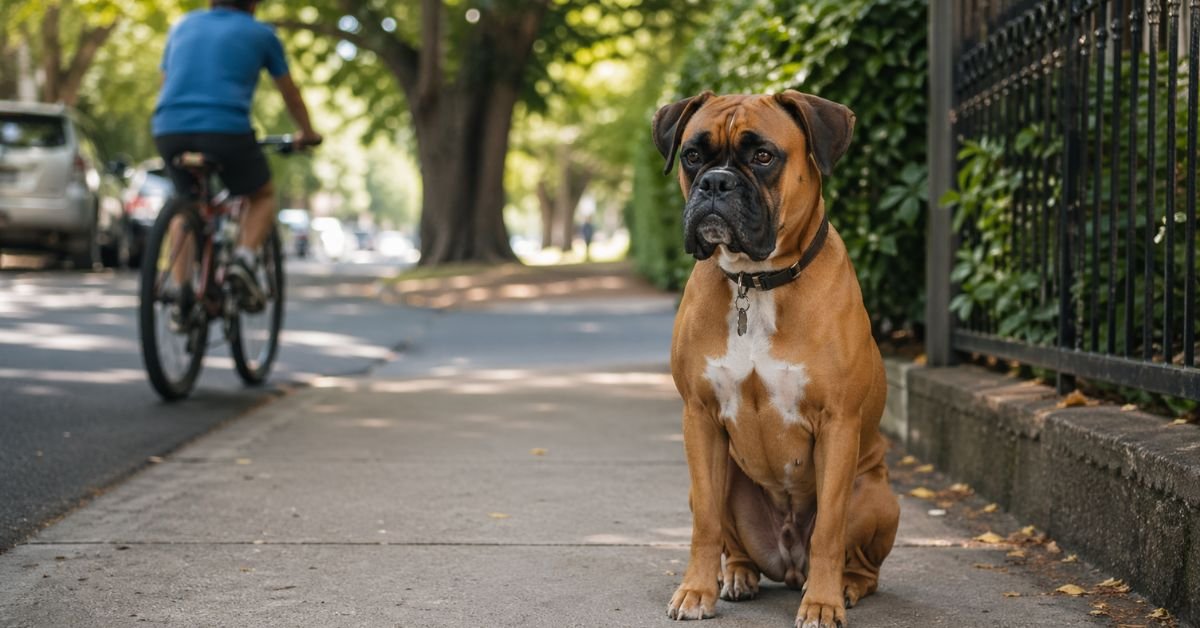
They call the Boxer the “Peter Pan” of the dog world and for good reason. These clowns in a dog suit never quite grow up, bouncing through life with a goofy grin and a heart full of chaos. But that same explosive, joyful energy that makes Boxers irresistible is also the reason standard socialization advice completely fails them.
Most guides tell you to “expose your dog to everything.” With Boxers, that’s a recipe for an over-stimulated, lunging, bouncing disaster. In 2026, the shift in professional canine behavioralism is clear: Neutrality Training teaches your Boxer to exist calmly near the world, not frantically engage with it is the gold standard.
The Critical Window: It Doesn’t End at 16 Weeks
Most owners hear “socialize before 16 weeks” and think the window slams shut after that. It doesn’t.
The primary socialization window (3–16 weeks) is critical for foundational exposure, yes. But Boxer dog socialization guide window that stretches from 4–14 months, and a tertiary reinforcement phase through 2 to 3 years of age. Skip those, and your well-socialized puppy becomes a reactive adolescent.
What Each Phase Requires
| Phase | Age Range | Focus |
| Primary Window | 3 – 16 weeks | Gentle exposure to people, sounds, surfaces, animals |
| Secondary Window | 4 – 14 months | Controlled distance encounters; building neutrality |
| Adolescent Reinforcement | 14 – 36 months | Maintaining calm under real-world distractions |
Key insight: boxer dog Socialization guide isn’t a checklist you complete it’s a lifestyle you maintain. A Boxer that was perfectly social at 10 weeks can regress significantly at 10 months without continued, intentional exposure.
The “Kidney Bean” Dance: Reading Boxer-Specific Body Language
If you’ve owned a Boxer, you know the move that full-body wiggle where their hindquarters swing toward their head in a literal kidney-bean shape. It looks adorable. To other dogs, it can look terrifying.
The problem: Boxers communicate with their entire body big, bold, fast movements. Many breeds (especially herding and terrier types) read this physicality as confrontational or chaotic, triggering defensive reactions.
Body Language Translation Table
| Boxer Behavior | What Boxer Means | What Other Dogs May Read |
| Kidney bean wiggle | “I’m SO happy to see you!” | Erratic, unstable energy |
| Hard direct stare | Neutral curiosity | Dominant challenge |
| Pawing at the face | Playful invitation | Rude, boundary-violating |
| Front-leg slam bow | “Let’s play NOW!” | Aggressive lunge |
What to do: During introductions, interrupt the kidney bean before it escalates. Call your Boxer to you, ask for a “sit,” reward the stillness, then allow a brief sniff interaction. Short, calm, controlled repeat.
The “Stare Problem”: When Your Boxer’s Face Causes Fight

Here’s what almost no one talks about: the Boxer’s brachycephalic (flat-faced) anatomy creates an optical illusion of dominance.
Because Boxers lack a pronounced muzzle, their eyes appear more forward-facing and their gaze more direct than most breeds. To a nervous Labrador or a status-conscious German Shepherd, that flat-faced direct stare can read as a hard challenge even when your Boxer is just curiously watching a butterfly.
- Never force a face-to-face greeting between a Boxer and an unfamiliar dog.
- Use parallel walking first: both dogs moving in the same direction at a distance of 10–15 feet.
- Allow sniffing only after both dogs show loose, wiggly body posture not stiff, forward-leaning tension.
- If another dog stiffens in response to your Boxer’s stare, redirect before the growl once vocalization starts, the encounter has already gone sideways.
The Boxer Paw Play Style: Bridging the Communication Gap

Boxers are notorious for using their front paws like hands. They bat, slap, scoop, and paw-punch their way through play hence the breed’s name, rooted in that boxing stance.
This play style is perfectly natural to another Boxer. To a Cavalier King Charles Spaniel? It’s an assault.
Bridging the Gap with Other Breeds
Step 1 Size-match where possible. For initial socialization, pair your Boxer with similarly-sized, high-energy breeds (Labradors, Vizslas, Standard Poodles) who can absorb the physicality without being overwhelmed.
Step 2 Teach “Four on the Floor.” Before any play session, reward your Boxer for standing calmly with all four paws on the ground for at least 5 seconds. This resets their arousal level.
Step 3 Use “play punctuation.” Every 30 to 60 seconds of play, call your Boxer out of the session, ask for a calm sit, then release them back. This prevents the arousal spiral that leads to Boxer play becoming Boxer bullying.
Step 4 Watch for “fun asymmetry.” If the other dog is consistently running away, hiding, or offering appeasement signals (lip licking, looking away, tucked tail), the play is one-sided. End it every time before the other dog’s owner has to.
Adolescent Socialization (8 to 18 Months): Navigating Fear Periods and Rebellion
This is where most Boxer owners lose the plot.
Between 8 to 11 months and again around 14 to 18 months, Boxers go through secondary fear imprint periods developmental phases where previously neutral stimuli can suddenly become terrifying, and previously social dogs can become reactive. Pair that with the Boxer’s adolescent “selective hearing” phase (they absolutely know their name; they’ve simply decided it’s optional), and you have a perfect storm.
Surviving the Adolescent Phase
- Do not push through fear responses. If your Boxer suddenly spooks at something they’ve seen 100 times, don’t drag them toward it. Back up, give distance, let them observe from a comfortable threshold.
- Increase management, not just training. Use longer leashes (20–30 ft long lines) to give the illusion of freedom while maintaining control during off-leash-style exploration.
- Keep socialization experiences positive and low-pressure. It is the time for structured parallel walks with one familiar, calm dog.
- Expect regression plan for it. A Boxer who was great with strangers at 6 months may be suspicious of men in hats at 12 months. This is normal. Treat it as a new training opportunity, not a failure.
Neutrality vs. Interaction: The Core Shift in 2026 Training

The old model said: expose your dog to everything and reward friendly interaction.
The 2026 model says: teach your dog that the world existing near them is not their business.
Neutrality Training means your Boxer learns that the presence of other dogs, strangers, bikes, skateboards, and children is simply information not a summons to engage.
The Stop-Go Method for Over-Excitement
This is the gold-standard fix for Boxers who lunge and bounce toward anything that moves.
- Walk toward the trigger (another dog, a person) at a distance where your Boxer notices but hasn’t yet fixated.
- The moment your Boxer pulls, stiffens, or locks eyes: STOP completely. Plant your feet. Say nothing.
- Wait. Do not repeat commands. Your Boxer will eventually check back in with you.
- The moment there is slack in the leash, say “yes” and take one step forward (toward the thing they want).
- Repeat: Any tension = full stop. Slack = forward progress.
The message becomes crystal clear: calm gets you closer; pulling gets you nowhere.
Over 2–3 weeks of consistent application, most Boxers learn that the fastest route to greeting is through composure.
Tactile & Sound Desensitization: Using 2026 Technology at Home
Between outdoor socialization sessions, the home environment is your most powerful training tool especially with modern technology.
Sound Desensitization Apps
Apps like iCalmDog, Adaptive Sound Technologies’ THROUGH A DOG’S EAR, and several AI-generated soundscape platforms now offer breed-specific desensitization protocols. Start sounds at barely audible levels (your Boxer should show zero reaction), reward calm behavior, and gradually increase volume over weeks not days.
Sounds to prioritize for Boxers:
- Crowds and party noise (Boxers are social creatures who often meet guests at full-force)
- Skateboard and bicycle wheels
- Children shrieking
- Thunderstorms and fireworks
- Veterinary office ambient sounds
Tactile Desensitization
Boxers are often sensitive about their paws, ears, and mouth being handled which becomes a major problem at the vet and groomer. Build a 10-minute daily body-handling routine:
- Touch each paw pad, between toes, nails
- Open the mouth gently and touch the gums
- Fold back each ear flap and look inside
- Run hands firmly along the spine, sides, and belly
Pair every touch with a high-value treat. Within 2–3 weeks, most Boxers tolerate full examinations without stress.
Safety & Health: Socializing Safely Around Boxer-Specific Risks

No socialization guide for Boxers is complete without addressing the elephant in the room: brachycephalic obstructive airway syndrome (BOAS).
Boxers cannot regulate their body temperature as efficiently as longer-muzzled breeds. During socialization outings especially high-excitement sessions they are at genuine risk of heatstroke and respiratory distress.
Non-Negotiable Safety Rules
- No outdoor socialization when temperatures exceed 24°C / 75°F without significant shade and water breaks every 10 to 15 minutes.
- Watch for the warning signs of overheating: excessive drooling, noisy/raspy breathing, blue-tinged gums, stumbling.
- Keep socialization sessions short: 15 to 20 minutes maximum for puppies, 30–40 minutes for adults in cool conditions.
- Avoid concrete and asphalt on warm days surface heat compounds ambient temperature rapidly.
- Carry a portable water bowl and offer water every 10 minutes during active outings.
- If your Boxer is recovering from any respiratory illness, pause all socialization outings until fully cleared by a vet.
- The Long-Term Payoff: What a Well-Socialized Boxer Looks Like

Invest in proper socialization and what you get is nothing short of extraordinary.
A well-socialized Boxer is:
- Calm on leash in the presence of other dogs, kids, and strangers not reactive, not lunging, not bouncing.
- Adaptable genuinely comfortable in cafes, parks, busy streets, and vet clinics.
- A breed ambassador. Boxers are powerful dogs, and a poorly socialized one reinforces every negative stereotype. A well-socialized one changes minds.
- Easier to manage for life reducing vet stress, boarding anxiety, and emergency handling complications.
The work is front-loaded. The reward pays dividends for 10 to 12 years. Start today.
Frequently Asked Questions
Q1: My Boxer gets along with female dogs but is aggressive with males. Is same-sex aggression normal?
Same-sex aggression (particularly male-to-male) is relatively common in Boxers and many working breeds. It often emerges at social maturity (around 18–24 months) even in previously friendly dogs. This is not a failure of socialization it’s a biological tendency that requires management and structured introductions, not forced interaction. Consult a certified professional dog trainer (CPDT-KA) who specializes in behavior if aggression is escalating. In some cases, dogs can learn to coexist peacefully; in others, management (keeping them separate) is the most humane solution.
Q2: My Boxer jumps on every guest. I’ve tried everything. What actually works?
The jumping is a greeting ritual your Boxer has self-reinforced for years. Telling guests to “ignore it” rarely works because the Boxer jumps on new stimuli, the guest moves, and the Boxer reads that movement as engagement.
What actually works:
- Management first: Use a leash inside the home for every guest arrival for 4–6 weeks.
- Teach an incompatible behavior: Ask for a “sit” or “go to your place” before the door opens. Reward heavily.
- Consistency is non-negotiable: Every person, every time. One “aww, it’s okay” from a guest undoes weeks of progress.
Q3: Can I use a dog park for Boxer socialization?
Dog parks are generally a poor socialization tool for Boxers for two reasons: First, the off-leash greeting style (dogs rushing at each other full-speed) bypasses all the calm, structured greeting protocols that teach a Boxer how to modulate their energy. Second, the Boxer’s physical play style frequently triggers reactive responses from smaller or less physical dogs, resulting in altercations that leave your Boxer more reactive, not less.
Better alternatives: structured playgroups with known, compatible dogs, parallel walks, and on-leash training around distractions.
Q4: At what age is it too late to socialize a Boxer?
It is never too late to begin but the process becomes longer and more incremental with older dogs. An under-socialized adult Boxer requires the same steps as a puppy (start at a distance, reward neutrality, build slowly), but with a more established nervous system pattern to work against. Progress measured in months rather than weeks is realistic. Working with a certified behaviorist (CAAB or DACVB) is strongly recommended for adult dogs showing fear or aggression.
Q5: My Boxer is friendly but constantly “mugs” other dogs by pawing at their face. How do I stop it?
This is the classic Boxer communication gap in action. The paw-to-face contact is a self-rewarding play invitation that your Boxer has discovered works at least on other Boxers. On most breeds, it provokes a snap or a scuffle.
The fix: Interrupt and redirect before the paw makes contact. As your Boxer begins to lift a paw toward another dog’s face, call them to you immediately, ask for a sit, reward it, then release for a brief sniff interaction (not another play session immediately). Over time, the sit-and-sniff replaces the paw-and-bounce as the default greeting behavior.