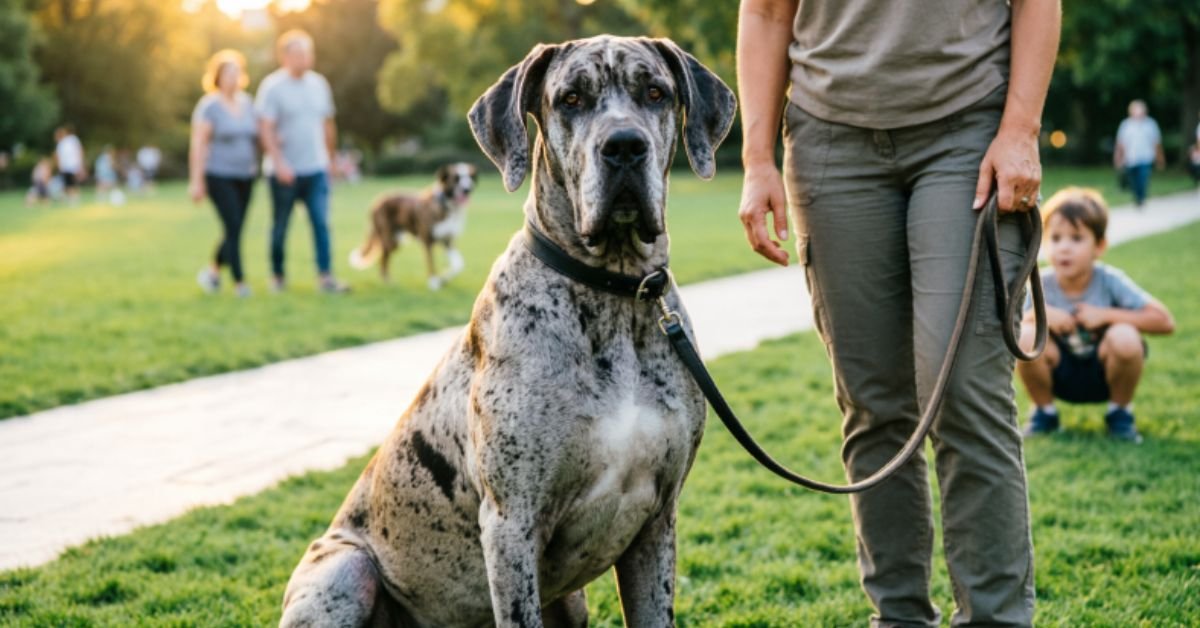
The socialization of Great Dane dogs is not merely a training recommendation, it is a critical health and safety protocol for one of the largest breeds on the planet. A well socialized Great Dane is a joy: calm, confident, and capable of navigating any environment without incident. A poorly socialized one, however, can become a 150-pound liability not out of aggression, but out of pure, unmanaged size and anxiety.
This guide provides a step by step roadmap for raising a confident, neutral, and gentle Great Dane from the first week home through adolescence and beyond.
The Gentle Giant Reality Why Socialization of Great Dane Dog Is High Stakes

The socialization of Great Dane dogs demands more intentionality than almost any other breed because the margin for error shrinks as the dog grows. What starts as a curious leap at 10 weeks becomes a chest height collision by 6 months.
Affectionately titled the “Apollo of Dogs” by the American Kennel Club, the Great Dane combines aristocratic dignity with enormous physical power. Males regularly reach 32–34 inches at the shoulder and weigh between 140–175 lbs. This sheer mass means that anxiety, fear, or reactivity behaviors manageable in a Border Collie can become genuinely dangerous in a Great Dane simply due to physics.
Key reasons socialization is non-negotiable:
- Size amplification: Every unwanted behavior jumping, pulling, bolting is amplified by mass. A Great Dane that panics at the vet can injure handlers.
- Developmental sensitivity: Great Danes have a compressed primary socialization window (8–16 weeks) but an unusually long adolescence (up to 3 years). Gaps in early exposure compound over time.
- Skeletal vulnerability: Rapid growth creates joint sensitivity. Chronic stress elevates cortisol, which negatively impacts bone development in giant breeds.
- Stranger interaction frequency: People approach Great Danes constantly. A calm, neutral dog is a breed ambassador; a reactive one creates dangerous situations.
The Socialization Window (8–16 Weeks): Low Impact Exposure Protocol

The socialization window between 8 and 16 weeks is the most neurologically plastic period in your Great Dane’s life. For giant breeds, the “Low-Impact” approach is essential; all exposures must be positive, controlled, and physically gentle on developing joints.
| Age / Week | Exposure Category | Recommended Activities | Joint-Safe Notes |
| 8–9 Weeks | Sounds | Vacuum cleaner from distance, TV, gentle music, doorbell recordings | Keep puppy on flat, non-slip flooring |
| 9–10 Weeks | Surfaces | Grass, carpet, tile, rubber mats short sessions only | No stairs; carry on transitions between levels |
| 10–11 Weeks | Sights & Strangers | Calm adults of varied appearances, hats, glasses, uniforms no crowds | Sit to greet; no jumping drills yet |
| 11–12 Weeks | Gentle Handling | Ear checks, paw holds, mouth opening, collar touches 2-min sessions | On raised non-slip surface or ground level only |
| 12–14 Weeks | Vehicle & Urban Sounds | Parked car exposure, city sounds via window no busy traffic | Short outings only; 5-min walk limit per month of age |
| 14–16 Weeks | Calm Dog Interactions | One on one with vaccinated, calm adult dogs no dog parks | Monitor for overstimulation; end on neutral note |
Critical Rule: Never force a puppy toward something that frightens it. A 5-minute positive session is worth more than a 30-minute stressful one.
Pro Tip: The Happy Vet Visit Protocol
The vet clinic is the most emotionally loaded environment your Great Dane will encounter. Build a positive association before any medical procedure is needed:
- Visit the clinic lobby 2–3 times before any appointment, no exam, just treats and praise.
- Ask staff to offer high-value treats (chicken, cheese) with no handling attached.
- Practice the weigh-in scale at home using a large bathroom scale and treats.
- Simulate stethoscope contact using a cold spoon on the chest pair with treats.
- Request a “consent check” approach from your vet: if the dog moves away, pause and allow re-approach.
Goal: Your Great Dane should walk into the clinic tail wagging, not trembling. An anxious giant breed dog is a genuine handling risk. Prevention is far easier than rehabilitation.
The ‘Gentle Pressure’ Rule: Socialization of Great Dane Dog on Leash

Teaching leash manners before your Great Dane is large enough to drag you is one of the most important investments you will make. The ‘Gentle Pressure’ Rule teaches the dog to yield to leash pressure not resist it before they reach the physical strength to overpower a handler.
Step-by-Step Protocol:
- Pressure and Release (Stationary): Apply gentle lateral pressure with two fingers. The moment the puppy steps even slightly toward you, release all pressure instantly and reward with a treat. Repeat 10 times per session.
- Follow the Feel Exercises: Apply gentle forward pressure. The instant the puppy steps forward, release and mark with “Yes!” Never jerk or haul. The lesson is: pressure predicts relief.
- Check-In Walking: Walk in silence. The moment your puppy makes eye contact with you, stop, reward, and praise. This builds orientation toward the handler, the antithesis of pulling.
- The Reverse Direction Drill: The instant the leash becomes taut not tight, taut calmly turn and walk in the opposite direction. The puppy learns that leash pressure means the walk stops, not intensifies.
- Introduce Public Environments Early: Practice on sidewalks, near traffic, in parking lots all with gentle pressure principles. A Great Dane that has never seen a skateboard at 12 weeks will react explosively at 18 months.
Equipment Note: Use a properly fitted martingale collar or front clip harness during early training. Never use prong collars, choke chains, or e-collars on a puppy.
Size Awareness & Manners: Four Paws on the Floor and the Great Dane Lean

Two of the most common behavioral challenges in the socialization of Great Dane dogs involve size management: jumping and the Great Dane Lean.
The ‘Four Paws on the Floor’ Drill:
- Foundation: Every greeting by every person, every time must begin with four paws on the floor. If one family member allows jumping, the behavior becomes nearly impossible to extinguish.
- Execution: Turn your back immediately the moment front paws leave the ground. Zero attention, no eye contact, no “No,” no touch. The instant all four paws return to ground, turn and reward warmly.
- Threshold Training: Teach the dog that the front door is a ‘wait’ zone. A Great Dane that automatically sits at doorways cannot simultaneously jump on guests.
- Visitors as Training Partners: Brief all visitors before entering. Hand them treats. Instruct: “If four paws are on the floor, reward. If they jump, turn away.”
Managing the Great Dane Lean:
The Great Dane Lean the breed’s tendency to press its full body weight against a person’s legs is affectionate in intent but hazardous in practice around elderly people or small children.
- Redirect, Never Punish: The lean is a bonding behavior. Reward the dog for standing beside you with four paws square no leaning by marking and treating that neutral body position.
- Station Training: Teach the dog to go to a designated mat near where you stand. The mat becomes the socially rewarded alternative to leaning.
- Structural Awareness Drills: Practice walking through narrow spaces (doorways, corridors) with the dog in heel position. This builds physical self-awareness.
Counter Surfing Socialization: Teaching Neutrality Around Food at Eye Level

A Great Dane’s nose is approximately at kitchen counter height. This creates a perpetual temptation that, if unaddressed, becomes one of the breed’s most persistent adult behaviors. Counter surfing is not stubbornness, it is an environmental opportunity meeting an unsocialized impulse.
- Management First, Training Always: Never leave accessible food on counters until this behavior is fully trained. One stolen chicken breast can undo weeks of training.
- Boundary Marking: Teach a clear ‘Out of Kitchen’ command using a visual boundary (tape line or baby gate threshold). Reward heavily every time the dog voluntarily moves out when asked.
- Leave It → Look At Me Sequence: Place low-value food at the counter edge. When the dog orients toward it, cue ‘Leave It,’ then redirect with ‘Look At Me.’ Reward the eye contact with higher-value treats than what is on the counter.
- Proofing in Context: Practice with food cooking, with guests present, and during meal preparation the highest-temptation contexts.
- Household Consistency: If any person ever feeds the dog from the counter, the behavior will persist. Food is delivered in the dog’s bowl at ground level always.
Joint Safety During Training: Critical Warnings for Giant Breeds

The socialization of Great Dane dogs must always account for the breed’s extraordinary skeletal vulnerability. Great Danes are highly susceptible to hypertrophic osteodystrophy (HOD), panosteitis, and osteochondrosis dissecans (OCD) all developmental joint conditions exacerbated by high-impact activity during puppyhood.
Joint Safety Non-Negotiables:
- NO STAIRS until 4 months minimum carry the puppy or use a ramp. Repeated stair use before growth plates close causes cumulative joint damage.
- NO JUMPING on or off furniture, cars, or people until 18–24 months. Growth plates in Great Danes do not fully close until this age.
- NO HARD SURFACES for long rest periods. Great Danes develop hygroma (fluid-filled elbow sacs) on hard flooring. Provide orthopedic foam bedding everywhere.
- WALK LIMITS: Apply the ‘5 minutes per month of age’ rule. A 3-month puppy = 15-minute walk maximum, twice daily. No jogging alongside a puppy under 18 months.
- NO FORCED RUNNING during play. Allow the dog to self-regulate pace. Chasing games on slippery surfaces are particularly high risk.
5 Common Giant Breed Socialization Mistakes

Mistake 1: Skipping Grooming Handling Socialization Many owners skip cooperative care training, nail trims, ear cleaning, tooth brushing, bathing because the puppy is compliant when small. By 14 months, a Great Dane that has never had calm grooming experiences becomes a 160-pound handling nightmare. Start touch desensitization at 8 weeks: hold paws, open mouth, touch ears always paired with treats.
Mistake 2: Over-Socializing with Small Dogs Too Quickly Rushing mixed-size dog introductions is a significant safety risk. A 12-week Great Dane already outweighs many adult small breeds. Clumsy puppy play can seriously injure a Chihuahua or toy breed. Use barrier introductions (through a gate), parallel walks, and supervised controlled meetings never dog park visits during puppyhood.
Mistake 3: Using Flooding Instead of Desensitization Flooding exposing a fearful dog to a stimulus at full intensity is both ineffective and damaging in giant breeds. A traumatic socialization experience can create fear based reactivity that is genuinely dangerous at adult weight. Always use systematic desensitization: start at a distance where the dog notices but does not react, then close the distance incrementally.
Mistake 4: Waiting Until Vaccinations Are Complete to Socialize The American Veterinary Society of Animal Behavior (AVSAB) is explicit: the risks of behavioral problems from under-socialization outweigh the risks of disease in appropriately managed environments. Puppy classes at reputable facilities and visits to vaccinated dogs’ homes should begin no later than 7–8 weeks.
Mistake 5: Treating Adolescent Regression as a Socialization Failure Between 6–18 months, Great Danes frequently experience fear periods and adolescent regression previously neutral stimuli become alarming, previously reliable commands become inconsistent. This is neurological, not willful. Lower criteria temporarily, increase reward frequency, and reduce exposure intensity until the dog stabilizes.
Final Word: A Gentle Giant Is Made, Not Born
The socialization of Great Dane dogs is the most important investment you will make in your dog’s quality of life and your own. A well-socialized Great Dane is one of the most magnificent companions imaginable: steady in any environment, gentle with every creature, and confident enough that the world does not frighten it.
That dog is built through consistent low impact exposures, cooperative care handling from week one, leash manners established before the dog can overpower you, and an owner who understands that this breed’s size demands a higher standard of behavioral investment than almost any other.
FAQs
Q: What is a Fear Period in Great Danes?
Great Danes commonly experience fear periods around 8–11 weeks and again at 6–14 months. During these windows, a single scary experience can imprint deeply. Reduce novelty, keep sessions positive and short, and never force the dog toward a trigger. Patience not flooding is your best tool.
Q: How do I socialize an older Great Dane that missed early windows?
Start with controlled, low-intensity exposures and pair each one with high value treats. Use a structured ‘Look at That’ protocol: reward the dog for noticing a trigger calmly without reacting. Work with a certified behaviorist (CDBC or CAAB) for dogs showing fear based reactivity. Progress will be slower but is absolutely achievable.
Q: My Great Dane puppy growled at a child. Is this normal?
A growl is communication, never punishment material. It signals the dog is uncomfortable. Identify the trigger, increase distance, and use desensitization. Punishing a growl removes the warning signal and increases bite risk. Consult a veterinary behaviorist immediately if behavior escalates.
Q: Can Great Danes live safely with small dogs?
Yes, with proper introductions. Begin with a barrier (baby gate), progress to on-leash parallel walks, then supervised off leash time. Never allow chase games until the Great Dane understands its size. Prey drive varies, always assessed individually.
Q: How often should I socialize my Great Dane puppy?
Aim for 3–5 short positive exposures per week, each 5–15 minutes. Quality far outweighs quantity. One overwhelmed puppy experience is more damaging than ten cancelled sessions. Watch for yawning, lip licking, or turning away these signal stresses and mean it’s time to stop.