The socialization of Bulldog is a medical necessity, not a behavioral preference and that distinction changes everything about how you approach it. A poorly socialized Bulldog doesn’t just become difficult at the dog park.
It becomes a dog whose chronic stress hormones suppress immune function, whose reactive episodes trigger dangerous respiratory events in a breed already compromised by Brachycephalic Obstructive Airway Syndrome (BOAS), and whose social anxiety actively shortens its lifespan. This 2026 roadmap gives you the breed specific, clinically grounded protocol to prevent that outcome.
The Stiff Gait Misunderstanding

The Stiff Gait Misunderstanding occurs when other dogs interpret the Bulldog’s genetically compressed skeletal frame as a threat posture not because the Bulldog is aggressive, but because its anatomy eliminates the fluid “neutral approach” signals that canine communication depends on.
Bulldogs have chondrodystrophic skeletal anatomy: a wide barrel chest, curved spine, and wide set limbs that force a heavy, rolling, frontal gait. A long muzzled dog uses a curved, head low, side-on approach to signal non threat. A Bulldog physically cannot do this. Its approach reads as stiff, direct, and loud three body language signals that trigger a defensive response in other dogs before any interaction even begins.
This is a biomechanical problem, and it demands a structural solution.
The Parallel Walking Protocol
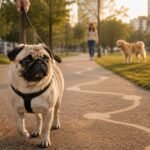
Parallel Walking is the evidence-based method for introducing a Bulldog to a new dog without triggering a threat response. Both dogs walk in the same direction, held by separate handlers, with no head-on orientation.
- Start 10–12 feet apart on Y-harnesses (never slip leads see Chapter 5), walking the same direction.
- Allow peripheral awareness only no direct eye contact, no full-body orientation toward each other.
- Walk for 5–7 minutes at a calm pace. Ground-sniffing (displacement behavior) is a good sign to let it happen.
- Reduce distance by 2 feet per session over 2–3 sessions, only when both dogs show loose, relaxed body posture.
- Allow a brief side-on sniff only after both dogs walk calmly at 3–4 feet apart.
Pro Tip: Walk with the wind at the dogs’ backs. Allowing scent to drift between them naturally is significantly less arousing than a direct nose-to-nose introduction especially important for Bulldogs, whose olfactory processing is already compromised by compressed nasal passages.
The 2026 Golden Window (8–16 Weeks)

The Bulldog socialization window is the 8-to-16-week period during which the brain’s neuroplasticity for accepting novelty as “safe” is at its peak and missing it produces compounding anxiety in a breed already predisposed to stress-driven reactivity.
The 2026 veterinary consensus adds a climate-conscious outdoor restriction: in regions with summer heat events above 28°C (82°F), all outdoor Bulldog puppy socialization must occur before 8 AM or after 7 PM, or move entirely to climate-controlled indoor spaces.
| Week | Focus Area | Recommended Surfaces | Duration | Key Goal |
| 8–9 | Household sounds, gentle handling, novel textures | Carpet, rubber mat, grass | 5–8 min | Neutral response to sound and touch |
| 10 | Gentle strangers (1–2 people), calm indoor dogs | Carpet, tile (brief) | 8–10 min | Positive human association |
| 11 | Outdoor textures grass and packed earth only | Grass, dirt, bark mulch | 10 min | Joint-safe proprioceptive exposure |
| 12 | Controlled puppy class (vaccinated, indoor, climate-controlled) | Indoor rubber flooring | 10–12 min | Parallel play, no rough wrestling |
| 13 | Novel objects: strollers, umbrellas, bicycles (stationary) | Grass, carpet | 10 min | Visual desensitization |
| 14 | Low-traffic public spaces: garden centers, pet-friendly patios | Grass + brief concrete | 12–15 min | Urban sound exposure |
| 15 | Structured child exposure (see Chapter 4) | Carpet, grass | 10 min | Positive child associations with clear boundaries |
| 16 | Review week repeat lowest-stress sessions from prior weeks | Mixed surfaces | 15 min | Reinforce without overwhelming |
Critical surface note: Until 16 weeks, a Bulldog’s growth plates are open and vulnerable. Concrete and asphalt should be transitional only, never a play surface. Extended hard-surface exposure at this age directly contributes to early onset elbow and hip dysplasia, a breed-elevated risk.
BOAS & The 24°C (75°F) Rule

BOAS (Brachycephalic Obstructive Airway Syndrome) makes overheating the number-one medical danger during Bulldog socialization, because the breed’s narrowed airways make panting the primary cooling mechanism structurally inefficient.
In a healthy dog, increased panting during excitement efficiently dissipates heat. In a Bulldog, the narrowed nares, elongated soft palate, and hypoplastic trachea mean that increased respiratory effort generates more heat than it removes. The result is a dangerous feedback loop that can escalate to heat stroke within minutes of play onset with no visible warning signs until the dog is already in crisis.
The 24°C (75°F) Rule
If ambient temperature exceeds 24°C (75°F), all outdoor Bulldog socialization must stop or move to an air-conditioned indoor environment. No exceptions.
This is a clinical protocol, not a guideline. In 2026, Bulldog specialist trainers increasingly use wearable core temperature monitors, clip-on telemetry devices that alert owners when body temperature approaches 39°C (102.2°F), the pre-danger threshold. These are now considered standard equipment for socialization programs in warmer climates.
For joint integrity: socialization must exclude jumping to greet, rough tumbling on hard surfaces, and repetitive forelimb impact the highest dysplasia risk movement pattern in the breed. Grass or rubber matting, with low impact, weight appropriate activity, is the 2026 evidence based standard.
Bulldogs & Children The Resource Guarding Reality

Resource guarding in Bulldogs around children occurs when a child approaches a Bulldog’s food, toys, or resting space without warning, triggering a hardwired protective response that bypasses trained behavior not because the dog is aggressive, but because its threshold was crossed faster than training can intercept.
Food, toys, sleeping spots, and any owner-adjacent space are potential guard resources. The dangerous assumption is that Bulldogs are infinitely tolerant. They are not. No dog is.
The ‘Respect the Nap’ Policy
Bulldogs sleep 12–14 hours daily, and BOAS-related oxygen saturation dips during deep sleep make sudden rousing particularly disorienting and reactive. The household rule must be non-negotiable: call the dog’s name from across the room, wait for head orientation, then approach.
Children should follow a formal greeting protocol:
- Stand still let the Bulldog initiate approach.
- Offer a fist-knuckle for sniffing before any petting.
- Never reach over the dog’s head from the side.
Body language literacy recognizing a hard eye, a stiff tail, or sudden stillness should begin at age 4 and be reviewed regularly. This is not anxious parenting. It is the canine literacy that prevents the majority of preventable dog child incidents.
5 Socialization Mistakes That Bulldogs Owners Make

The most damaging socialization mistakes for Bulldogs are those that ignore the breed’s specific respiratory, skeletal, and behavioral thresholds turning well intentioned training into medical and behavioral setbacks.
Mistake 1: Forcing Interactions Pulling a hesitant Bulldog toward a dog it has signaled discomfort about doesn’t build confidence it builds learned helplessness. The dog stops communicating and skips straight to reaction. Every interaction must be opt-in. Honor retreats.
Mistake 2: Using Slip Leads Slip leads tighten under any lateral pressure. In a BOAS dog, tracheal compression during excitement is a respiratory emergency. The 2026 standard is a properly fitted Y-shaped harness with front and back clip points, no neck involvement, no exceptions.
Mistake 3: Over-Exercising Before Sessions A tired Bulldog is not a calm Bulldog. Over-exercised dogs arrive already at elevated core temperature with compromised respiratory capacity; their reactivity threshold is at its lowest. Socialization sessions must follow rest, not exercise.
Mistake 4: Missing the Reinforcement Window The reward must land within 1.3 seconds of the desired behavior. Fumbling for treats kills the neural association. Preloading high value rewards liver paste in a squeeze tube, small chicken pieces in an immediately accessible pouch before every session.
Mistake 5: Socializing Only With Other Bulldogs Breed-specific play groups feel safe, but they produce dogs only comfortable with Bulldogs. The real world is full of labs, terriers, and border collies. Varied, controlled exposure to different dog sizes, energy levels, and movement styles is essential for building genuine resilience.
The Bulldog Legacy: Building a Lifetime of Confidence
The socialization of Bulldog demands more medical literacy, more structural planning, and more patience than almost any other breed but every session invested compounds. The Bulldog who walks into a farmer’s market on a cool morning with soft eyes and loose hips, who greets a neighbor’s child with a wagging rear end, who holds steady in a vet’s waiting room without entering respiratory distress, that dog is not lucky.
That dog was built, deliberately and specifically, by an owner who understood what this breed actually needs.
Start now. Start right. The roadmap is in your hands.
FAQ
Q: My Bulldog makes a snorting, gasping sound mid-session. Should I stop?
This is likely reverse sneezing (pharyngeal gag reflex) a nasopharyngeal spasm triggered by excitement or irritants. In a healthy dog it resolves in 30–60 seconds. Gently cover the nostrils for 2–3 seconds to interrupt the spasm. If episodes exceed 90 seconds, involve blue-tinged gums, or recur after every session, schedule an immediate BOAS-specialist evaluation.
Q: I adopted an adult Bulldog rescue. Is socialization still possible?
Yes, but shift from exposure-based to threshold management-based socialization. Adult rescues have established neural pathways around their triggers. The work is systematic desensitization and counter conditioning delivered consistently below the reactivity threshold. Progress is slower but reliable. A veterinary behaviorist can design a protocol matched to your dog’s specific history.
Q: What does a “Green Light” look like on a Bulldog during socialization?
Genuine comfort signals include: loose, wiggly hips (full wag may be structurally limited), soft half closed eyes, open relaxed mouth, voluntary approach and retreat from the stimulus, and the most reliable indicator checking back in with the handler mid-interaction. A Bulldog that chooses to look at you during a social encounter is communicating felt security. That is the benchmark.