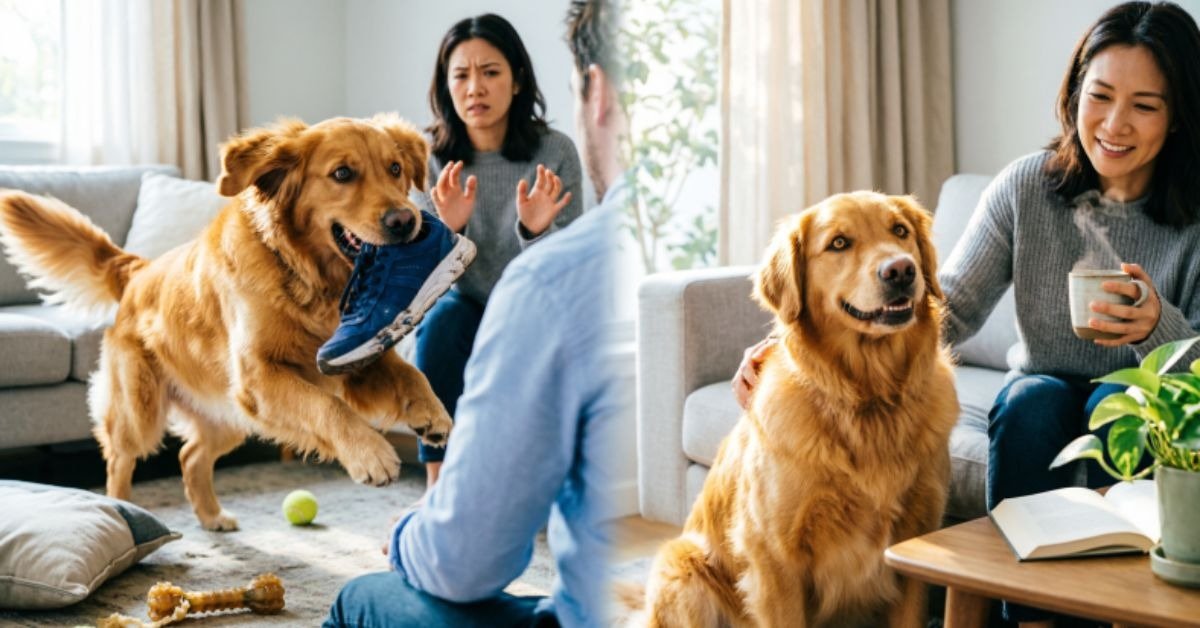
Everyone told you Golden Retrievers are the perfect family dog, gentle, loving, and endlessly cheerful. And honestly? They weren’t wrong. But if you’ve ever come home to a shredded couch cushion, been knocked flat by an overly enthusiastic greeting, or watched your pup growl over a chew toy, you know the real story. Golden Retriever behavior problems are more common than Instagram would have you believe.
The good news: every single one of them is fixable. You don’t need to be a professional dog trainer, you just need a little knowledge, a lot of patience, and the willingness to see the world from your dog’s perspective.
Managing the “Land Shark” Nipping and Destructive Chewing
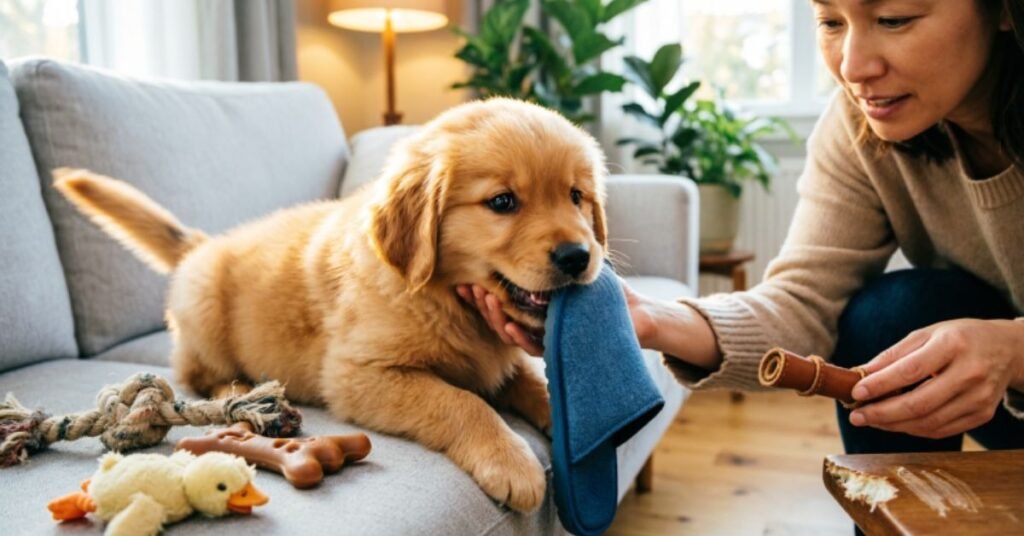
Quick Fix: To stop Golden Retriever chewing and nipping, redirect the behavior immediately to a high value chew toy, pair it with a firm “No,” and increase daily mental and physical stimulation to eliminate the boredom that drives the behavior in the first place.
Golden Retrievers were bred to carry things in their mouths: birds, balls, your favorite sneaker. Puppies especially explore the world through biting, and if that energy isn’t redirected early, it becomes a deeply ingrained habit that follows them into adulthood. Destructive chewing is almost always a sign of boredom, teething discomfort, or pent-up energy with nowhere to go. The dog isn’t being destructive out of spite; they’re crying out for engagement.
3 Training Fixes That Actually Work:
- Redirect immediately and consistently. The moment your Golden nips or grabs something forbidden, calmly say “No” and swap it with an appropriate chew toy. Praise them the moment they take it. Consistency is non-negotiable: every family member must follow the same rule, every single time.
- Tire them out before they act out. A 30–45 minute walk or fetch session before alone time dramatically reduces destructive behavior. A physically and mentally tired Golden is a well behaved Golden.
- Use bitter apple spray strategically. Apply it to furniture legs, baseboards, and cables. Most dogs hate the taste and self-correct within days.
Pro-Tip: Rotate your dog’s chew toys every few days to keep them feeling “new.” Puzzle feeders and Kongs stuffed with frozen peanut butter are exceptional boredom-busters that engage your dog’s brain for 20–30 minutes at a stretch.
The Shadow Dog: Helping Your Golden with Separation Anxiety

Quick Fix: To reduce Golden Retriever separation anxiety, practice calm, low-drama departures, start with very short absences of just 5 minutes, and gradually build up your dog’s confidence by teaching them that being alone is safe and that you always come back.
Goldens are deeply social animals, and being left alone goes against every instinct they have. If your dog follows you from room to room, whines when you reach for your keys, or destroys furniture only when you’re gone, you’re dealing with one of the most emotionally charged Golden Retriever behavior problems owners encounter. The anxiety is real and punishing it only makes it worse.
Signs Your Golden Has Separation Anxiety:
- Pacing, whining, or excessive drooling before you leave
- Destructive behavior that only happens when you’re absent
- Barking or howling reported by neighbors
- Indoor accidents despite being fully house-trained
How to Build Their Confidence When Alone:
- Start with micro departures. Leave for just 5 minutes, return calmly, and gradually extend the time over days and weeks. This rewires your dog’s belief that departure = abandonment.
- Kill the dramatic goodbye. Long emotional farewells spike anxiety before you’ve even left. Walk out quietly, greet your dog calmly when you return with no big productions.
- Build a safe haven. A crate paired with a worn t-shirt that carries your scent can transform into a genuine comfort zone your dog chooses willingly.
- Use sound to ease loneliness. A dog camera, background TV, or talk radio provides the sound of human voices during long stretches alone, surprisingly effective for many dogs.
Pro-Tip: If the anxiety is severe, think non-stop barking, self-injury, or complete inability to settle, consult your vet before training. A short-term behavioral support plan, or in some cases medication, can make the entire process significantly smoother.
Taming the Leash: No More Pulling or Over-Excitement

Quick Fix: To stop a Golden Retriever from pulling on the leash, halt the moment tension hits the lead, wait for slack, then move forward as the reward combined with a front-clip harness, this teaches your dog within days that walking beside you is the fastest way to get where they want to go.
A 65-pound Golden Retriever at the end of a taut leash isn’t just inconvenient it’s a shoulder injury waiting to happen. Pulling persists because it works: the dog pulls, they move forward, behavior reinforced. The counter-intuitive truth is that your forward movement is the most powerful reward you have. Take it away, and the rules of the game change entirely.
Training Tips for Polite Walking:
- Stop dead the moment they pull. Stand still, say nothing, wait. The instant the leash goes slack, mark it with “Yes!” and move forward again. Repetition over several walks makes this click fast.
- Switch to a front-clip harness. It redirects your dog’s momentum toward you rather than forward, making sustained pulling physically awkward without any discomfort.
- Practice name and focus exercises on every walk. Say your dog’s name randomly during walks and reward eye contact with a treat. You’re building a check-in habit that competes with every distraction they’ll ever encounter.
- Prioritize quality over distance. A slow, structured 15-minute walk builds better leash manners than a chaotic 45-minute one where pulling goes unchecked.
Pro-Tip: Introduce your “Let’s go” or “With me” cue at home first in a hallway or the backyard before testing it on a busy street. Master it in easy mode, then level up.
Stopping the Jump Teaching Your Dog Polite Greetings

Quick Fix: To stop a Golden Retriever from jumping up, immediately withdraw all attention turn your back, cross your arms, make zero eye contact then ask for a sit and reward the moment four paws hit the floor, so your dog learns that calm greetings, not jumping, earn the love they’re after.
Your Golden doesn’t jump because they’re badly behaved. They jump because it has worked brilliantly every time someone laughed, squealed, or reached down to pet them. Change what jumping earns, and the jumping changes. It really is that straightforward the challenge is enforcing it without exceptions.
Simple Steps for “Four on the Floor”:
- Turn your back, every time. The instant your dog jumps, crosses your arms, turns away, gives zero acknowledgement. No eye contact, no verbal “no,” no pushing them down, any physical touch, even a shove, registers as interaction and reinforces the behavior.
- Reward the sit immediately and enthusiastically. Ask for a sit as guests walk in. The moment four paws are on the floor and your dog sits, delivering praise and treats like it’s the best thing they’ve ever done. Because in training terms, it is.
- Brief every guest before they walk through the door. One visitor who allows jumping just this once can unravel weeks of careful training. Get everyone on the same page.
- Run daily door drills. Approach the door, open it, ask for a sit, reward repeat. Make this a ritual before guests ever arrive so the behavior becomes automatic.
Pro-Tip: Keep a treat jar right next to the front door. When rewarding polite greetings is effortless, you’ll actually do it consistently and consistency is everything.
Dealing with Resource Guarding: Protecting Food and Toys

Quick Fix: To safely address Golden Retriever resource guarding, never punish the growl it’s a warning, not defiance and instead practice “trade-up” exercises where you approach with something better than what your dog has, building a positive association with your presence near their valued items.
Resource guarding growling, stiffening, or snapping when approached near food, toys, or sleeping spots is one of the more serious Golden Retriever behavior problems, and also one of the most mishandled. It’s a natural survival instinct, not stubbornness or aggression for its own sake. React with force or punishment, and you escalate. React with patience and strategy, and you resolve it.
How to Safely Manage and Reduce Guarding:
- Never punish a growl. A growl is communicating your dog’s way of saying “I’m uncomfortable.” Suppress the growl through punishment and you remove the warning signal, not the emotion underneath it. Biting without warning is the dangerous result.
- Master the trade-up technique. When your dog has something they’re guarding, approach with a higher-value item: a piece of chicken, a special toy. Offer the trade, praise when they take it, then return their original item. Repeated consistently, your approach starts to predict good things.
- Build “drop it” and “leave it” into daily training. Practice these cues in low-stakes moments, not just crisis situations. Positive reinforcement trained drop-it and leave-it commands give you a reliable, confrontation-free way to manage objects.
- Approach the food bowl during meals. Walk up while your dog is eating and drop something delicious into the bowl. Do this daily. Over time, your approach near the bowl stops being a threat and becomes something they actually look forward to.
Pro Tip: If guarding escalates to stiffening, snapping, or biting, stop DIY training and bring in a certified professional trainer or veterinary behaviorist immediately. Managing safety is the priority always.
You and Your Golden Are Still Learning Each Other’s Language
Here’s the truth every experienced dog trainer eventually arrives at: Golden Retriever behavior problems aren’t really problems at all. They’re communication gaps. Your dog isn’t being difficult, defiant, or destructive on purpose; they’re doing what dogs do, in a world built entirely for humans, trying their very best to figure out what you need from them.
Every chewed shoe was a dog desperate for more stimulation. Every leap at the door was a dog overflowing with love and no outlet for it. Every growl over a food bowl was a dog doing the only thing they knew to feel safe.
When you replace frustration with curiosity when you stop asking “why is my dog so bad?” and start asking “what is my dog trying to tell me?” something shifts. The pulling stops. The jumping fades. The anxiety quiets. And what’s left is the dog you always dreamed of: loyal, calm, joyful, and unshakeably devoted to you.
Questions About Golden Retriever Behavior (FAQ)
At what age do Golden Retrievers finally calm down?
Most Goldens start to settle between 2 and 3 years of age. However, they will always remain active dogs that require daily exercise to stay calm indoors.
Why is my Golden Retriever suddenly acting aggressive?
Sudden aggression is rare and usually points to medical pain, fear, or severe resource guarding. If your dog’s personality changes quickly, see a vet immediately to check for underlying health issues.
Are Golden Retrievers difficult to train?
No, they are actually one of the easiest breeds to train due to their high intelligence and desire to please. The main challenge is managing their high energy during the training process.
Turning “Problems” Into Partnership
Solving Golden Retriever behavior problems isn’t about being “the boss” it’s about becoming a better communicator for your best friend. Every chewed shoe or pulled leash is just a communication gap waiting to be filled with patience and consistent training.
Your Golden doesn’t want to be a “bad dog”; they want to be your greatest joy. When you replace frustration with empathy and clear rules, you’ll find that those “problems” were just a temporary phase on the road to a lifelong friendship. Stay patient, keep the treats handy, and remember: every bit of effort you put in now will be returned to you in a lifetime of loyalty.