Pugs are tenacious, curious, and emotionally driven to follow their humans everywhere including trails their anatomy was never built for. That gap between spirit and physiology is exactly where injuries happen
Most hiking advice for pugs is either dangerously generic or needlessly alarmist. What you actually need is breed-specific, physiology-first guidance and that’s exactly what this guide delivers.
Quick Answer
Pugs can hike safely with strict precautions: keep trails under 3 to 4 km, hike only below 20°C air temperature, use a Y-shaped harness (never a collar), carry Doggles for eye protection, and know the Spatula Tongue overheating sign. Their flat faces limit oxygen intake, making shade breaks, cold water access, and a 1:1 rest-to-walk ratio non-negotiable.
Why Pug Physiology Changes Every Hiking Rule
Pugs have stenotic nares (narrowed nostrils), an elongated soft palate, and a compressed trachea. Every breath is already a partial obstruction before the hike even begins.
When oxygen demand spikes on trail, that system hits its limit fast. A Labrador at 70% effort is cruising. A Pug at 70% effort may already be approaching heat stroke.
Their short legs and low ground clearance also mean every rock, root, and incline demands far more physical effort than it looks. Even a gentle slope is a cardiovascular event for a compact, heavy-headed breed.
The Micro-Climate Problem: Ground vs. Air Temperature

When air temperature reads 25°C, ground surface temperature on dirt, rock, or asphalt can hit 40–45°C. Pugs hike entirely within that superheated layer they are not feeling what you feel at waist height.
Before every hike, press the back of your hand on the trail surface for 7 seconds. If it’s uncomfortable for you, it’s dangerous for your pug.
Always prioritize shaded forest trails, grassy paths, and pre-9am start times to keep ground temps manageable.
Hard Rule: If air temperature exceeds 20°C (68°F), cancel the hike. No exceptions cloud cover and breeze do not compensate for a pug’s limited thermoregulation.
Reading the Signs Before It Becomes an Emergency
The Spatula Tongue Sign
Normal pug panting produces a roughly cylindrical tongue. When it flattens and spreads wide like a spatula or paddle that’s your emergency signal.
It means the dog’s cooling system is overwhelmed and heat stroke is imminent. Stop hiking immediately, move to shade, and pour cool (not cold) water on the paws, groin, and neck.
If the tongue doesn’t return to normal shape within 5 minutes of rest and cooling, treat it as a veterinary emergency and move fast.
The Reverse Sneeze Protocol

That honking, gagging, snorting episode is a soft palate spasm common in pugs, and far more frequent during physical exertion on trail.
To stop it: gently cover one nostril for 1–2 seconds while stroking the throat downward. This triggers a swallow reflex that breaks the spasm within seconds.
After any reverse sneezing episode, rest for 10 full minutes before moving on. Two episodes in one outing means the hike is over-turned immediately.
Community Pain Points: What Pug Owners Actually Struggle With
The Stubborn Stop

Your pug plants all four paws and refuses to move. Most owners assume stubbornness. Most of the time, it’s exhaustion or physical discomfort the dog can’t express any other way.
Pugs are people-pleasers. Resistance without reason is rare. Treat every trail stop as a distress signal check paw pads, breathing rate, and body heat before anything else.
Only after ruling out physical causes should you use a high-value treat or enthusiastic voice cue to re-engage. Never use leash pressure to force a stopped pug forward.
Harness Chafing
Chafing typically happens where a poorly fitted harness rubs the inner “armpit” area during extended movement. On a pug’s barrel-shaped chest, standard harness sizing almost never fits correctly.
Check for redness, hair loss, or skin irritation after every hike. Apply paw balm or coconut oil to friction points before departure as a preventive barrier.
Anxiety Around Large Off-Leash Dogs
A large dog charging toward your pug doesn’t just cause fear it can trigger a panic respiratory response in an already-stressed airway. That’s a genuine medical risk, not just a behavioral inconvenience.
Step off the trail before the dog reaches you, place your body between them, and use a calm, firm voice. Carry a small deterrent spray for aggressive off-leash encounters.
Whenever possible, choose trails with mandatory leash policies to remove the variable entirely.
Gear That Actually Matters (and Why)
The Y-Shaped Harness: Non-Negotiable

A standard collar applies direct pressure to the trachea on any leash tension. For a pug whose trachea is already compromised this risks coughing spirals, laryngeal spasm, and long-term tracheal collapse.
An H-shaped harness with a cross-chest strap isn’t much better; it still compresses throat tissue under load.
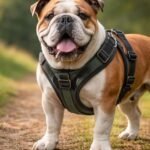
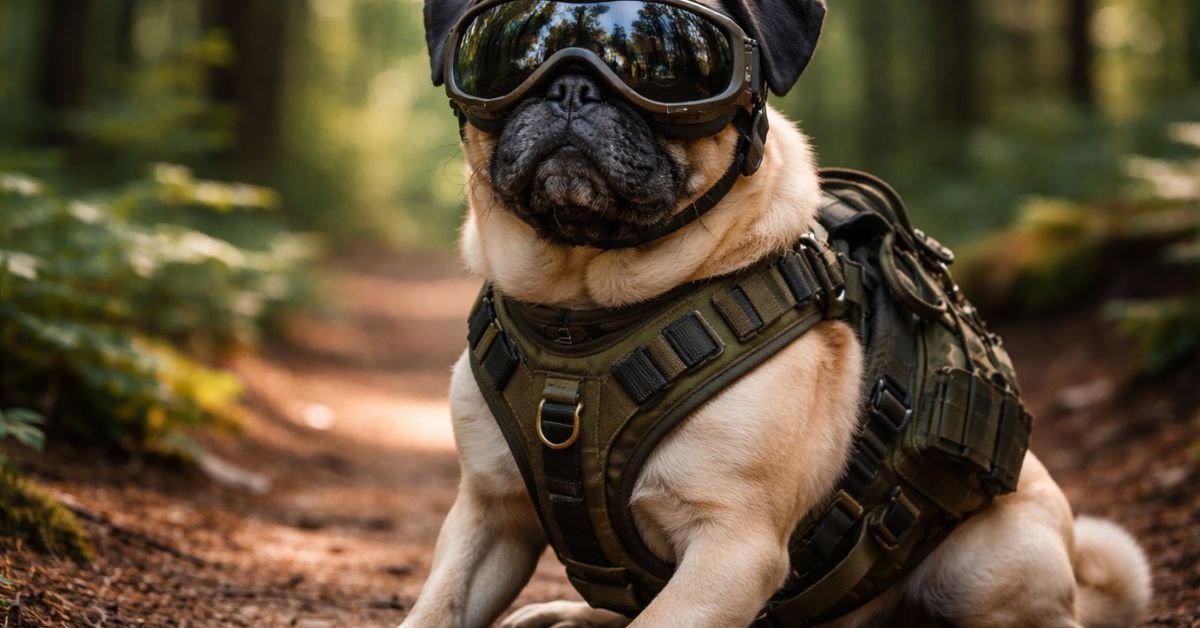
A Y-shaped harness routes all pressure to the sternum and lateral chest wall, bypassing the trachea entirely. It also allows full shoulder movement, reducing gait fatigue on longer trails.
Doggles: Eye Protection Is Medical, Not Cosmetic
Pug eyes are proptotic they protrude beyond the orbital socket because the skull lacks depth to contain them normally. A single branch, pebble, or airborne debris at trail level can cause corneal ulcers or permanent vision damage.
Doggles (canine goggles with impact and UV protection) are the standard fix. Buy brachycephalic-specific sizing standard canine goggles sit too far forward and don’t seal on a flat face.
UV protection also matters on snow-covered or high-altitude trails where photokeratitis risk increases significantly.
Full Gear Checklist
| Gear | Why It Matters |
| Y-Shaped Harness | Bypasses trachea; mandatory for flat-faced breeds |
| Doggles | Impact + UV protection for protruding eyes |
| Wide Collapsible Bowl | Flat faces need shallow, wide bowls to drink properly |
| Cooling Bandana / Vest | Adds 3–5°C of effective body cooling |
| Paw Wax or Boots | Guards against superheated ground surfaces |
| Trail First Aid Kit | Eye wash saline, paw balm, gauze, vet number saved offline |
Safety Protocols: Build These Habits Before You Hit the Trail
The 1:1 Rest Ratio
- Walk 10 minutes. Rest in shade 10 minutes. No extensions, even if the dog seems fine.
- Offer 30–50ml of water at every rest stop — small amounts frequently beats large drinks rarely.
- If breathing rate hasn’t dropped after 5 minutes of rest, extend the break or end the hike.
- Always hike away from the trailhead first so the return leg (when fatigue sets in) is flat or downhill.
- Set a hard turnaround time, not a distance goal. Pugs slow down dramatically in the second half of any outing.
Pre-Hike Conditioning
Don’t take a couch pug straight to a trail. Built up with progressively longer off-pavement walks over 4 to 6 weeks, grass, gravel, and gentle inclines in a local park prepare the cardiovascular system specifically for trail demands.
Trail Readiness Checklist: Vet-cleared · Y-harness fitted · Doggles accepted · Paw wax applied · Start before 9am · Trail under 3km · Cooling vest soaked · Emergency vet number saved offline.
Conclusion: The Trail Builds the Bond
Every preparation the early start, the harness fitting, the Doggle desensitization is a message to your pug: I see your limits, and I’ll never push past them.
The pugs who thrive on trails don’t have unusual anatomy. They have owners who chose safety over ego and did the work before the trailhead.
The trail doesn’t care how far you went. Your pug only knows you went together and came home safe. That’s the only metric that matters.
Frequently Asked Questions
Q1. How far can a Pug safely hike?
A conditioned adult Pug in cool weather can manage 3–4 km with regular rest breaks. Unconditioned or older dogs should start at 1–2 km and build slowly. Always prioritize your dog’s real-time signals over any preset distance target.
Q2. What age can Pugs start hiking?
Avoid uneven trail terrain until 14 months growth plates are still open before then. Senior Pugs (8+ years) can hike with vet clearance but need shorter distances and more frequent rest. Always get a vet assessment before starting any trail routine.
Q3. Can Pugs handle hills and inclines?
Mild inclines are manageable for a conditioned Pug. Anything over 10–15% grade should be treated as a high-intensity interval — rest as long as the climb took before continuing. Avoid summit trails and heavy switchbacks entirely.
Q4. How much water does a Pug need on a hike?
Target 30 to 50ml per kg of body weight for the outing, delivered in small sips every 10–15 minutes of movement. A 9kg Pug on a 3km trail needs roughly 400–500ml. Always carry more than you think you’ll need.
Q5. How long does recovery take after a hike?
Plan for 24 to 48 hours of light activity only. Watch for prolonged panting at rest, reduced appetite, or unusual tiredness. Always rinse paws and belly with cool water post-hike and check pads for cuts or heat damage.