Quick Answer: Great Danes can hike, but only after growth plate closure at 18–24 months. Limit trails to 3 to 5 miles on soft, flat terrain. Use a no-pull harness, feed 2 to 3 hours before hiking, and provide 20 30 ml of water per kg of body weight per hour to prevent Bloat and joint damage.
The “Couch Potato” Myth: Why Your Great Dane Deserves Better
Walk into any veterinary clinic and mention you want to hike with your Great Dane, and you’ll likely get a cautious look. Ask in a dog forum and someone will inevitably say, “Aren’t they just giant lap dogs?”
Both reactions miss the truth entirely.
Great Danes were bred as boar-hunting dogs in 18th-century Germany athletes capable of taking down 200-pound wild boars on rugged terrain. That muscle memory hasn’t gone anywhere. What has changed is our understanding of their physiology, and that knowledge is exactly what separates a dangerous hike from an extraordinary one.
This guide is written for the Active Apollo owner: someone who loves their Dane deeply, wants to share adventures with them, but lies awake worrying about Bloat, joint failure, or a trail that ends in an emergency vet visit. If that’s you, read every word.
The Joint Impact Paradox: Size Is Both the Problem and the Solution
Here’s what most hiking guides don’t tell you: Great Danes have proportionally smaller joints relative to their body mass than medium-sized breeds. A 140-pound Dane doesn’t simply have the joints of a 140-pound human equivalent; the cartilage surface area and synovial fluid distribution haven’t scaled linearly with their dramatic size increase through selective breeding.
This creates what veterinary orthopedists call the joint impact paradox: the very power that makes a Dane look capable of any terrain is what makes overuse injuries so catastrophic.
Ascent vs. Descent The Danger Most Guides Miss

Every hiking article tells you about the effort of going uphill. Almost none mention that downhill descents are 2 to 3× more damaging to a Great Dane’s joints than ascents. On a descent, the forelimbs absorb braking force repeatedly and in a dog whose front-loaded body weight already places 60% of mass on the foreleg assembly, this compounds rapidly.
Practical rule: If a trail has significant switchbacks or a descent steeper than 15°, it’s not suitable for a Dane, regardless of their fitness level.
Growth Plate Closure: The Non-Negotiable Threshold
Before any hiking conversation begins, there is one biological checkpoint that cannot be bypassed:
*Growth plates* (physeal cartilage\text{physeal cartilage} physeal cartilage) in Great Danes typically close between **18 and 24 months** significantly later than in small breeds (9–12 months). Hiking or sustained high-impact exercise before closure risks permanent physeal fractures, angular limb deformities, and early-onset osteoarthritis.
Do not hike with a Dane under 18 months. Period. Gentle walks on flat surfaces, yes. Trail hiking with elevation change, no.
GDV and Bloat Prevention: The Non-Negotiable Safety Protocol

Gastric Dilatation-Volvulus (GDV) commonly called Bloat kills more Great Danes than almost any other condition. The stomach fills with gas, twists on its axis, and cuts off blood supply to critical organs. Without emergency surgery, death can occur within hours.
Hiking creates a perfect storm for GDV: elevated heart rate, physical jostling, post-exercise feeding, and excited drinking.
Your Bloat Prevention Checklist for Hikes
- Feed your Dane 2–3 hours before the hike begins never immediately before or after
- No vigorous activity for 1 hour post-meal enforce rest even if they’re begging for the trail
- Use a slow-feeder bowl for post-hike meals to prevent gulping
- Hydrate gradually on the trail offer 20–30 ml per kg of body weight per hour in small increments, not large volumes at once (a 60 kg Dane needs approximately 1,200–1,800 ml/hour total, spread across multiple short stops)
- Know the warning signs mid-trail: unproductive retching, distended abdomen, restlessness, excessive drooling. These are emergencies get off the trail immediately
Some experienced owners who hike frequently discuss with their vets the option of prophylactic gastropexy, a surgical tacking of the stomach as a preventive measure before beginning an active hiking lifestyle with their Dane.
Paw Pad Surface Area and Giant Breed Ground Contact
A Great Dane’s paw pad is larger in absolute terms than most dogs, but the pressure per square centimeter is still substantial given their weight distribution. On rocky terrain, gravel paths, or hot asphalt approaching trailheads, paw pad lacerations are common and genuinely painful.
Paw Protection Protocol
- Trail condition check: Rocky or technical terrain requires wax-based paw balm (applied the night before and morning of) or dog trail boots specifically sized for giant breeds. Brands like Ruffwear offer XL sizing designed for Dane-width paws
- Temperature rule: If asphalt is too hot for your palm held flat for 5 seconds, it’s too hot for paw pads this matters at trailhead parking areas
- Post-hike inspection: Check between toes for embedded debris, cracking, or early-stage abrasion after every outing
Choosing the Best Hiking Harness for Giant Breeds

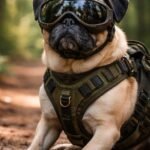
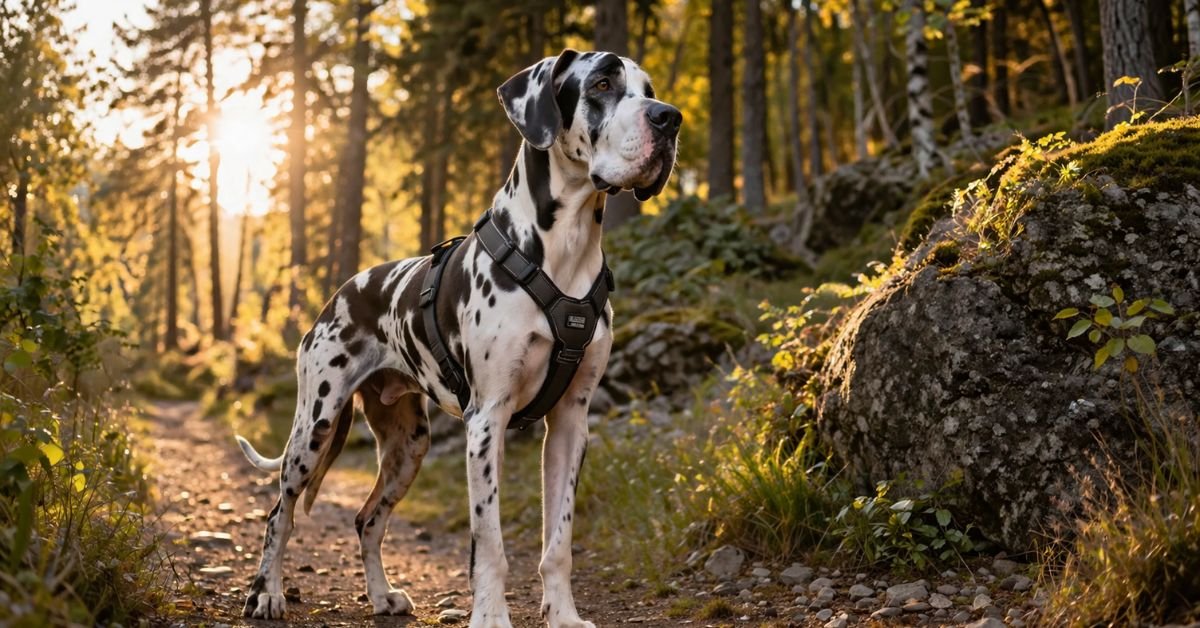
Standard collars are inappropriate for trail use with a Dane neck strain, tracheal pressure, and loss of directional control on uneven ground are all real risks. A giant-breed-specific hiking harness is essential equipment, not optional gear.
What to Look For
- Y-front or H-front design that doesn’t restrict shoulder movement critical for a dog with the Dane’s long stride
- Padded sternum plate to distribute pressure across the chest rather than concentrate it
- Dual attachment points (front clip for trail control, back clip for cruising)
- Weight-bearing back handle this is the feature most owners overlook until they need it
The Lifting Logistics Problem
Community forums on Reddit’s r/greatdanes are full of stories about the moment a Dane decided they were done hiking and simply stopped. One owner described it as “the Great Dane Staredown” your 150-pound dog plants all four feet, makes eye contact, and communicates with absolute clarity that the return trip will not involve their legs.
This is where the back handle becomes critical not for lifting the entire dog, but for assisting them over obstacles, up steep steps, or into a vehicle when fatigue sets in. Plan your exit logistics before you start: if your Dane decides they’re done 2 miles in, can you physically get them back and into your car?
Community Insights: What Real Dane Owners Have Learned
The Happy Tail Syndrome on Narrow Trails
Members of Great Dane communities on Quora and Reddit consistently flag one hazard that no professional guide mentions: Happy Tail Syndrome on narrow forest trails. A Dane’s tail, swinging at full enthusiasm, makes contact with trees, rocks, and dense brush repeatedly on a single-track trail. Over time or in a single unlucky swing this causes lacerations that bleed dramatically and heal poorly due to the constant motion of the tail.
Solution: Choose wider trails (minimum 6-foot width recommended) or wrap the tail tip with self-adhesive bandage wrap before entering dense vegetation.
Managing Energy Bursts and Sudden Stops
Experienced Dane hikers note a predictable pattern: explosive enthusiasm for the first 20–30 minutes, followed by a sharp energy cliff. Unlike retrievers or huskies who moderate their pace, Danes tend to sprint and stop. Plan for this by:
- Building in a mandatory 10-minute rest at the halfway point, regardless of how energetic they seem
- Keeping the outbound leg slightly shorter than the return (trail in 1.8 miles, back 1.5 via shortcut if available)
Caloric Needs: The Math Most Hikers Skip
A sedentary Great Dane requires approximately 25–30 calories per kilogram of body weight per day using a resting energy formula. During a moderate 3-mile hike, caloric expenditure increases by roughly 30–50% above baseline.
For a 60 kg Dane, this translates to roughly 450–900 additional calories on hiking days. These should not come from a dramatically increased single meal — that increases Bloat risk. Instead:
- Give a slightly larger pre-hike meal (within their 2–3 hour window)
- Offer high-calorie, low-bloat trail snacks (plain boiled chicken, small commercial training treats) at rest stops
- Compensate with a moderately increased evening meal after full post-hike rest
Great Dane Endurance Limits: Age-Specific Trail Guidelines
| Age | Maximum Trail Distance | Terrain |
| Under 18 months | No trail hiking | Flat walks only |
| 18–24 months | 1–2 miles | Flat, soft surface only |
| 2–5 years (prime) | 3–5 miles | Moderate, avoid technical |
| 5–7 years | 2–3 miles | Flat preferred |
| 7+ years (senior) | 1–2 miles max | Flat, monitored closely |
These are upper limits for a healthy, conditioned Dane not starting points. Build distance gradually over multiple months.
The Bond You’re Actually Building

Every technical precaution in this guide exists to protect one thing: the relationship between you and a dog whose entire emotional world revolves around your presence.
Great Danes are not independent adventure dogs. They are companion athletes who hike not because the mountain calls to them, but because you are on that trail and they would follow you anywhere. When you return safely, when you read their body language correctly, when the harness fits right and the water comes at the right time you are communicating trust in a language deeper than words.
That staredown on mile two? That’s not stubbornness. That’s honesty. And when you learn to read it and respond with patience rather than frustration, you’ll have built something rare: a hiking partnership with one of the most emotionally intelligent dogs on earth.
Frequently Asked Questions
Q: Can Great Danes go on long hikes?
A: Healthy adult Danes (2–5 years, post growth plate closure) can manage 3–5 miles on moderate terrain. Beyond that, joint stress and Bloat risk increase significantly. Always build distance gradually and monitor for fatigue.
Q: What is the best hiking harness for a Great Dane?
A: Look for a Y-front or H-front design with a padded sternum, dual attachment points, and a rear handle for assist lifting. Brands with giant-breed sizing include Ruffwear and Julius-K9. Avoid any harness that restricts shoulder rotation.
Q: How do I prevent Bloat when hiking with my Great Dane?
A: Feed 2–3 hours before hiking, offer water in small increments (not large volumes at once), avoid vigorous activity immediately after eating, use a slow feeder post-hike, and know the warning signs: unproductive retching, distended belly, excessive drooling. Consult your vet about prophylactic gastropexy.
Q: At what age can a Great Dane start hiking?
A: Not before 18 months, when growth plates begin to close. Many vets recommend waiting until 24 months for any sustained trail activity. Early high-impact exercise risks permanent joint and bone damage.
Q: My Great Dane refuses to walk back on the trail. What should I do?
A: This is the “Dane Staredown” a known phenomenon. Always hike with a giant-breed harness with a back handle for assist support, plan return logistics before you start, and never hike farther than you could physically manage if your dog stops cooperating. Bring high-value treats to re-motivate, and respect their limit.