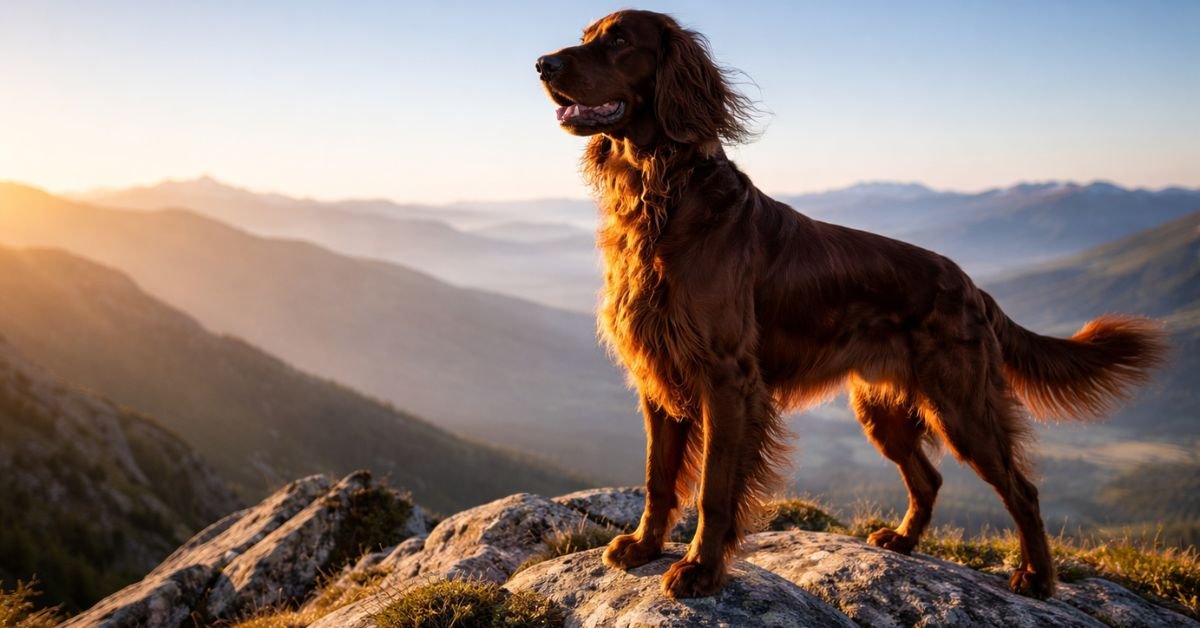
You’re two miles into the trail. The wind shifts. Your Irish Setter walking perfectly beside you one second ago is now a red blur vanishing into the tree line.
This isn’t a training failure. This is centuries of gun dog breeding doing exactly what it was designed to do.
The Irish Setter is the Ferrari of the woods. Breathtaking speed, extraordinary range, and a nose that turns every hike into a field trial. But like a Ferrari, it demands a driver who truly understands the machine.
This guide gives you that knowledge breed-specific, practical, and zero fluff.
Quick Answer: How to Hike Safely with an Irish Setter?
Summary Box
- Use a 15–30 ft long-line until recall is 95%+ reliable under distraction.
- Apply leave-in conditioner to feathering before the hike to repel burrs.
- Feed your dog 2–3 hours before departure to reduce bloat (GDV) risk.
- Outfit your dog in neon orange or blue their red coat disappears in fall foliage.
- Account for quartering: your Setter runs 2x your distance, so manage hydration and energy accordingly.
- Always carry a tick comb, paw balm, and a collapsible water bowl.
The “Quartering” Factor: Your Dog Runs Double Your Miles

Every pointing breed instinctively quarters a natural Z-pattern sweep left and right of the handler to locate scent. For Irish Setters, this is constant and relentless.
On a 6-mile trail, your Setter is logging 10–12 miles. GPS studies on hunting dogs consistently show a 1.7x–2x distance multiplier.
That has serious practical consequences for stamina and calorie management.
What to do:
- Offer high-protein trail snacks every 45 to 60 minutes on longer hikes.
- Watch for the “setter flop” sudden lying down mid-trail signals hypoglycemia or early heat stress, not laziness.
- Apply paw balm before the hike. Double mileage means double abrasion on paw pads.
- A field-bred Setter handles 12 to 15 miles comfortably at full maturity. Show-bred lines tap out closer to 8 to10 miles.
Show-Bred vs. Field-Bred Irish Setters on the Trail
| Trait | Show-Bred | Field-Bred |
| Build | Heavier, muscular | Lean, long-legged |
| Coat | Long, full feathering | Shorter, tighter coat |
| Stamina | Moderate (8–10 miles) | High (12–15+ miles) |
| Prey Drive | Moderate | Extreme |
| Off-Leash Recall | Easier to train | Requires intensive work |
| Best Trail Type | Moderate, groomed trails | Rugged, wilderness terrain |
Knowing your dog’s lineage changes your entire training and packing strategy.
Coat Defense: The Leave-In Conditioner Hack

Most new Irish Setter owners discover this only after their third hour of burr removal.
Before every hike, work a silicone-based leave-in dog conditioner through the feathering ears, chest, belly, legs, and tail. It creates a slick surface that stops burr hooks from gripping the hair shaft. Seeds and debris slide off or remove in seconds.
Pre-hike coat prep:
- Spritz leave-in conditioner onto all feathered areas.
- Comb through with a wide-tooth comb don’t leave it unworked.
- Focus on ear fringes, which drag the ground and collect everything.
- Never apply conditioner to paw pads it creates dangerous slip on rocks and roots.
This one step cuts post-hike grooming from 45 minutes down to under 10.
The Autumn Camouflage Risk

This safety issue doesn’t get enough attention.
An Irish Setter’s mahogany coat is nearly identical in color to autumn foliage dried oak leaves, rust ferns, fallen maples. At any distance over 30 feet in low light, your dog vanishes completely.
Two dangers: you lose visual contact instantly, and in hunting areas, your dog could be mistaken for game.
Gear up:
- Neon orange is the standard for hunting-adjacent trails during deer and bird season.
- Electric blue works better in dense autumn undergrowth where orange blends with dead leaves.
- Use a high-vis vest, not just a collar coverage needs to be visible from multiple angles.
- Add a GPS tracker collar (Garmin Alpha, Tractive, or Whistle). When your Setter ghosts you, you want a dot on a map, not a prayer.
October through December: treat every trail like hunting season is active because it likely is.
The “Setter Sidetrack”: Tackling Prey Drive and Selective Hearing
The Irish Setter that follows you from room to room at home becomes a phantom the moment an interesting scent registers on trail.
This isn’t disobedience. It’s a neurological shift. When prey drive activates, instinct overrides decision-making. Your voice becomes irrelevant information.
Building a Recall That Actually Works

Phase 1 Long-Line Training: Never practice recall without a 15 to 30 ft biothane long-line until success rate is 95%+ in high-distraction environments. It’s not punishment, it’s a safety net that lets you reward correct behavior in real conditions.
Phase 2 Emergency Recall Word: Pick a word you never use casually “HERE” or a specific whistle pattern. Pair it exclusively with the highest-value reward your dog knows (real meat, not kibble). Use it 3–5 times per hike and always follow through with the jackpot reward.
Phase 3 Pattern Interruption: When your Setter locks onto a bird before the chase begins, use a sharp hand clap plus recall word simultaneously. You have a 1 to 2 second window before the predatory sequence fully engages.
Trail tactics for gun dog recall:
- Change directions randomly it keeps your Setter checking back in with you.
- Reward every voluntary eye contact or approach with a treat.
- In high-prey areas, keep the long-line attached to a well-fitted harness until you’ve assessed the recall risk level.
Deep-Chest Safety: Bloat (GDV) on the Trail
Irish Setters are high-risk for Gastric Dilatation-Volvulus the second-leading killer of large breeds. It can kill a healthy dog in hours. On a remote trail, far from emergency care, the risk multiplies.
GDV occurs when the stomach fills with gas and twists, cutting off blood supply. Vigorous exercise around mealtimes dramatically increases risk.
Non-negotiable trail rules:
- No food within 2 hours before a hike.
- No vigorous activity for 1 hour after eating post-hike.
- Feed two smaller meals daily instead of one large meal on active days.
- Know the symptoms: unproductive retching, distended abdomen, restlessness, pale gums. If you see these on trail, end the hike and get to a vet immediately.
- Ask your vet about prophylactic gastropexy, a surgical stomach tacking that prevents the twist, often done during spay/neuter.
Health & Hydration: Cooling That Mahogany Coat

A dark coat absorbs solar radiation significantly more than lighter coats. On warm hikes, this matters fast.
Cooling protocol:
- Offer water every 20–30 minutes and don’t wait for the dog to signal thirst.
- Encourage creek crossings and wading Irish Setters do this naturally and it’s effective cooling.
- Carry a lightweight cooling bandana or vest for summer hikes above 75°F (24°C).
- Watch for excessive panting, slowed pace, or shade-seeking early heat stress signs.
Temperature limits:
- Upper limit: Avoid strenuous hiking above 85°F (29°C).
- Lower limit: Below 20°F (-6°C), the Setter’s single-layer coat needs an insulating dog coat for extended exposure.
Hydration math: A working dog needs roughly 1 oz of water per pound of bodyweight per active hour. A 65 lb Setter on a 3-hour hike needs close to 1.5 liters. Pack accordingly.
Post-Hike Feather-Care Routine
Don’t skip this. Mats left overnight become nearly impossible to remove without scissors.
Step-by-step routine:
- Tick check first. Run fingers through armpits, groin, between toes, ear edges, and under the collar. The dense coat hides ticks extremely well.
- Slicker brush the feathering while still slightly damp debris releases more easily.
- Wide-tooth metal comb on ear fringes and tail, working tip-to-base to avoid pulling.
- Detangling spray on any mats before combing never force through a mat.
- Inspect paw pads for cuts, cracks, or embedded grass seeds.
- Dry the ear canals gently with a cotton ball after water crossings heavy ear flaps trap moisture and cause infections.
- Final pin brush pass to restore coat shine and catch remaining debris.
With the pre-hike conditioner trick: 8–12 minutes total. Without it: 30to45 minutes.
The “Velcro vs. Ghost” Behavior
The Irish Setter community across Reddit and Quora talks about this constantly: the dog that won’t leave your side at home but disappears completely on the trail.
The explanation is simple. The home environment has low stimulation and a reinforcement history built around proximity to you. The trail overloads every sense simultaneously scent, sound, movement, wind. The dog’s response is to range and investigate.
“Velcro” behavior at home is often anxiety-based. “Ghost” behavior on trails is drive-based. Two different neurological modes. Train for the mode you’ll actually be in, not the one that gives you false confidence.
Conclusion: The Trail Builds the Bond
Every experienced Irish Setter owner says the same thing the chaos is the point.
The dog that dragged you through a blackberry thicket chasing a grouse is the same dog that puts its head in your lap at the campfire that night, completely spent and deeply satisfied.
Hiking with an Irish Setter demands real preparation and breed-specific knowledge. But the return on that investment watching 65 pounds of fire-red athleticism move through wild terrain with pure joy is unlike anything else in the outdoor world.
Get the gear right. Train the recall. Protect the coat. Then step aside and let your Setter show you what a true trail partner looks like.
Frequently Asked Questions
1. Can Irish Setters Be Trusted Off-Leash on Trail?
Yes but it takes 12–18 months of dedicated recall training for most dogs. The benchmark is 95%+ reliability in high-distraction environments, not your backyard. Until you hit that consistently, use a long-line. Field-bred lines are significantly harder to get off-leash reliably than show-bred lines due to their stronger field-bred stamina and prey drive intensity.
2. What Is the Best Harness for a Deep-Chested Setter?
Use a Y-front or H-style harness that keeps the sternum clear and doesn’t restrict shoulder movement. The Ruffwear Front Range, Julius-K9 IDC, and Non-Stop Dogwear Freemotion all fit the Setter’s deep chest and narrow waist well. Avoid step-in harnesses they shift during active trail movement. Attach the long-line to the back D-ring to avoid tracheal pressure.
3. How Do You Remove Burrs From Long Ear Hair?
Apply coconut oil or detangling spray directly to the burr cluster and let it sit for 2–3 minutes. Work from the outside of the cluster inward using your fingers never pull from the base out. Use a wide-spaced metal greyhound comb, not a slicker brush. For tight mats against skin, use blunt-tipped scissors to split the mat first before combing.
4. How Far Can a 1-Year-Old Irish Setter Hike?
Keep it under 4–5 miles maximum. Growth plates in large breeds don’t close until 18–24 months. Repetitive high-impact exercise before closure causes lasting joint damage. A 1-year-old Setter will happily run itself to injury if it has no off switch. Build distance gradually after the 18-month mark and get a full orthopedic check before starting a serious trail routine.
5. What Are the Temperature Limits for an Irish Setter?
Hot weather: Reduce activity above 75°F (24°C) and avoid strenuous hiking above 85°F (29°C). The dark coat absorbs heat aggressively. Cold weather: Below 20°F (-6°C), use an insulating dog coat for hikes longer than 30 minutes. Always factor in wind chill. A 35°F day with strong wind is functionally much colder than the air temperature alone.