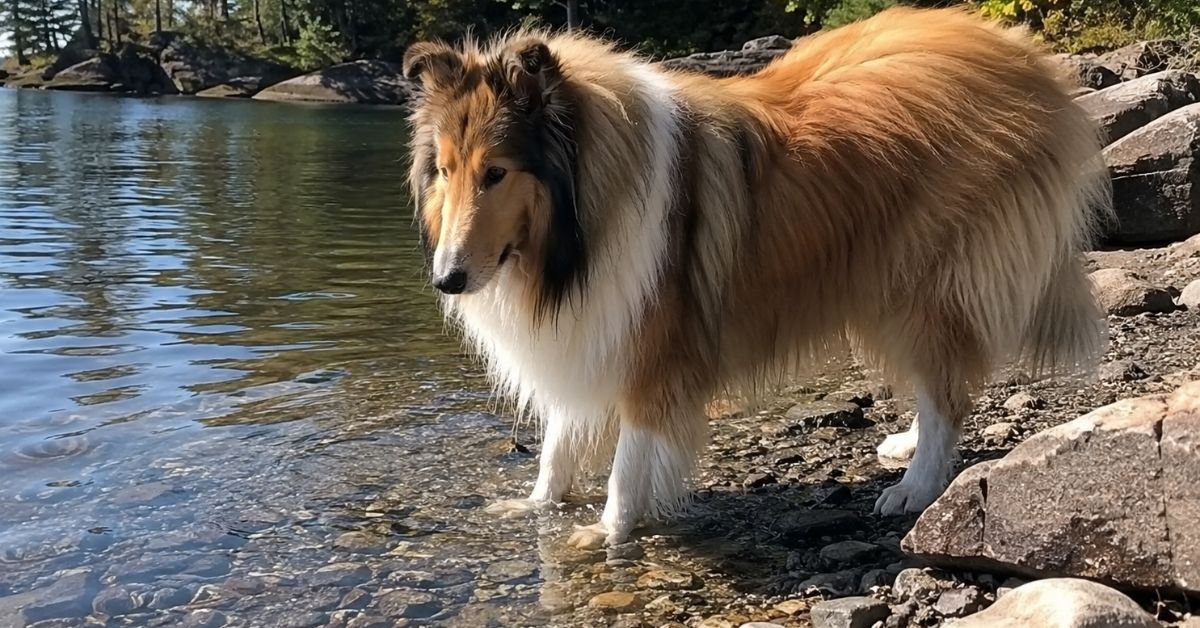
Most collie owners find out the hard way that a dry collie and a wet collie are basically two different dogs. The coat triples in weight, the herding brain switches on, and suddenly your “good boy” is trying to circle every swimmer in the lake like they’re loose sheep. This collie dog swimming guide comes from a decade of actual lake mornings, pool mishaps, and one very memorable incident involving a kayak not a rewritten vet brochure.
If you own a Rough Collie, Smooth Collie, or Border Collie, swimming isn’t automatically “safe just because dogs can swim.” There’s coat physics, instinct management, and paw care involved that nobody mentions until you’ve lived it.
Can Collies Actually Swim Well?

Yes, collies can swim well, but ability varies sharply by coat type and line. Border Collies generally swim fastest and longest due to higher drive and a lighter double coat. Rough Collies swim competently but tire sooner due to coat drag. Smooth Collies swim efficiently with minimal coat resistance. None of the three breeds swim instinctively well from day one it’s a learned skill, not a built-in trait.
That short answer covers the headline question, but the real differences only show up once you compare the three coat types side by side. This is the part most generic guides skip entirely, and it’s exactly where collie owners get caught off guard.
Rough Collie vs. Smooth Collie vs. Border Collie: Swimming Comparison
| Trait | Rough Collie | Smooth Collie | Border Collie |
| Water entry speed | Slow, often hesitant; wades before committing | Moderate; cautious but quicker to commit than Rough | Fast; high play/work drive overrides hesitation |
| Coat absorption rate | High dense undercoat soaks fast and holds significant water weight | Low to moderate minimal undercoat, sheds water quickly | Moderate varies by individual coat density, generally less than Rough |
| Average swim endurance | 5 to 10 minutes before fatigue sets in for most untrained adults | 10 to 15 minutes due to lower drag | 15–20+ minutes, especially with retrieve-based motivation |
| Drying time after swim | 2–4 hours air dry | 30–60 minutes | 45–90 minutes |
| Herding-instinct interference | Moderate; present but less intense than Border Collie | Moderate; similar to Rough Collie | High; strongest tendency to herd swimmers and other dogs |
| Best swim style to encourage | Short, supervised sessions in calm shallow water | Standard recreational swimming, tolerates longer sessions | Structured retrieve games to channel drive productively |
These numbers come from repeated observation across multiple dogs and seasons, not a single data point, so treat them as a working range rather than a hard rule. Individual fitness, age, and prior water exposure shift these numbers in both directions.
The Double Coat Problem Nobody Warns You About

This is the part generic articles skip entirely, and it’s the single biggest factor in collie water safety.
I’ve had collies come out of a lake noticeably heavier like wearing a soaked wool sweater that’s three sizes too big.
- Energy drain is real. A waterlogged coat can tire a collie out faster than the swimming itself, especially on the swim back to shore.
- Buoyancy drops. Dry coat floats; saturated coat sinks slightly, which is why even confident swimmers can start struggling 50 feet from where they started fine.
- Drying time is brutal. Expect 2-4 hours of air drying minimum for a Rough Collie, even with towel work. Smooth Collies dry in a fraction of that time, which is honestly an underrated advantage of the smooth coat.
- Skin issues can follow. A coat that stays damp against the skin for hours, especially in warm weather, creates the kind of environment hot spots love. I towel-dry the undercoat itself, not just the surface guard hairs, to cut this risk down.
If your collie is swimming for more than a few minutes at a time, a life jacket isn’t optional gear, it’s a coat-weight compensator. I learned this after my own dog went from confident paddler to visibly struggling within ten minutes, simply because her coat had absorbed what felt like an extra five pounds.
How Coat Type Changes Your Swim Plan
- Rough Collies: Plan for shorter sessions and budget real time afterward for drying. Bring a second towel one is rarely enough.
- Smooth Collies: You have more flexibility on session length, but don’t mistake fast drying for low risk; fatigue still happens, just less visibly.
- Border Collies: Coat tends to be a smaller issue than drive management the challenge is usually getting them to stop, not keeping them warm.
The Herding Instinct Doesn’t Take a Day Off in Water

This is the thing that genuinely surprises new collie owners at the lake.
Collies Border Collies especially will try to herd swimmers. Kids playing in the shallow end, other dogs paddling around, even adults doing laps can trigger the eye-stalk-circle behavior.
I’ve watched my own dog physically herd a group of kids back toward the shore because their splashing pattern apparently looked like “scattering sheep” to her brain.
What this means for you practically:
- Don’t assume your collie swimming near other dogs is “playing.” Watch the body language a stiff, low approach with intense eye contact is herding, not socializing.
- Recall training on land must be rock solid before you trust it in water, because the herding drive overrides normal obedience faster than you’d expect.
- If your dog starts circling swimmers rather than swimming toward you, that’s your cue to call them out, not let it “run its course.”
- Giving them a job a floating dummy or toy to fetch redirects that drive into something productive instead of letting it fixate on people.
This isn’t aggression. It’s instinct misfiring, but it can genuinely alarm strangers who don’t know the breed, so managing it matters for everyone’s comfort at a public lake or beach.
Lake Water vs. Pool Water: The Paw-Pad Reality

I’ve done both for years, and the aftercare is not the same.
After Lake Swimming
Natural water tends to be gentler on paw pads, but it introduces other issues:
- Check between the toes for debris, especially burrs, small stones, or sharp plant matter picked up at the entry point.
- Algae and bacteria are the real risk, not the water itself. Rinse paws with clean water after, particularly in warmer months when blue-green algae blooms are more likely.
- Rocky lake bottoms can cause micro-abrasions that you won’t notice until the next day when your dog is subtly favoring a paw.
- Sand can be deceptively abrasive too it works its way between the pads during a long swim session and causes irritation that looks like nothing at first glance.
After Pool Swimming
Chlorine is the opposite problem it’s chemical drying rather than physical abrasion.
- Pads can get dry and slightly cracked with repeated chlorine exposure, especially in dogs who swim weekly.
- I started applying a thin layer of paw balm the evening after pool sessions, and it noticeably cut down on cracking over a season.
- Rinse immediately after pool swims. Chlorine residue left to dry on the coat can cause skin irritation, and it’s worse on collies because the undercoat holds onto it longer than a short coat would.
- Watch the nose and eyes too — chlorine splash can cause mild irritation in dogs who swim with their head low to the water.
A Realistic First-Swim Routine That Actually Works
Skip the deep end on day one. Here’s the sequence that’s worked across multiple collies for me:
- Start at a shallow, gently sloping entry point lake coves work better than steep pool steps for first attempts.
- Get in the water yourself first. Collies bond-swim better when they’re following a person, not being pushed in.
- Use a fitted life jacket from the very first session, not as a “fail-safe” but as a confidence tool. Dogs swim more naturally when they’re not fighting to stay level.
- Keep first sessions under 10 minutes. Coat saturation and energy drain hit faster than people expect.
- End on a win. Get them out while they’re still enjoying it, not after they’ve started struggling.
- Repeat at the same location twice before changing scenery. Familiarity builds confidence faster than novelty does at this stage.
Quick Safety Checklist Before Any Swim
- Life jacket fitted and buckled (check the gap under the belly strap collies can wiggle out of loose ones)
- Recall practiced and reliable that day, not just “usually fine”
- No open cuts or hot spots that water could aggravate
- Towel and paw balm in the car for after
- A clear exit point identified before they’re already swimming
- Water temperature checked cold water shortens safe swim time significantly, even for strong swimmers
Final Thoughts
Collies can become genuinely confident, happy swimmers, but the breed brings its own quirks to the water that generic “how to teach your dog to swim” advice completely misses. Respect the coat, manage the herding brain, and treat paw care as part of the routine, not an afterthought.
Once you’ve got those three things dialed in, swimming becomes one of the best low-impact exercises for a breed that’s otherwise built to run all day.
FAQs
Do Collies need a life jacket every time they swim?
For open water or longer sessions, yes. Once their coat is fully saturated, buoyancy drops and fatigue sets in faster than most owners expect, even with strong swimmers.
Why does my Collie try to herd people in the pool or lake?
It’s the same instinct that drives them to herd sheep on land fast, erratic movement (splashing, swimming kids) can trigger eye-stalk-circle behavior. It’s instinct, not aggression, but it should still be interrupted.
How long does it take a Collie’s coat to dry after swimming?
Rough Collies typically take 2-4 hours to air dry fully, even with towel drying first. Smooth Collies dry much faster, often within 30-60 minutes.
Is chlorine or lake water worse for a Collie’s paws?
Chlorine tends to dry and crack pads over repeated exposure, while lake water poses more risk from debris, algae, and abrasive surfaces. Different problems, both manageable with rinsing and a paw balm routine.
At what age can Collie puppies start swimming?
Most vets and trainers recommend waiting until at least 4-6 months, once basic recall and confidence are established. Even then, always use a properly fitted puppy life jacket and shallow, calm water for first sessions.