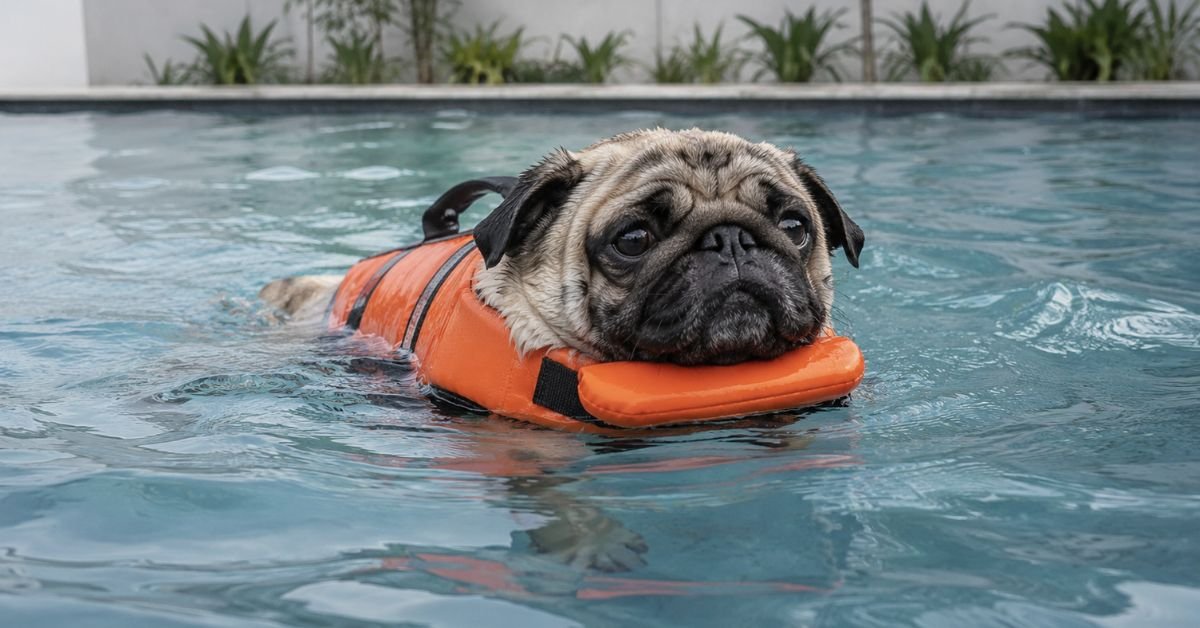
If you’ve searched for a pug dog swimming guide because your pug just stared at the pool like it owed him money, you’re not alone. I’ve had three pugs over the past 11 years, and every single one had the same reaction: pure confusion, followed by a body that sinks like a brick the second their paws leave solid ground.
This isn’t going to be one of those “dogs love water!” articles. Pugs are built wrong for swimming, and pretending otherwise gets dogs hurt.
Core Update Content
Why Pugs Struggle in Water (The Anatomy Nobody Explains Properly)

Pugs are front-heavy. Their chest and head carry most of their body weight, while their back legs are short and weak by comparison.
Put a pug in water without support, and physics takes over fast:
- Their head dips forward because there’s nothing in the back half to balance it out
- Their short legs can’t generate enough propulsion to keep their nose above the surface
- Their dense muscle-to-fat ratio means they don’t float the way a Labrador or a Golden Retriever does
I learned this the hard way with my first pug, Biscuit, in a friend’s backyard pool in 2015. No drama, no splashing for help he just sank silently. That silence is the scariest part. Pugs don’t always panic visibly when they’re struggling, which is exactly why supervision isn’t optional.
The Equipment You Actually Need (Skip the Cute Stuff)

Forget the bandana life vests sold as “accessories.” You need a vest engineered for buoyancy, not Instagram photos.
Most vests on the market are designed for medium and large breeds with even weight distribution. A pug’s body doesn’t work that way, so a “standard” vest often fails exactly where it matters most under the chin and chest.
Non-negotiables:
- A snug-fit dog life jacket with a handle on the back (for quick grabs)
- A jacket with flotation panels under the chest, not just the back this is the part most owners skip, and it’s the part pugs need most
- A shallow entry point (steps, ramp, or kiddie pool) never a drop-off edge for the first 10+ sessions
Standard Vest vs. Pug-Approved Front-Float Vest

Here’s the comparison nobody puts in writing, because most pet stores sell one generic vest for every breed shape. This is the difference that actually keeps a flat-faced dog’s nose above water.
| Feature | Standard Dog Life Jacket | Pug-Approved Front-Float Vest |
| Chest buoyancy | Minimal or none foam sits mostly on the back | Thick foam panel under the chest, where pugs actually need lift |
| Neck/chin support | Rarely included | Raised chin float or collar lip to stop the head from dipping forward |
| Weight distribution fit | Built for balanced (even front-to-back) breeds | Built for front-heavy, short-legged breeds |
| Handle placement | Single back handle | Back handle plus a front chest handle for fast head-lift grabs |
| Strap design | 2-strap, loose-fitting | 3-strap, snug-fit to prevent slipping off a short, barrel-shaped torso |
| Best for | Labradors, Retrievers, balanced-bodied breeds | Pugs, French Bulldogs, Boston Terriers, other brachycephalic breeds |
Why this matters in real use: a standard vest will float a pug’s back end just fine and let their head sink anyway which defeats the entire purpose. I switched to a front-float style vest after Biscuit’s near-miss, and it was the single biggest safety upgrade we made, more than any amount of training.
When shopping, search specifically for “brachycephalic” or “flat-faced dog” in the product listing not just “small dog life jacket,” which usually means smaller sizing, not different buoyancy engineering.
Common Mistakes Owners Make (That Undo All the Progress)
Even with the right vest, a few habits quietly sabotage the whole process. These are mistakes I’ve made myself or watched other pug owners make at the dog park pool days.
- Forcing the first dip. Carrying a pug straight into deep water “to get it over with” creates a fear response that can take months to undo
- Removing the vest too early. Owners often pull the vest after one or two calm sessions confidence in shallow water doesn’t transfer to confidence in deep water
- Swimming during peak heat. Midday sun plus water exertion is a fast track to heat stress in a breed that already struggles to cool itself efficiently
- Ignoring the recovery nap. Pugs need a longer rest period after swimming than most breeds expect them to sleep harder and longer for a few hours afterward, and don’t mistake that for something being wrong
Step-by-Step: Introducing Your Pug to Water Safely

Step 1 Land first. Practice putting the life jacket on at home, walking around the yard in it, for 2-3 days before water is even involved. Pugs hate new sensations on their body, and a vest is a new sensation.
Step 2 The kiddie pool phase (this is the part most guides skip). Buy a cheap, hard plastic kiddie pool, fill it with 2-3 inches of water max, and let your pug walk through it on their own terms. No lifting them in. No forcing.
Step 3 Add depth slowly. Once they’re comfortable standing in 3 inches, move to 6 inches over the next week. You’re teaching their body to trust water, not teaching them to swim yet.
Step 4 First real pool or lake session. Always with the life jacket. Always with you in the water beside them, one hand ready under their belly. Sessions should be 5-10 minutes max for a first-timer pugs tire fast and overheat even faster.
Step 5 Watch the breathing, not just the body. Brachycephalic dogs work harder to breathe even on dry land. Add swimming exertion, and you can see open-mouth breathing turn into genuine distress quickly. If the breathing sounds wheezy or strained, the session is over no exceptions.
The Wrinkle Problem Nobody Talks About
This is the part of every pug dog swimming guide that gets glossed over, and it’s arguably more dangerous long-term than the drowning risk.
Water trapped in facial wrinkles causes:
- Yeast and fungal infections (that musty, sour smell pug owners know too well)
- Skin fold dermatitis red, irritated, sometimes oozing skin
- In bad cases, swelling that affects breathing because the airway is already compromised
My post-swim drying routine (non-negotiable, every single time):
- Dry the body first with a regular towel
- Use a separate, dry cotton cloth or baby washcloth specifically for the face wrinkles
- Get into every fold nose roll, eye wrinkles, the chin pocket and press, don’t rub
- Follow up with a pet-safe wrinkle wipe containing a mild antifungal ingredient (ask your vet for a brand recommendation)
- Check again 2 hours later wrinkles can stay damp longer than you’d think
Skip this even once during a hot, humid week, and you’re looking at a vet visit within 48-72 hours. I’ve been there.
Unique “Pro-Tip” Section
The floating hot dog trick. Forget standard floating treats most pugs aren’t motivated enough to chase a bland rubber toy. Take a piece of low-sodium hot dog or a high-value freeze-dried liver treat, thread it onto a long wooden skewer, and let it bob just out of reach at the water’s surface. The smell pulls them forward better than anything store-bought I’ve tried.
The “dry land panic test” before you ever get near water. Before introducing a pool, gently mimic the sensation of water lapping by spraying a light mist from a spray bottle near (not on) their face. If they panic at mist, they will panic harder in water. This tells you how slow you genuinely need to go.
Ice cube trick for overheating, not for swimming. After a swim session in summer, pugs can overheat during the drying process because they’re already breathing hard. Letting them lick an ice cube (not bite, just lick) for a minute helps regulate their temperature without shocking their system the way a cold bath would.
Never swim within 90 minutes of feeding. This sounds like generic advice, but with pugs specifically, a full belly plus heavy front-body weight is a genuinely dangerous combination for bloat and labored breathing in water.
Conclusion
Pugs were never built to be natural swimmers, and no amount of practice changes their basic anatomy. What you can change is how safely and slowly you introduce them to water, how seriously you take the life jacket, and how disciplined you are about drying those wrinkles afterward.
Go slow. Watch their breathing more than their excitement level. A pug who’s calm and curious in 3 inches of kiddie pool water is a bigger win than one who’s “brave” in the deep end.
Frequently Asked Questions (FAQs)
Can pugs actually learn to swim, or will they always need a life jacket?
Most pugs can learn to paddle and move through water with practice, but very few ever become strong, self-sufficient swimmers because of their body shape. A life jacket isn’t a training-wheels phase you eventually remove it’s a permanent piece of safety gear for almost every pug, every time.
My pug shakes and whines near the pool is this normal, or should I stop trying?
Mild shaking and hesitation is normal first-time nervousness. But whining combined with trying to climb you or scratch at the edge to escape is a clear “no” signal push through that and you risk creating a lasting water phobia instead of confidence.
How do I know if my pug’s wrinkles got infected after swimming?
Watch for a sour or yeasty smell, redness, or the skin looking shinier and more irritated than usual within 24-48 hours. Catching it early with an antifungal wipe routine usually resolves it without a vet visit; waiting it out rarely does.
Is the ocean worse than a pool for pugs?
Yes, significantly. Waves and currents add unpredictable resistance that their short legs can’t compensate for, and saltwater dries out and irritates wrinkle skin faster than chlorinated or fresh water. If you do attempt the ocean, stick to ankle-deep water only, life jacket on, and treat it as a 2-minute supervised dip, not a swim session.
What’s the actual age to start introducing a pug puppy to water?
Wait until at least 12-16 weeks, after their core vaccinations, and even then keep it to the dry-land vest practice and kiddie pool stage only. Puppy lungs and temperature regulation are even less developed than an adult pug’s, so rushing this stage causes more harm than starting “too late.”