You Googled “training tips of bichon frise” at 11pm, didn’t you?
Maybe it was right after your Bichon peed on the rug again or after a neighbor knocked on your door about the barking. You’re not a bad pet parent. You’re just working with a dog that nobody gave you the real manual for.
That’s exactly what this guide is.
No recycled generic advice. No hollow “be consistent!” mantras. Just the breed-specific, field-tested, 2026-ready system that actually works for Bichons fluffy little tornadoes that they are.
The Bichon Mindset Why Traditional Training Backfires
They’re “Velcro Dogs.” That’s Not a Metaphor.

Bichons were literally bred to be human companions. Not hunters. Not herders. Companions. That means their entire nervous system is wired around you your mood, your tone, your presence.
When you raise your voice even slightly? They shut down. When you seem frustrated? They get anxious. When you leave? Their world collapses.
This is why harsh corrections, alpha-style dominance training, or anything remotely punitive makes training tips for bichon frise behaviour worse, not better.
Sensitivity Training Is Non-Negotiable
Think of a Bichon’s emotional regulation like a wine glass beautiful, functional, but it shatters if you handle it wrong.
What this means practically:
- A firm “No!” can set back a training session by days
- Even your stressed body language reads as a threat to them
- Short sessions (5–10 minutes max) prevent emotional flooding
- Calm, cheerful energy is your most powerful training tool
Trainer’s Note: I once worked with a 3-year-old Bichon named Coco who had “refused” to learn sit for months. Her owner was a lovely person but unknowingly held her breath and tensed her shoulders during training. We changed nothing except the owner’s body language. Coco learned sit in two days.
The Housebreaking Blueprint (Solving the #1 Bichon Problem)

Let’s address the elephant or rather, the puddle in the room.
Bichons are not stubborn about potty training. They are anatomically limited.
A Bichon puppy’s bladder is about the size of a grape. It physically cannot hold urine for long. Expecting a 10-week-old Bichon to “get it” in two weeks is like expecting a newborn to sleep through the night.
The 15-Minute Bladder Rule
Here’s the real science behind how to potty train a bichon frise:
- Puppies (8–16 weeks): Take outside every 15 to 20 minutes while awake
- After every meal: Out within 5 minutes, no exceptions
- After every nap: Straight outside before play
- After any excitement: Greetings, play sessions, visitors all trigger the urge
Set a phone timer. This isn’t a suggestion. It’s the whole system.
The Step-by-Step Routine
- Pick one spot. Same patch of grass every time. Smell cues reinforce the habit.
- Use a cue word. “Go potty” said calmly not as a demand, as a gentle reminder.
- Wait quietly. No talking, no phone. Let them sniff and focus.
- Jackpot the moment. The second they go? Throw a tiny party. High-pitched praise, a small treat, the works.
- No punishment for accidents. Ever. Rubbing their nose in it teaches them nothing except to fear you.
Trainer’s Note: Bichon housebreaking regressions are almost always tied to a change in routine, not stubbornness. New baby? House guests? Schedule shift? Your Bichon’s bladder habits will wobble. Go back to basics for 1–2 weeks and they’ll reset.
Handling Regression Without Punishment
Regression happens. It’s normal.
Your response:
- Quietly clean it up with an enzyme cleaner (regular cleaners leave scent traces)
- Ask yourself what changed in the last week
- Return to the 15-minute schedule for 5 to 7 days
- Never scold after the fact they genuinely cannot connect a past action to your current frustration
Curing Separation Anxiety in 2026

Bichon Frise separation anxiety solutions are one of the most-searched topics in Bichon communities and for good reason.
A Bichon left alone without preparation can spiral fast: barking for hours, destroying furniture, having accidents despite being fully housebroken, even self-harming behaviors like excessive licking.
The 2026 approach combines behavioral science with smart-home tools that genuinely work.
Modern Desensitization (The Behavioral Side)
Step 1: Practice micro-departures. Leave for 30 seconds. Return calm. No big hellos. Repeat 10x a day.
Step 2: Build duration slowly. 1 minute → 5 minutes → 15 minutes → 30 minutes. Never jump ahead.
Step 3: Create a “pre-departure ritual.” Same music, same Kong stuffed with frozen peanut butter, same “I’ll be back” phrase. Predictability = safety for anxious dogs.
Step 4: Departure cues lose their power. If your Bichon panics when they see keys? Pick up your keys 20x a day and put them down without leaving. They’ll stop meaning anything.
Smart-Home Tech That Actually Helps
In 2026, we have tools that previous generations of dog trainers could only dream about:
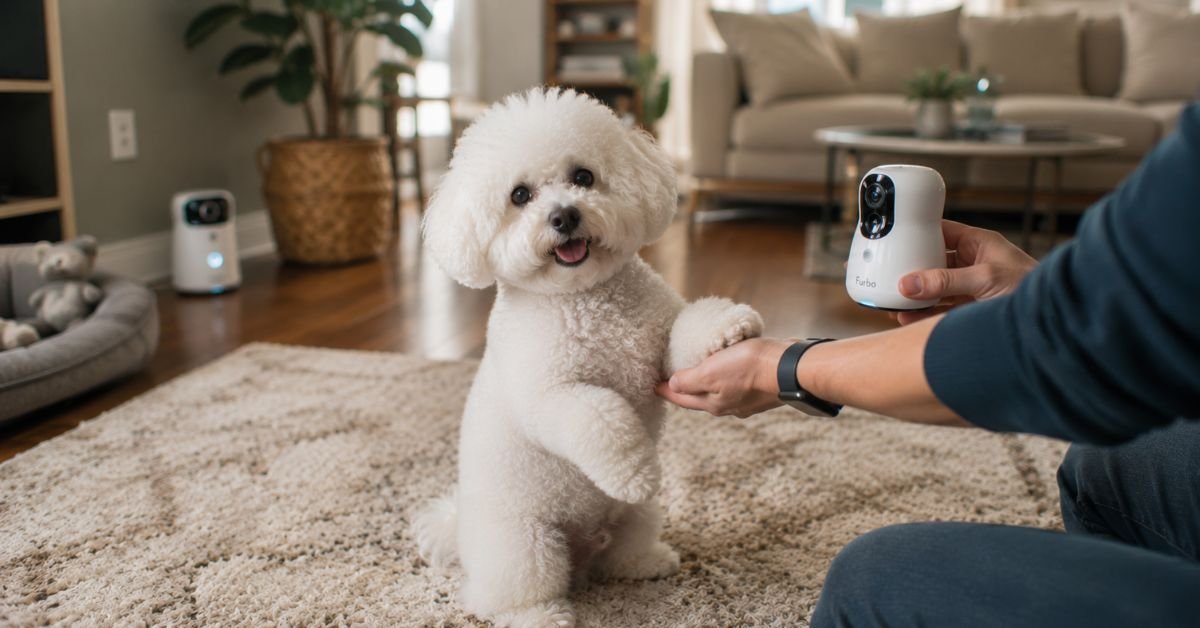
- AI dog cameras (Furbo, Petcube Bites 2): Two-way audio lets you check in without rushing home. Some models dispense treats remotely useful for calm-behavior reinforcement.
- Automated treat dispensers on a timer: Train your Bichon to settle on their mat, then set the dispenser to reward them every 20 minutes when you’re away. It teaches that calm + alone = reward.
- Calming playlists and white noise machines: Research backs this up specific frequencies genuinely lower canine cortisol. Spotify even has a “Music for Dogs” playlist.
- GPS + activity trackers (Whistle, Fi Collar): Monitor whether anxiety is actually improving over time with data.
Trainer’s Note: One of my clients used a Furbo camera to discover her Bichon was fine for the first 2 hours then spiraled around the time school buses went by. The problem wasn’t departure anxiety. It was noise sensitivity. Different problem, different solution. Tech gave us that data.
Socialization & Distraction-Proofing
The “Bichon Blitz” Is Real
If you’ve ever watched your Bichon suddenly sprint in insane circles around the living room for no apparent reason you’ve witnessed the Bichon Blitz (also called zoomies). It’s harmless, but it signals an overstimulated dog who needs an outlet.
During this state? Training is impossible. Don’t even try.
How to handle it: Let them run it out. Then, once they’re settled, that’s your training window.
How to Stop Bichon Frise Barking
Bichons bark at everything guests, squirrels, their own reflection, the concept of Tuesdays.
The counter-conditioning method:
- When they bark at something, say “thank you” calmly (acknowledges they alerted you)
- Redirect with “look at me” and a treat
- Reward four seconds of quiet that’s the behavior you want
- Build quiet duration over weeks
Never yell “Quiet!” It sounds like you’re barking with them.
Teaching Focus in High-Distraction Environments
This is why your Bichon listens perfectly in your living room but ignores you completely at the park.
The “outside bubble” technique:
- Start training in a low-distraction backyard, not a busy park
- Practice “look at me” 20x per session until it’s automatic
- Slowly increase distractions one step at a time
- Carry high-value treats outside (chicken, cheese) versus the boring kibble used indoors
The rule: the more distracting the environment, the better the treat.
Grooming Manners From “Please No” to “Fine, Whatever”

Most Bichons learn to hate grooming because it starts wrong.
Holding a puppy down for a full groom on day one? That’s a trauma event, not a training session.
The Gradual Desensitization Method
Week 1: Touch paws, ears, and mouth daily. No tools. Just gentle handling. Treat generously.
Week 2: Introduce the brush. Let them sniff it. Touch it to their coat for 3 seconds. Treat. Done.
Week 3: Short brushing sessions 30 seconds max. Build from there.
For nail clipping specifically:
- Touch the clippers to each paw. Treat.
- Clip one nail. Treat enormously. Session over.
- Build to two nails, then three, over weeks
Trainer’s Note: Tear stain cleaning is the thing Bichon owners dread most. The trick? Warm water on a soft cloth, and pair it always with a high-value treat held in front of their face. They’re focused on the treat, not the cloth. In three weeks, most Bichons stand completely still for it.
Your Daily Training Checklist (For Busy Owners)
Here’s the bichon frise puppy training schedule that works for real life not Pinterest perfection:
Morning (10 minutes)
- [ ] Potty trip immediately after waking
- [ ] 5-minute training session (sit, stay, name recognition)
- [ ] Potty trip after breakfast
Midday (5 minutes)
- [ ] Potty trip
- [ ] 1-minute “look at me” practice
- [ ] 30-second grooming touch session
Evening (10 minutes)
- [ ] Short walk with focus work (“look at me” around distractions)
- [ ] Potty trip before bed routine
- [ ] 5-minute calm-settle practice (mat training)
Weekly
- [ ] One new environment for socialization (coffee shop patio, friend’s house)
- [ ] One extended brushing session (building duration by 30 seconds each week)
- [ ] Review what’s working; adjust what isn’
The Bottom Line
Bichons aren’t hard to train. They’re hard to train wrong.
They respond to gentleness, consistency, and understanding that their brain is wired for connection not compliance. Work with that wiring instead of against it, and you’ll have a dog that’s not just well-behaved, but genuinely happy.
The best training tips of bichon frise all come back to one thing: build trust first, and the rest follows.
Start with just two things tomorrow: the 15-minute bladder schedule and one 5-minute training session with zero frustration. That’s it. That’s the whole first step.
You’ve got this. And honestly? So does your Bichon
Frequently Asked Questions
How long does it take to potty train a Bichon Frise?
Most Bichons reach reliable housebreaking between 4 to 6 months but some take up to a year. It’s almost never attitude; it’s anatomy. Stick to the 15-minute schedule consistently and you’ll get there.
Are Bichon Frises easy or hard to train?
Bichons are intelligent and eager to please, which makes them very trainable but only with the right approach. They’re emotionally sensitive and shut down under pressure or harsh tones. With positive reinforcement and short, cheerful sessions, most Bichons pick up commands quickly.
Why does my Bichon Frise listen indoors but ignore me outside?
Your dog has learned commands in a low-distraction environment, so cues only work there. Outside, smells and sounds compete for attention. The fix: train in progressively more distracting environments with higher-value treats (chicken or cheese, not kibble).
How do I stop my Bichon Frise from barking so much?
Never yell “Quiet!” to your Bichon it sounds like you’re joining in. Use the counter-conditioning method: say “thank you” calmly, redirect with “look at me,” then reward four seconds of silence. Build that quiet duration over weeks.
Can I leave a Bichon Frise alone during the day?
Yes but it requires gradual preparation. Start with 30-second micro-departures and build up slowly over weeks. A well-prepared Bichon can comfortably handle 4–6 hours alone. Smart-home tools like AI cameras and treat dispensers help enormously.
What is the best age to start training a Bichon Frise puppy?
Start the day you bring them home typically 8 weeks. Early socialization between weeks 8–16 is especially critical. Keep sessions to 3 to 5 minutes at this age. Short, positive, and frequent beats are long and exhausting every time.