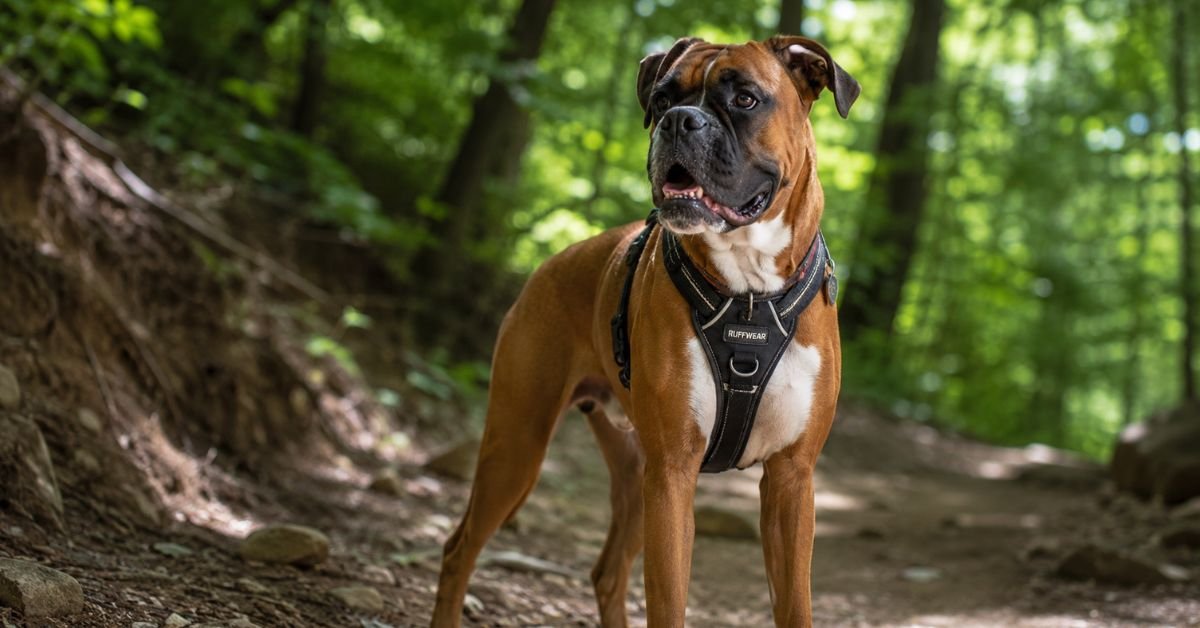
There’s a special kind of chaos that comes with hiking alongside a Boxer and if you’ve tried it, you already know. These dogs are pure joy on four legs: thunderously excited, embarrassingly affectionate, and genetically wired to sprint directly toward whatever they shouldn’t. But following the right boxer dog hiking tips isn’t just about having fun it’s about understanding what makes this breed genuinely different from every other dog bounding down a trail, and making decisions that protect that wrinkled, wheezing, irresistible face you love.
This guide was built for real Boxer owners, not hikers who happen to own dogs.
The Boxer’s Anatomy vs. The Trail: Why Their Nose Changes Everything

Most dog hiking guides were written with a Labrador in mind. Boxers are not Labradors.
Boxers are brachycephalic, a term that means “short-skulled” and carries serious implications on the trail. Their compressed nasal passages, elongated soft palates, and narrowed tracheas mean they physically cannot move air through their airways as efficiently as longer-snouted breeds.
What this means in practice:
- A Labrador pants to release 80 to 90% of body heat through evaporative cooling. A Boxer’s panting is measurably less effective; their anatomy restricts airflow before it even reaches the lungs.
- Steep inclines that a Border Collie shrugs off can push a Boxer into respiratory distress within minutes, not hours.
- High humidity compounds the problem exponentially. On a 78°F day with 85% humidity, a Boxer can begin showing signs of heat stroke in under 20 minutes of vigorous activity.
Your trail selection strategy should reflect this biology. Flat to moderate terrain, shaded canopy trails, and lower-elevation routes aren’t a compromise they’re the correct choice for brachycephalic dog trail safety.
Check the elevation profile of any trail before you go. In 2026, apps like AllTrails Pro and FarOut now feature AI-integrated trail mapping that lets you filter by shade percentage, elevation gain per mile, and even crowd density all factors that matter enormously for a Boxer’s safety on the trail.
Pre-Trail Conditioning for a Goofy Athlete: Building Stamina Without Burning Out
Here’s the cruel irony of owning a Boxer: they look like elite athletes and act like they can run forever right up until they can’t.
Boxers are sprint dogs masquerading as endurance athletes. They have explosive, muscular energy reserves that deplete faster than their enthusiasm suggests. Owners on r/Boxer frequently report the same experience: their dog bolted up the first mile like a rocket, then collapsed into a panting heap and refused to take another step. This is not stubbornness. This is physiology.
Build trail fitness over 6–8 weeks with a structured progression:
- Weeks 1–2: Daily 20–30 minute walks on varied terrain (gravel, grass, slight incline). Focus on loose-leash manners and paw conditioning.
- Weeks 3–4: Introduce 45-minute sessions with short uphill bursts. Watch respiratory rate carefully if they’re breathing with an open, wide mouth and their sides are heaving, stop and rest.
- Weeks 5–6: Attempt 60 to 90 minute hikes on low-elevation trails. Practice stopping at intervals, not just when the dog demands it.
- Weeks 7–8: Graduate to your target trail distance, always keeping 30% energy in reserve for the return trip.
The golden rule of Boxer energy management on trails: Always plan the turnaround point at less than half your dog’s perceived capacity. The way back is always harder than the way out.
Gear That Actually Matters (2026 Edition)
The hiking dog gear market has matured significantly. For Boxer owners specifically, three categories of equipment are non-negotiable.
Cooling Vests: Now Smarter Than Ever

The old wet-bandana method is obsolete. Modern phase-change cooling vests for dogs brands like Ruffwear’s Swamp Cooler Pro and the Hurtta Cooling Wrap use evaporative and conductive cooling to actively pull heat away from the dog’s core.
In 2026, several vests now integrate temperature-sensing panels that change color when your dog’s surface skin temperature enters the warning zone. This is genuinely useful for brachycephalic breeds because their heat signals come faster and with less behavioral warning than other dogs.
Fit matters critically for Boxers. Their deep chest, narrow waist, and muscular shoulders make standard sizing unreliable. Look for vests with independent chest and girth adjustments.
Harnesses: Protecting That Deep Chest Without Chafing
Boxers have a thin, fine coat with minimal undercoat meaning friction burns from ill-fitting harnesses develop faster than in double-coated breeds.
The best hiking harness for Boxers shares these features:
- Y-front or H-style chest design avoids pressure on the sternum and allows natural shoulder movement
- Padded sternum and girth straps essential for preventing hot spots on their short, sensitive coat
- Rear attachment point for non-pulling trail walking, front attachment for redirecting on switchbacks
The Ruffwear Front Range and Julius-K9 IDC Powerharness consistently perform well for the Boxer body type. Avoid vest-style harnesses with broad chest panels they restrict the shoulder rotation that Boxers rely on for their characteristically bouncy gait.
Dog Booties: Not Just for Snow
Boxer paw pads are thinner and more susceptible to abrasion than working breeds with tougher foot structure. Volcanic rock, shale, and sun-baked granite can cause significant paw damage within a single hike.
Dog booties for sensitive paws specifically the Ruffwear Grip Trex or QUMY non-slip trail boots take adjustment time. Introduce them on short neighborhood walks for 2 weeks before trail use.
If booties are a non-starter, paw wax (Musher’s Secret or Tuff Paw) applied 20 minutes pre-hike provides meaningful abrasion resistance. Inspect pads at every rest stop for cracking, bleeding, or limping.
The “Boxer Flop” and Trail Behavior: Decoding What Your Dog Is Telling You

Anyone who has walked a Boxer has encountered the Flop: a sudden, dramatic collapse onto the ground with zero warning, often in the worst possible place (a narrow switchback, the middle of a bridge, directly in front of other hikers).
The Flop is one of the most discussed topics on r/hikingwithdogs for Boxer owners, and it’s almost always misread as stubbornness or drama. The Flop is usually communication.
Why Boxers flop on trails:
- Thermal overload Their cooling system is maxed and they’re self-regulating. This is the most medically important cause.
- Sensory overwhelm Boxers form intense emotional bonds with their owners and can develop anxiety in new, stimulating environments. The trail is loud, smelly, and full of strangers.
- Genuine fatigue They’ve hit their limit and their body is overriding their enthusiasm.
- Paw pain Subtle surface discomfort they can’t articulate any other way.
When your Boxer flops:
- Stop immediately and find shade. Do not pull, coax, or force movement.
- Check paw pads and temperature.
- Offer water and give a 10–15 minute rest minimum.
- If the flop happens within the first 30% of the hike, turn around. Their body is telling you the conditions are wrong today.
Managing Trail Excitement and Wildlife Encounters

Boxers have a significant prey drive and are notoriously distracted by other dogs, wildlife, and strangers. Their over-friendly exuberance the full-body wiggle, the face-first launch is endearing at home and genuinely dangerous on a narrow trail with a 60-lb dog on the wrong end of your leash.
Trail etiquette for energetic breeds requires proactive management:
- Default to stepping off the trail when approaching other hikers. This prevents the sudden lunge greeting that can knock someone down a slope.
- Practice “Look at That” (LAT) counter-conditioning before trail trips teach your Boxer that spotting another dog or person triggers a look-back-at-you reflex, not a launch sequence.
- In wildlife-rich areas, use a short 4–6 foot leash rather than a retractable. Retractable leashes are actively dangerous on trails with any elevation change and violate Leave No Trace guidelines on most federal lands.
2026 Leave No Trace Update: Many national forests and BLM lands now require dogs to be leashed at all times and mandate that owners carry waste bags rated for environmental decomposition. Biodegradable waste bags are now the standard expectation, and several wilderness areas are conducting compliance checks at trailheads.
Emergency and First Aid: Heat Exhaustion vs. Normal Panting
This is the section that could save your dog’s life.
Boxers pant heavily during exercise that’s normal. But the line between normal panting and canine heat stroke is thin for brachycephalic breeds, and crossing it without intervention can be fatal within 30–60 minutes.
Normal panting (you’re fine to continue):
- Mouth is open but relaxed, tongue is pink
- Dog is still tracking movement and responding to commands
- Breathing is rhythmic, not gasping
- Dog willingly drinks water when offered
Heat exhaustion warning signs (rest immediately, monitor closely):
- Excessive, labored panting with a wide, curled tongue
- Saliva becoming thick and ropy rather than watery
- Glazed or unfocused eyes
- Reluctance to move or sudden weakness in hind legs
- Gums shifting from pink to pale, brick red, or white
Heat stroke emergency signs (act within minutes):
- Vomiting, diarrhea, or stumbling
- Gums that are bright red or grey
- Collapse or unresponsiveness
- Rectal temperature above 104°F (use a digital thermometer pack one)
Emergency cooling protocol:
- Move to shade immediately.
- Apply cool (not cold or ice) water to paw pads, groin, armpits, and neck these are the primary heat-exchange zones.
- Fan actively. Do not cover with a wet towel this traps heat.
- Offer small sips of water only if the dog is conscious and alert.
- Begin evacuation to a veterinarian regardless of apparent recovery. Internal organ damage from heat stroke is not visible and requires bloodwork to assess.
Canine heat stroke prevention is always better than treatment. Download an offline veterinary first aid guide (the ASPCA and AVMA both publish free PDFs) and save it to your phone before you leave cell range.
Conclusion:
A well-prepared Boxer on a trail is one of life’s genuine pleasures. They meet every tree, rock, and fellow hiker with the same absurd, full-body enthusiasm they bring to breakfast. They make you laugh. They make strangers stop and ask what breed that is. They collapse next to you at the summit and look at you like you’ve just done the best thing anyone has ever done.
But that experience only happens safely when you understand who they actually are a brachycephalic, heat-sensitive, emotionally intense, anatomically specific dog who deserves gear, trails, and plans built around their biology rather than the average dog’s.
Know the signs. Pack the right gear. Condition before you commit to mileage. And when they flop and they will flop listen.
The trail will be there next weekend. Your Boxer won’t be.
Frequently Asked Questions
Q: How far can a Boxer hike in a single day?
Most adult Boxers (ages 2–6, fully conditioned) can comfortably handle 5 to 8 miles on moderate terrain in cool conditions (under 65°F). In temperatures above 70°F, halve that estimate. Senior Boxers (7+) should be limited to 3 to 4 miles with frequent rest breaks. Puppies under 18 months should not hike distances that exceed their joint development capacity avoid sustained hikes longer than 20 to 30 minutes until growth plates close.
Q: My Boxer flopped and won’t move on the trail how do I get them going again?
First, rule out heat and injury before trying to encourage movement. Let them rest fully for 10–15 minutes in shade with water available. If after that rest they’re still reluctant, treat it as a signal to turn back rather than a training challenge. Never drag or forcibly pull a Boxer who has flopped you risk both injury and a complete breakdown of trail trust. If they physically cannot walk after rest, you may need to carry them out (at 50–70 lbs, plan accordingly by always hiking with another person when possible).
Q: What temperature is too hot to hike with a Boxer?
As a general guideline, once ambient temperature exceeds 75°F with any meaningful humidity, a Boxer should not be taken on strenuous trail hikes. On overcast, low-humidity days, up to 78°F can be manageable with cooling gear, shade breaks every 15 minutes, and constant hydration. Above 80°F, the risk of heat exhaustion in brachycephalic dogs becomes significant enough that hiking should be postponed or replaced with an early morning outing (before 8 AM) when ground temperature is cooler.
Q: Do Boxers need dog boots on hiking trails?
Not universally, but more often than owners expect. Boxers have thinner paw pads than many working breeds, and jagged rock surfaces especially granite, shale, and lava rock can cause abrasion within a single outing. Paw wax offers basic protection on moderate terrain. On technical rocky trails, booties are strongly recommended. The bigger challenge is acclimation: introduce boots gradually over 1 to 2 weeks at home before expecting cooperation on a trail.
Q: Are there hiking trails that are better suited for Boxers than others?
Yes. The ideal Boxer trail has: consistent shade coverage (forest canopy over open meadow or exposed ridgeline), low-to-moderate elevation gain (under 500 feet per mile), soft or packed dirt surface rather than exposed rock, accessible water sources, and cooler microclimate. Coastal trails, riparian corridors along rivers, and forested low-elevation paths consistently outperform exposed high-desert or alpine routes for brachycephalic breeds. Use AllTrails filters for “dog-friendly,” “shaded,” and “easy to moderate” as your starting parameters.