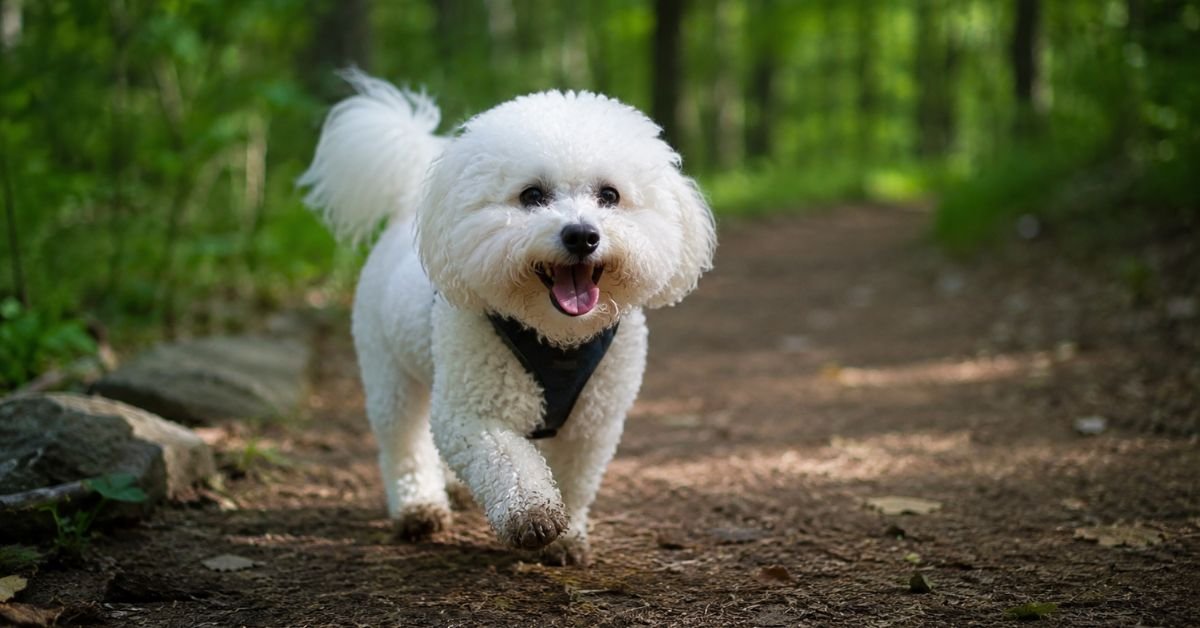
Bichon Frises were bred as active Mediterranean sailing companions not lapdogs.
These bichon frise hiking tips will help you leverage that natural stamina while protecting their specific vulnerabilities: a velcro-textured curly coat, patellar luxation-prone joints, and a semi-restricted airway that accelerates heat buildup.
Physical Prep & Stamina
Condition your Bichon over 4 to 6 weeks before attempting any real trail.
A trail-ready adult Bichon (18 months+) should comfortably complete three consecutive 45-minute walks with elevation changes before their first hike.
Realistic distance limits:
- Healthy adult (1.5–7 years): 3–5 miles on moderate terrain
- Senior (7+ years) or puppy (under 12 months): under 2 miles, flat only
The Velcro Coat Problem

A Bichon’s dense, double-curl coat embeds burrs, ticks, seeds, and sap at an exceptional rate a single bramble patch can mean 45 minutes of post-hike detangling.
Pre-hike coat protocol:
- Apply a silicone-based detangling spray (Bio-Groom Super Cream or equivalent) to legs, belly, and chest creates a slick barrier that prevents debris from anchoring
- Use a protective trail bodysuit (Gooby or Ruffwear XS–S) on dense vegetation routes
- Trim paw and leg “feathers” before hiking season
Post-hike essentials: Fine-tooth metal comb, fragrance-free baby wipes, tick removal tool, travel detangling spray.
Terrain & Joint Safety

Bichon Frises carry a genetic predisposition to patellar luxation kneecap displacement triggered by steep descents and impact landings.
Watch for sudden three-legged gait or a skipping motion. Stop immediately if observed.
Hard rules on trail:
- No jumping off rocks or logs lift them over obstacles
- Take full switchbacks; never allow straight-down scrambling
- Prefer soft soil and packed dirt over rocky scree
- Slow pace dramatically on all downhill sections
Vet-recommended glucosamine/chondroitin supplementation from age 2 onward provides measurable long-term joint protection for active small breeds.
Heat & Hydration Control

Bichons have a moderately shortened muzzle that restricts airflow relative to long-nosed breeds. Combined with a thick double coat, core temperature rises faster than most owners expect.
Stop and seek shade immediately for:
- Rapid shallow panting that doesn’t ease during rest
- Bright red gums or tongue
- Stumbling or disorientation
Hydration rule: 1 oz of water per pound of bodyweight per hour of activity. A 12 lb Bichon needs ~12 oz/hour.
Cooling tactics:
- Wet the belly and inner thighs (thin fur, surface vessels) for rapid temperature drop
- Use an evaporative cooling vest (Ruffwear Swamp Cooler XS)
- Hike before 10 AM or after 3 PM on warm days
2026 Gear Checklist
| Gear | Purpose | Key Spec |
| Step-in mesh harness | Prevents tracheal stress | XS, padded chest plate |
| Paw boots | Guards pads on rock/heat | Ruffwear Grip Trex XS, flexible sole |
| Micro GPS tracker | Trail safety if dog bolts | Tractive Nano (<10g), clips to harness |
| Evaporative cooling vest | Heat management | Ruffwear Swamp Cooler XS |
| Silicone collapsible bowl | Hydration on-trail | Folds flat, dishwasher safe |
| Protective trail bodysuit | Full coat debris shield | Breathable lycra, belly coverage |
| Mini first aid kit | Cuts, stings, splinters | Tweezers, vet wrap, saline, vet-dosed Benadryl |
Trail Etiquette & Wildlife Safety

Recall is non-negotiable. A Bichon without a solid “come” command stays on leash always.
Off-leash dogs are the top hazard for small breeds on trails. When an uncontrolled dog approaches: step aside, pick up your Bichon, request a recall before proceeding.
Predator awareness: Hawks, coyotes, and foxes actively target small, light-colored dogs. Keep your Bichon on a 4 to 6 ft leash in wildlife-active zones. Avoid dawn and dusk hiking windows.
Conclusion
A conditioned Bichon Frise with the right gear, a protected coat, and joint-smart trail habits is a genuinely capable hiking companion.
Build gradually. Watch for fatigue signals. Protect the coat before you leave the house. The trails are accessible and your Bichon will love every step.
FAQs
How far can a Bichon Frise realistically hike?
A healthy conditioned adult Bichon can handle 3 to 5 miles on moderate terrain with breaks. Puppies under 12 months and seniors over 7 years should stay under 2 miles on flat ground.
How do I keep mud and burrs out of my Bichon’s fur during a hike?
Apply a silicone-based detangling spray to legs, belly, and chest before setting out. For heavy vegetation trails, add a protective lycra trail bodysuit. Carry a fine-tooth comb for on-trail fixes.
Do Bichon Frises need boots for hiking?
On rocky terrain or surfaces above 85°F (29°C), yes. Boots protect pads from cuts, heat burns, and embedded burrs. Introduce them at home first most Bichons need 2–3 sessions to walk normally in them.
What are the signs my Bichon is getting too tired on the trail?
Stop and rest immediately if you observe: lagging behind, shallow panting that won’t slow, lifting paws, bright red gums, or refusal to continue. These are not behavioral they are physiological warning signs.
Bichon