If you’ve been searching for real, breed-specific cavalier king hiking tips not the watered-down “bring water and check paws” advice you’ll find everywhere else you’re in the right place. These silky-eared dogs can absolutely share the trail with you, but they come with a specific set of physiological needs that most generic hiking guides completely miss.
I learned this the hard way with my 3-year-old Cavalier king charles spaniel hiking tips, Charlie. And trust me, that lesson cost me a mile of trail-carrying a very smug, fluffy emperor in my arms.
Charlie’s Trail Disaster: The Story Behind This Guide
It was a crisp October morning. I’d packed everything I thought we needed collapsible water bowl, treat pouch, a small first aid kit. Charlie trotted out of the car looking like royalty, his copper-and-white feathering catching the light perfectly.
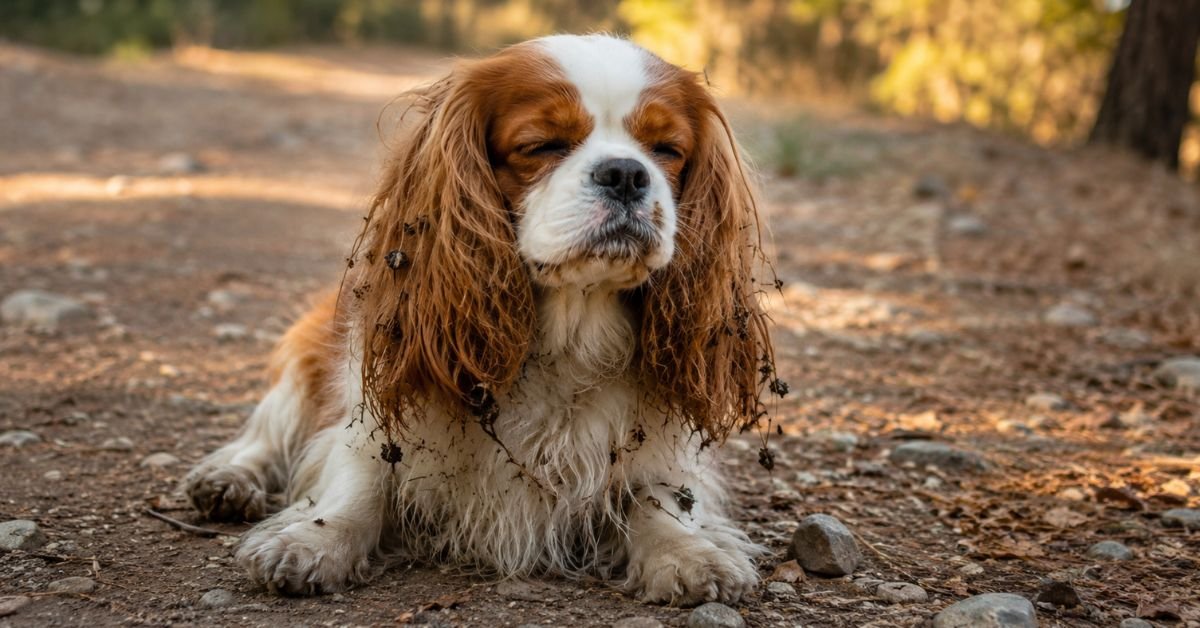
Two miles in, that same beautiful coat had become a velcro magnet for the entire ecosystem. Burrs, seed heads, and tangled plant matter were woven through his chest feathers and ear fringes. I spent 20 minutes picking debris off him by a creek.
Then, at the steepest section of the trail, Charlie sat down. Full stop. Refused to move.
He wasn’t injured. He wasn’t in distress. He was just done. And because I hadn’t brought a dog backpack, I improvised a carry with my hiking jacket across a full mile of uneven terrain while he rode like royalty. Again.
Never again. Now I hike smarter. Here’s the complete system I’ve built since that trip.
The 80°F (26°C) Hard Limit: Cavaliers and Heat Safety

Direct answer: The absolute maximum safe hiking temperature for a Cavalier King Charles Spaniel hiking tips is 80°F (26°C). Because Cavaliers are a mildly brachycephalic breed with compressed airways, temperatures above this threshold cause rapid heat exhaustion and severe respiratory distress far faster than in longer-muzzled breeds.
Most people don’t mentally categorize Cavaliers as brachycephalic they aren’t as extreme as Bulldogs or Pugs. But that mild airway compression is real, and it matters on a warm trail more than most owners expect.
Plan your timing accordingly:
- Best window: Before 9 AM or after 6 PM in warm months
- Avoid: Sun-exposed ridgelines and open terrain after mid-morning in summer
- Emergency signs to watch for: Labored panting, excessive drooling, glazed eyes, stumbling gait stop and cool down immediately if you see any of these
My personal rule with Charlie is simple: if my phone’s weather app reads 80°F or higher at trailhead time, we turn around and walk the neighborhood instead. No exceptions.
Realistic Distance & Elevation Limits by Life Stage
Direct answer: A healthy adult Cavalier can safely hike 3–5 miles on moderate terrain with elevation gain under 500 feet. Puppies should be capped at 1–1.5 miles on flat ground, and seniors at 1.5–2 miles maximum, regardless of how eager they appear.
This is where I see the most well-meaning owners push too hard. A Cavalier is built for companionship, not endurance athletics. Here’s the full breakdown:
Puppies (Under 18 Months)
- Max distance: 1–1.5 miles, flat terrain only
- Elevation: Zero growth plates are still developing and stress injuries are a real risk
- Treat these as confidence-building nature walks, not hikes
Fit Adults (18 Months – 7 Years)
- Sweet spot: 3–5 miles on moderate, well-shaded trails
- Elevation gain: Keep cumulative gain under 500 feet per outing
- Water and rest break every 30–40 minutes
- Charlie handles 4 miles comfortably on a cool morning that’s roughly his ceiling for a great day
Senior Dogs (7 Years and Older)
- Hard cap: 1.5–2 miles, even if they’re eager and pulling ahead
- Older Cavaliers mask discomfort exceptionally well and will push past their limit for you
- Flat, shaded trails with soft surfaces only
The Backpack Backup Strategy: Your Non-Negotiable Trail Insurance

Direct answer: Every Cavalier owner should carry a dog backpack or front-mounted carrier on every hike. When a Cavalier hits their physical limit, they stop and you need a safe way to carry them out without improvising with your jacket the way I did with Charlie.
After that first trail disaster, a front-mounted dog carrier became permanently attached to my hiking kit. Keeping Charlie against my chest means I can monitor his breathing and body temperature in real time a genuine safety advantage, not just convenience.
Pull out the carrier when you see:
- The classic Cavalier sit-down protest (sudden, total refusal to move)
- Paw pads showing pink irritation or sensitivity on rough terrain
- Breathing becoming noticeably faster or more labored than usual
- You’re on the return leg and they’re visibly flagging
What to look for in a carrier:
- Mesh ventilation panels on all sides
- A supportive, padded base that keeps the spine in a natural position
- Secure chest clip so they can’t shift forward unexpectedly on descents
The goal isn’t to carry them the whole hike. It’s having a reliable exit plan your trail insurance policy for the moment they hit their limit.
Coat Management: The Pre-Hike Conditioner Trick and Post-Hike Brush Routine

Direct answer: Apply a lightweight leave-in conditioning spray to your Cavalier’s feathering before every hike to create a slick surface that prevents burrs and foxtails from gripping deeply. Follow with a full slicker brush session within 30 minutes of finishing the hike, before debris can mat further into the coat.
Charlie’s coat taught me everything. Here’s the system I use every single time now.
Before the Hike (In the Parking Lot)
Spritz a leave-in conditioning spray through the chest feathering, ear fringes, and leg furnishings. The light coating makes the coat surface slightly slippery burrs land on it rather than grip into it. Takes 90 seconds and saves 20 minutes of detangling later.
Run a quick finger-comb through the chest and underarm areas to catch any pre-existing tangles before they compound on the trail.
On the Trail
Watch specifically for foxtail grass in dry, late-summer terrain. Those barbed seed awns don’t just tangle they can penetrate skin and migrate to internal organs, causing serious damage. In high-foxtail areas, put a lightweight mesh snood on Charlie’s ears and use a belly band to protect the underbelly feathering.
Post-Hike (Within 30 Minutes)
Slicker brush, head to tail, before you drive home. Foxtails and burrs are dramatically easier to remove before they’ve had time to dry and mat further in. Work methodically: ears, chest, armpits, belly, between every toe.
I do a dedicated fine-tooth comb pass through the ear fringes last — that’s where foxtails hide and begin migrating inward. Don’t skip this step.
Critical Medical Warnings: MVD and Syringomyelia on the Trail
Direct answer: Before hiking any Cavalier, get a cardiac evaluation for Mitral Valve Disease (MVD) and always use a Y-shaped harness never a collar due to Syringomyelia (SM) risk. These two breed-specific conditions are non-negotiable safety factors for trail activity.
This section isn’t here to frighten you away from hiking. It’s here to make sure you hike informed.
Mitral Valve Disease (MVD): The Pre-Hike Cardiac Check
MVD affects the majority of Cavaliers by age 10, with many developing early murmurs far younger. It’s the most common cause of death in the breed.
Get a cardiac clearance from your vet before establishing any hiking routine. The conversation you need to have: “Given my dog’s current murmur grade, what are safe exercise intensity and distance limits?” A Grade 1 murmur with no symptoms is a very different situation from a Grade 3 your vet’s answer should shape your trail plan directly.
Syringomyelia (SM): Why a Y-Harness Is Mandatory

Syringomyelia causes fluid-filled cavities to form within the spinal cord, often linked to the Cavalier’s characteristic skull shape. A key symptom is extreme sensitivity around the neck and shoulders.
Never attach a leash to a collar on a Cavalier ever. Leash pressure and sudden jerks transmit directly to the neck and can worsen SM symptoms, or aggravate an undiagnosed case.
Use a Y-shaped harness exclusively. Not an H-shaped harness or figure-8 style both can restrict shoulder movement. The Y-front design distributes all pressure across the chest and sternum, keeping the neck completely free. This is a permanent, non-negotiable rule for Charlie on every walk, diagnosed or not.
Managing Spaniel Prey Drive on the Trail
Direct answer: Cavaliers retain genuine spaniel hunting instinct they will lock onto scent trails, lunge at wildlife, and selectively lose their recall ability when prey drive activates. Manage this with a 20-foot long line on open trails and a solid, distraction-proofed recall cue before any off-leash freedom.
This gets skipped in almost every Cavalier hiking article, and it shouldn’t. These dogs were bred to flush birds. That instinct doesn’t disappear because you live in a suburb.
How spaniel prey drive shows up on the trail:
- Sudden, hard lunging toward rustling undergrowth
- Nose-locked tunnel vision when a scent trail activates
- Complete selective deafness when a squirrel, rabbit, or bird enters the picture
My system with Charlie: a 20-foot long line on wider, quieter trails. Not full off-leash freedom but enough slack that he can sniff, explore, and feel independent while I retain control the moment his prey drive switches on. On narrow or busier trails, he’s on a 6-foot leash with a heel cue we trained specifically for trail environments.
One hard rule: If your Cavalier’s recall isn’t reliable under genuine high-distraction conditions, they stay on leash until it is. No summit view is worth a lost dog in the backcountry.
Hydration and the Ear Trick: Keeping Cavaliers Drinking (Without Soaking Their Fringes)
Direct answer: Offer water every 20–30 minutes on the trail using a shallow, wide silicone bowl that allows ear fringes to fall outside the rim. Use a snood during water breaks to keep ear fringes dry and prevent the ear infections Cavaliers are already predisposed to.
Don’t wait for obvious thirst signals by the time a Cavalier shows them, mild dehydration has already set in.
| Problem | Trail Solution |
| Ear fringes dragging into the bowl | Shallow, wide silicone bowl ears fall naturally outside the rim |
| Ears still getting wet | Snood on before every water break packable, cheap, 10 seconds to apply |
| Dog refusing trail water | Tiny splash of low-sodium chicken broth to encourage drinking |
| Wet ear fringes at hike’s end | Pat dry with microfiber cloth, fully air-dry before crating |
I keep a snood clipped to the outside of my pack on every hike. It takes up zero space and has saved Charlie from several post-hike ear infections that I now know were entirely preventable.
Complete Pre-Hike Checklist for Cavalier Owners
Run through this before every trailhead:
- Temperature confirmed under 80°F / 26°C
- Vet cardiac clearance current (especially dogs over 4 years)
- Y-shaped harness fitted no collar attached to leash
- Leave-in conditioner applied to feathering in the parking lot
- Shallow, wide silicone water bowl packed
- Snood packed for water breaks
- Dog backpack or front carrier packed (your exit plan)
- 20-foot long line or 6-foot leash selected for trail type
- Post-hike slicker brush and fine-tooth comb in the car
- First aid kit including fine-point tweezers for foxtail removal
Questions Cavalier Owners Ask Me All the Time
Can Cavalier King Charles Spaniels go on long hikes?
Yes but “long” for a Cavalier means something different than it does for a Lab or a Husky. A fit adult Cavalier can handle 3–5 miles on moderate terrain in cool conditions. Anything beyond that starts pushing into territory where heat, joint fatigue, and cardiac stress become real concerns. Distance is not a badge of honor with this breed coming home healthy is.
What type of harness is safest for a Cavalier on the trail?
A Y-shaped front harness is the only safe option. Never use a collar, and avoid H-shaped or figure-8 harnesses that restrict shoulder movement. The Y-front design keeps all pressure off the neck and throat entirely, which is critical given the breed’s Syringomyelia risk even in dogs that haven’t been formally diagnosed.
How do I know if my Cavalier is too tired to keep hiking?
Watch for these signals: sudden sit-down refusal to move, paw pads appearing pink or sensitive, breathing that becomes faster or more shallow than their normal trail pace, and tail carriage dropping low. Cavaliers are people-pleasers they will push past their limit for you. It’s your job to read the signs before they do.
Do Cavaliers need special paw protection on trails?
On rocky, gravelly, or hot-surface terrain, yes. Dog booties or paw wax applied before the hike protect the pads from abrasion and heat transfer from sun-baked ground. Always check between the toe pads after every hike foxtails love to wedge in there and go unnoticed until they cause an infection.
Is it safe to hike with a Cavalier that has a heart murmur?
It depends entirely on the murmur grade and your vet’s assessment don’t make this call yourself. A low-grade murmur with no symptoms may still allow moderate trail activity. A higher-grade murmur may mean trail walks are off the table entirely. Get the cardiac evaluation first, get specific exercise tolerance guidance from your vet, and follow it precisely.
How often should I give my Cavalier water on a hike?
Every 20–30 minutes during active movement don’t wait for them to ask. Use a shallow, wide silicone bowl and put a snood on their ears before each water break to keep those long fringes dry. If your dog seems reluctant to drink trail water, a small splash of low-sodium chicken broth in the bowl usually solves the problem immediately.
Can Cavaliers hike off-leash?
Only if their recall is bombproof under genuine high-distraction conditions and even then, only on appropriate trails. Cavaliers carry real spaniel prey drive. The moment a squirrel or rabbit activates that instinct, a reliable recall is the only thing standing between you and a lost dog in the woods. A 20-foot long line is a safer middle ground that gives them freedom while keeping you in control.
What should I do if my Cavalier refuses to walk mid-hike?
First, rule out pain check paws, feel along the spine and neck for sensitivity, and assess their breathing. If everything checks out physically, your dog has simply hit their limit. This is exactly why you carry a dog backpack. Pull it out, put them in, and carry them to the trailhead. Their sit-down protest is honest communication respect it.